
Education
UAE moves spring break for schools and universities
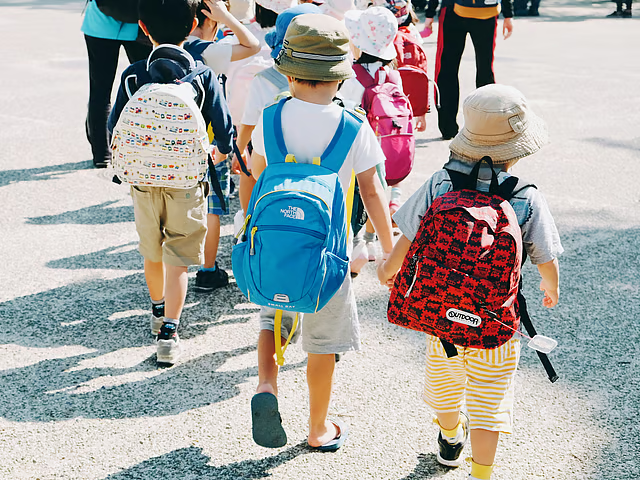
The UAE on Wednesday announced an early spring break for students in schools and universities.
The Ministry of Education and the Ministry of Higher Education and Scientific Research on Wednesday announced that spring break will begin for schools and universities from Monday, March 9, until Sunday, March 22.
The break applies to all students and academic and administrative staff across public and private schools as well as universities. Classes and official working hours will resume on Monday, March 23.
The Ministry of Education and the Ministry of Higher Education and Scientific Research Announce Spring Break for Students and Academic and Administrative Staff Across Schools and Universities in UAE
This follows the approval of the Education, Human Development and Community Development Council (EHCD).
Earlier dates
In 2025, the UAE introduced a unified school calendar covering both public and private schools nationwide.
The previously approved spring break was from March 16 to 29 as per the official school calendar for the 2025–2026 academic year applying to all public and private schools across the country. The last day of class before the break was March 13.
The new decision taken amid the blatant Iranian aggression on the country will see students ending their online classes this weekend and moving on to the spring break.
On Tuesday, the Ministry of Education and the Ministry of Higher Education and Scientific Research had extended distance learning across the country until Friday, March 6 with teaching and learning to continue remotely under ongoing assessment frameworks.
Safe environment
The government had clarified that it wants the education process to continue in a safe environment for the student community.
“We’re making sure education isn’t missing a beat by rolling out remote learning systems, guaranteeing students stay on track in their academic journey across all grades,” Dr Saif Al Dhaheri, official spokesperson for the National Crisis and Emergency Management Authority (NCEMA), had said during a government media briefing on the current developments in the country on Tuesday.
“We want our students to keep learning in a safe and steady environment, ensuring that education never skips a beat,” he added.
GN
Books
King Fahad National Library Selects Face to Face with ISIS as “Book of the Day”
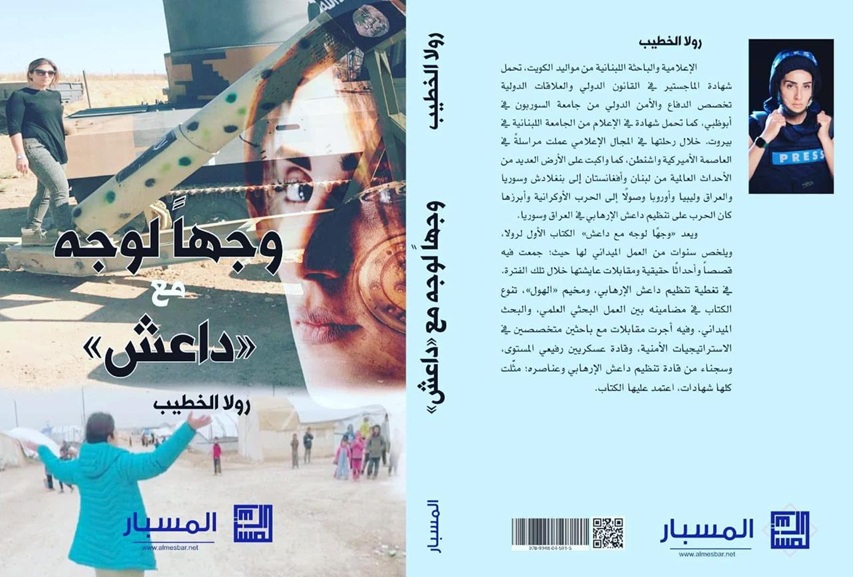
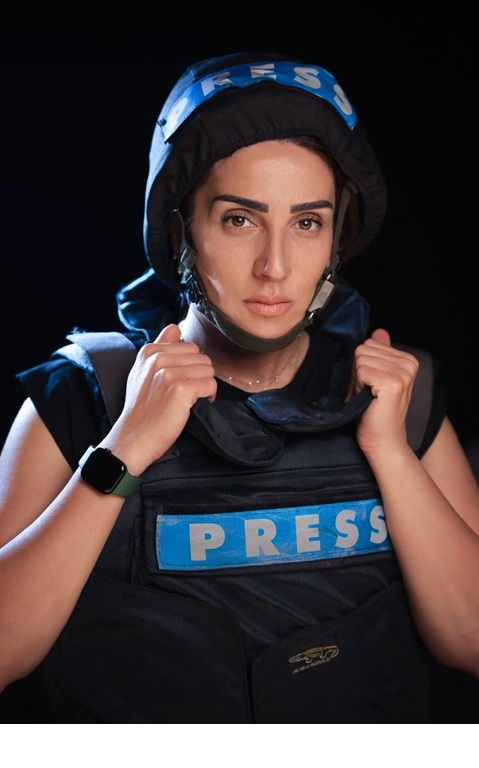
The King Fahad National Library in the Kingdom of Saudi Arabia has selected Face to Face with ISIS, authored by Lebanese journalist and researcher Rola Al Khatib, as its “Book of the Day”—a recognition highlighting works that contribute to knowledge and public awareness on issues of strategic importance.

The book draws on Al Khatib’s years of firsthand field reporting from the frontlines of the war against ISIS in Iraq and Syria, combined with extensive academic research examining the international campaign against the terrorist organization.
One of the book’s central arguments is that military action, while necessary, is not sufficient on its own to defeat terrorism. Rather, it should serve as the first step in a broader strategy that must be followed by intellectual, educational, social, economic, and security measures aimed at addressing the root causes of extremism and preventing its resurgence.
The selection by King Fahad National Library reflects the growing recognition of research that bridges field experience and academic analysis, contributing to a deeper understanding of terrorism and more comprehensive approaches to countering violent extremism.
Medica contact
Rola Al Khatib
Education
UAE schools, universities to resume in-person classes Monday
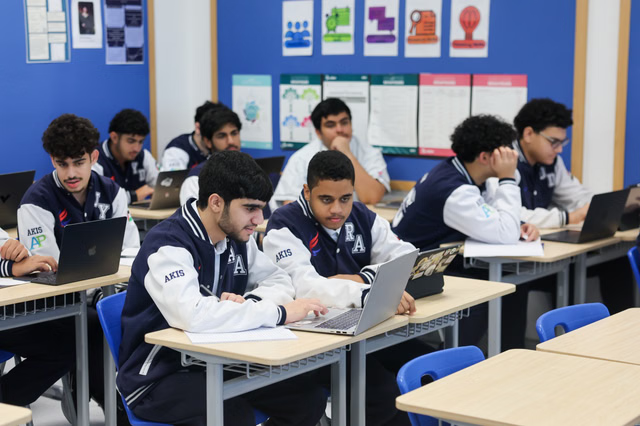
The Ministry of Education has announced the resumption of in-person learning for all students, teachers and administrative staff in public and private schools, as well as nurseries across the UAE, effective Monday, May 11.
In a statement, the ministry said the decision followed continuous monitoring of developments and coordination with relevant authorities to ensure the continuity of the educational process and academic assessments.
Safety protocols to remain in place
The ministry affirmed that educational institutions would continue implementing approved safety and security protocols and procedures to support the smooth continuation of classes.
Authorities said schools and nurseries would also remain prepared to activate alternative learning models if required, depending on ongoing developments and continuous assessments.
The Ministry of Education said coordination with educational institutions nationwide would continue to ensure a smooth return to classroom learning.
Any further updates, the ministry added, would be announced through official channels.
UAE universities to resume in-person learning
The Ministry of Higher Education and Scientific Research also has announced that all public and private universities and higher education institutions across the UAE will resume in-person learning from Monday.
The decision applies to students, academic staff and administrative employees nationwide following a temporary period of remote learning introduced as a precautionary measure amid heightened regional tensions.
Authorities said the move follows continuous monitoring of developments and coordination with relevant entities to ensure the continuity of education and academic assessments.
The ministry confirmed that universities will continue implementing approved safety and security protocols while remaining prepared to activate alternative learning models if required.
Officials also said coordination with higher education institutions across the country would continue to ensure a smooth return to on-campus learning, with any further updates to be announced through official channels.
Remote learning measures
The announcement comes after schools, universities and nurseries across the UAE temporarily shifted to remote learning from May 5 to 8 as a precautionary measure amid heightened regional tensions and emergency alerts linked to missile and drone interceptions by UAE air defence systems.
GN
Education
Students Return to In-Person Classes with Safety Measures
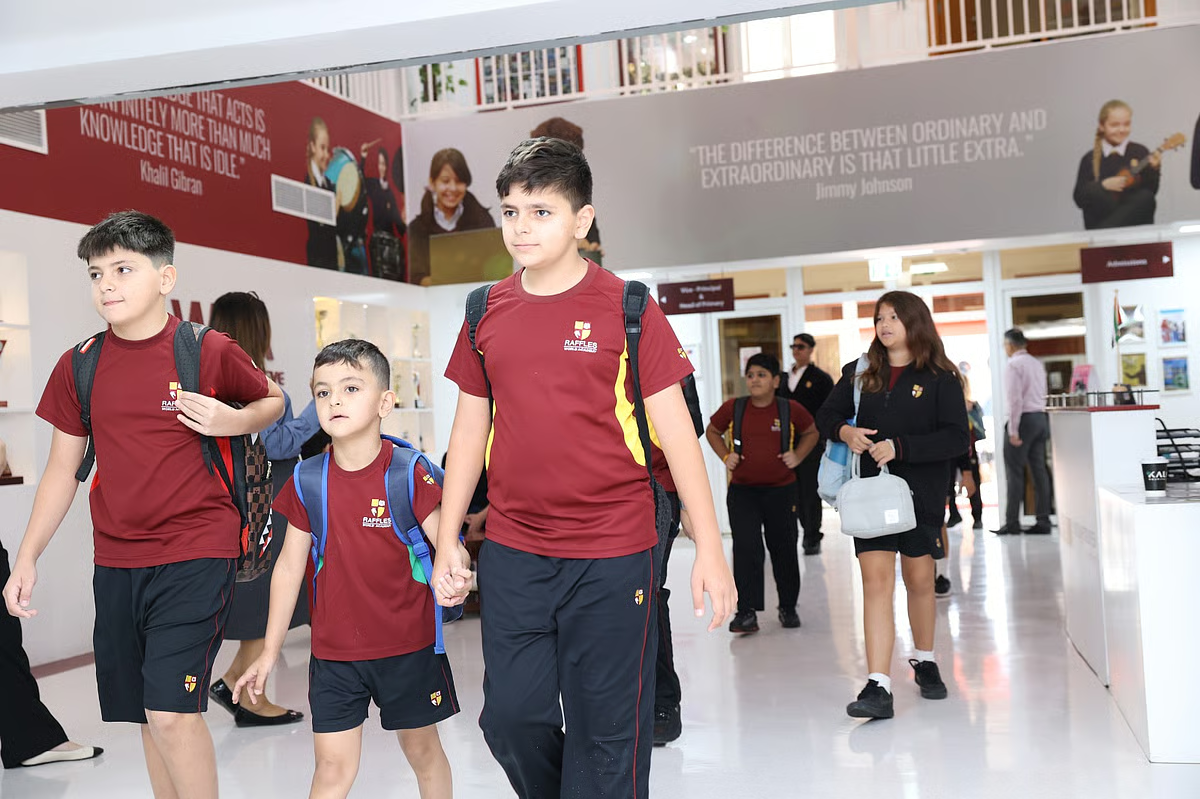
More than a million students have been allowed to return to all educational institutions in the UAE from today after weeks of distance learning due to geopolitical tensions that ensued the US-Israel-Iran war. Most of the school students are returning to campuses after a pause of around 50 days since March 2. The yellow buses ferrying the students have hit the roads again after a brief uncertainty over their operations over the past few days. Meanwhile, several students across nurseries, schools and universities are still continuing to follow remote learning till there is a permanent solution to the war. Gulf News reporters and photographers are out on the field to provide you with all the updates live.
10:37 AM, 20 April 2026
Joy returns to classrooms as students and teachers reunite
“You can really see the joy on the children’s faces, how happy and excited they are to be back in the classroom with their friends and teachers. It’s clearly visible in the way they’re laughing and interacting again,” said Andrew Hyland, Media Studies teacher at GEMS Metropole School.
“It’s the same for us as teachers too. We’re happier having the students back, and it feels good to return to our routines and the rhythm of school life.
At GEMS Metropole School, a parent survey conducted ahead of reopening showed that around 80 per cent of families were eager for students to return to campus.
According to Nav Iqbal – Principal, CEO, Brand Ambassador at Gems Metropole School, early indications suggest attendance may be higher than initially expected, with most students back in school.
“It’s a little too early to give final numbers, as we only confirm attendance at the end of the school day,” the principal said.
“We had anticipated around 80 per cent on campus and 20 per cent on distance learning, but it feels higher than that. We will publish the official figures later today on our social media channels, but it was great to see more students back across the school than before.
Parents who are unable to attend, whether due to travel or other reasons – have been informed that learning support will be provided. That group is generally less than 10 per cent.”
10:22 AM, 20 April 2026
‘Excited to bring the kids back,’ says parent
Reem Odeh, a mother of a FS2 student at GEMS Metropole School, said that while it was good to have the children at home, being back in school with friends and teachers is far more beneficial for them.
“We were very excited to bring the kids back. We prepared everything, and they woke up early this morning, really looking forward to returning to school.”
10:15 AM, 20 April 2026
‘Overjoyed to have children back in school,’ says parent
Karen Fathallah, a parent of two children in FS1 and Year 2 at Gems Metropole School said she is overjoyed to have them back in school and to see teachers and staff again.
~ Zainab Husain reporting from GEMS Metropole School, Dubai
Karen Fathallah, a parent of two children in FS1 and Year 2 at Gems Metropole School said she is overjoyed to have them back in school and to see teachers and staff again.
10:13 AM, 20 April 2026
Excitement as students reunite with friends and teachers
“School online is definitely not the same. I’m excited to be back in a proper routine, to have structure again, and to see my friends and teachers in person,” Neeti, Grade 11 student and prefect and Gems Metropole School.
10:07 AM, 20 April 2026
Some schools extend distance learning for one week
“As per the direction from APEA, the school has been granted approval to continue with distance learning for one week. During this time, we will be conducting comprehensive training for teachers, leaders, administrative staff, as well as transport teams including bus drivers and conductors. This initiative is aimed at ensuring that all safety protocols and operational measures are thoroughly understood and implemented. We remain committed to prioritising the well-being and safety of our entire school community, and we look forward to being fully prepared to resume on-site classes from Monday, April 27,” Shiny Davison, Principal, Woodlem Park school, Ajman, told Gulf News.
10:05 AM, 20 April 2026
Teachers focus on reflection and readjustment
Erin Nelson, Deputy Headteacher of Primary at GEMS Metropole School, said the focus on the first day back is to recognise students’ progress during online learning, give them space to reflect on the past seven weeks, and support a gradual return to normal school routines.
09:57 AM, 20 April 2026
Hallways come alive as students head to classes
Students at GEMS Metropole School in Motor City are seen moving through the hallways between classes as the school day gets underway.
09:55 AM, 20 April 2026
Safe zones and tighter protocols as Dubai schools reopen
Schools across Dubai are a little different as campuses reopen with enhanced safety measures in place, including designated safe zones and updated emergency procedures in line with guidance from the KHDA.
At GEMS Metropole School, staff say preparations have focused on both classroom safety and wider campus operations from emergency readiness to traffic flow and student movement.
Overseeing these measures is Nizar Mahmoud Mourad, Manager of School Operations at the school.
“Student safety remains our top priority, and we are fully aligned with the instructions issued by the relevant authorities. We have also introduced additional internal procedures to strengthen preparedness across the campus.
“This includes designated safe zones and shelter areas, along with comprehensive training for staff so students know exactly what to do before, during and after any emergency.”
– Zainab Husain reporting from GEMS Metropole School, Dubai
GN


Emirates Specialty Hospital Expands Cancer Care Services in Dubai with Opening of Dedicated Chemotherapy Unit

When Rheumatoid Arthritis Threatened Her Independence: How the Right Diagnosis Helped Her Get Her Life Back

Saudi German Hospital Dubai Launches Mental Health and Wellness Center for Children and Adolescents

Araghchi, Oman Sultan discuss transit, stability in Muscat

UAE’s café culture keeps growing despite price pressure

Netflix to Livestream BTS Comeback Concert
-
 politics6 months ago
Araghchi, Oman Sultan discuss transit, stability in Muscat
-
 UAE10 months ago
UAE’s café culture keeps growing despite price pressure
-
 Entertainment9 months ago
Netflix to Livestream BTS Comeback Concert
-
 Discover9 months ago
Is February 2026 really a once-in -283-years MiracleIn?
-

 Football10 months ago
Algeria, Burkina Faso, Côte d’Ivoire win AFCON 2025 openers
-

 Health10 months ago
NMC Royal Hospital, Khalifa City, performs rare wrist salvage, restoring function for young patient
-
 Health10 months ago
Bascom Palmer Eye Institute Abu Dhabi and Emirates Society of Ophthalmology Sign Strategic Partnership Agreement
-

 Health11 months ago
Emirates Society of Colorectal Surgery Concludes the 3rd International Congress Under the Leadership of Dr. Sara Al Bastaki