
weather
Rain across Saudi Arabia through January 20
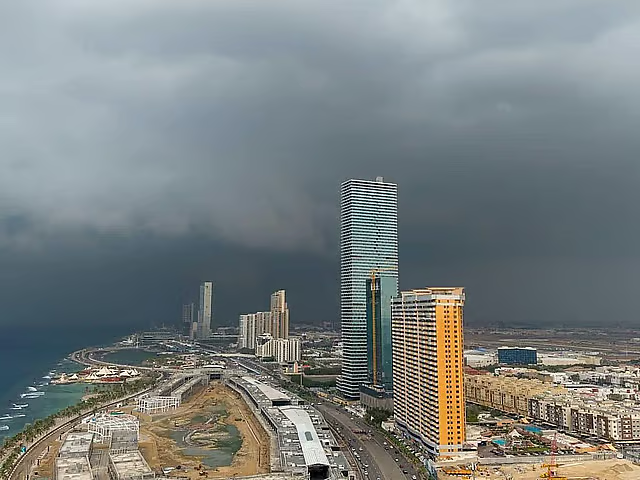
Saudi Arabia is expected to see rainfall across several regions over the coming week, with conditions continuing through Tuesday, January 20, according to the National Centre for Meteorology (NCM).
The forecast, based on outputs from the Saudi numerical weather model, was accompanied by an animated map illustrating the projected movement and intensity of rainfall across the Kingdom during this period.
Today, activity will remain concentrated over southern and north-western Jazan and Asir, while the system moves from the eastern Makkah Region towards the Riyadh Region, approaching Al Dawadmi. Rainfall is expected to reach Riyadh city, extend across areas between Riyadh and Al Dawadmi, and affect the entire Asir coastline, including the Jazan islands.
Rain is forecast to reach the Eastern Province, including Al Ahsa and Dammam, while weakening over Riyadh. As the day progresses, rainfall is expected to ease across the Eastern Province and central regions, but continue over Asir, Jazan, Al Baha and AlQunfudhah. Light rainfall is also forecast for southern parts of the Makkah Region, including Taif.
Rainfall activity is expected to resume on Friday evening, January 16, affecting western Jazan, eastern Asir and southern areas of the Makkah Region, before tapering off later that night.
On Saturday, January 17, scattered and generally light rain is forecast over southern parts of the Makkah Region and Al Baha, extending from Taif to Al Qunfudhah. Conditions are expected to gradually improve by evening, except in areas of the Makkah Region near the Holy City.
According to the NCM, scattered showers will continue on Sunday, January 18, over parts of the Makkah Region, including Jeddah, before shifting towards southern Madinah. Later in the day, rainfall is expected to expand across Makkah and Taif and reach northern Riyadh and parts of the Eastern Province by evening.
By the early hours of Monday, January 19, rainfall is forecast to ease over Makkah and move towards Riyadh, Dammam and Al Ahsa. Light to moderate rain may persist through midday in parts of the Eastern Province, Asir, Al Baha, Al Qunfudhah and southern areas of the Makkah Region, particularly Taif.
Conditions are expected to gradually stabilise by Monday evening, though isolated showers may continue in some western areas.
The NCM said Tuesday, January 20, may still bring rainfall to some parts of Al Qunfudhah and areas near Al Baha city, marking the final phase of the weather system.
Residents have been advised to follow official weather updates and take necessary precautions, particularly in areas vulnerable to heavy rainfall and surface runoff.
GN
UAE
3 days of rain expected from Tuesday

The UAE is expected to see rainfall from Tuesday through Thursday, accompanied by fog, mist and a drop in temperatures later in the week, the National Centre of Meteorology (NCM) said.
The forecaster said convective clouds are expected to develop from Tuesday afternoon, bringing showers to parts of the country, particularly in eastern areas, while humid conditions could lead to fog or mist formation in some coastal and inland regions.
Weather on Monday is forecast to remain generally fair, with clouds appearing over eastern areas. Humidity is expected to increase overnight and into Tuesday morning, especially in western coastal and inland areas, raising the likelihood of fog and mist.
On Tuesday, skies will be fair to partly cloudy, with convective cloud build-up and rainfall expected during the afternoon. Similar conditions are forecast on Wednesday, when rain-bearing clouds are again likely to form over eastern regions.
The NCM said temperatures are expected to fall on Thursday, particularly in western parts of the country. Fresh north-westerly winds could also generate blowing dust in exposed areas, while sea conditions in the Arabian Gulf may become moderate and occasionally rough, especially in western waters.
Winds throughout the period are expected to range between 10 and 25 kph, with gusts reaching up to 40 kph in some areas.
GN
weather
UAE temperatures to hit 46°C

The UAE is set for another hot day on Friday, with temperatures expected to climb to as high as 46°C in inland areas, while generally fair conditions prevail across the country, according to the National Center of Meteorology (NCM).
The weather forecast indicates clear to partly fair skies for most regions, with humid conditions developing overnight and into Saturday morning across some western coastal areas. Light to moderate winds are expected from the southeast to northeast, occasionally reaching speeds of up to 30 km/h.
Daytime temperatures are forecast to range between 40°C and 46°C inland, 37°C to 43°C along coastal and island areas, and 31°C to 36°C in mountainous regions. The Arabian Gulf and the Oman Sea are expected to remain relatively calm.
In the coming week, the weather is expected to remain largely stable through early next week, although humidity levels are likely to increase during the night and early morning hours, raising the possibility of mist or fog formation in some coastal and inland areas.
On Saturday, fair conditions will continue, with northwesterly winds strengthening at times and reaching up to 40 km/h. Sea conditions may become slight to moderate in the Arabian Gulf.
By Sunday and Monday, partly cloudy skies are expected at times over eastern regions, while humid conditions persist overnight and during the early morning. Winds will remain generally light to moderate, occasionally freshening and reaching up to 35 km/h.
On Tuesday, cloud cover is expected to increase over eastern areas during the afternoon, while the chance of mist formation remains in some coastal locations by Wednesday morning. Temperatures will remain seasonally high, with generally calm to moderate sea conditions continuing across both the Arabian Gulf and the Oman Sea.
GN
weather
Saudi forecaster warns temperatures could hit 50°C

Saudi Arabia’s National Center for Meteorology warned that temperatures in the Kingdom’s Eastern Province could reach 50°C today as a heatwave continues to affect the region ahead of the Eid Al Adha holiday.
Hussein Al Qahtani, NCM spokesperson, said the hot weather conditions were expected to persist until Friday, with forecast temperatures ranging between 47°C and 50°C in several governorates across the Eastern Province.
The warning comes as millions of Muslims prepare for Eid Al Adha and the Hajj pilgrimage season, during which Saudi authorities have repeatedly urged residents and pilgrims to avoid prolonged exposure to direct sunlight and extreme heat.
Al Qahtani called on the public to follow guidance issued by relevant authorities and monitor official weather updates during the holiday period.
Saudi Arabia has intensified heat mitigation measures during this year’s Hajj season, including expanded shaded areas, misting systems and emergency medical preparedness at key pilgrimage sites.
GN


Beyond Uniforms and Lunchboxes: Is Your Child Healthy and Ready for School?

Back to the Heat: Why Returning to the UAE Can Leave Holidaymakers Feeling Exhausted


UAE’s café culture keeps growing despite price pressure

Araghchi, Oman Sultan discuss transit, stability in Muscat

Is February 2026 really a once-in -283-years MiracleIn?
-
 UAE8 months ago
UAE’s café culture keeps growing despite price pressure
-
 politics4 months ago
Araghchi, Oman Sultan discuss transit, stability in Muscat
-
Discover7 months ago
Is February 2026 really a once-in -283-years MiracleIn?
-

 Entertainment7 months ago
Netflix to Livestream BTS Comeback Concert
-

 Football8 months ago
Algeria, Burkina Faso, Côte d’Ivoire win AFCON 2025 openers
-

 Health8 months ago
NMC Royal Hospital, Khalifa City, performs rare wrist salvage, restoring function for young patient
-

 Health8 months ago
Bascom Palmer Eye Institute Abu Dhabi and Emirates Society of Ophthalmology Sign Strategic Partnership Agreement
-

 Health9 months ago
Emirates Society of Colorectal Surgery Concludes the 3rd International Congress Under the Leadership of Dr. Sara Al Bastaki