
UAE
UAE joins global under-16 social media ban

: The race to keep children off social media has shifted from political promises to technical enforcement.
After Australia became the first country to introduce a nationwide ban on social media for children under 16, governments across Europe, Asia and now the Middle East are enacting similar measures. The UAE on Thursday became the latest country to introduce mandatory age checks, making it the first Arab nation to set a legal minimum age for social media use.
The real challenge now is not whether children should be restricted from social media, but how governments and technology companies can enforce the rules effectively.
UAE joins growing list of countries
The UAE announced that children under 15 will no longer be allowed to create or operate personal social media accounts, while teenagers aged 15 and 16 can access platforms only under stricter safeguards such as parental supervision, content filtering and limits on interactions with strangers. Platforms have one year to comply.
The move follows a growing international trend led by Australia, whose landmark law came into force in December 2025.
According to Reuters, at least a dozen countries have either implemented or are in the process of legislating nationwide restrictions on children’s access to social media, while several others are tightening parental consent and age-verification rules.
As of 18 June 2026, countries fall into three broad categories:
Bans enforced (in force)
| Country | Minimum age | Status |
| Australia | Under 16 | World’s first nationwide ban, in force since December 2025. Platforms are legally responsible for preventing under-16s from creating or using accounts. |
| Indonesia | Under 16 | GovernmentGovernment has announced plans to prohibit under-16s from major social media platforms. has implemented on end of March 2026. |
Passed or tabled legislation (awaiting implementation or final approval)
| Country | Proposed age | Status |
| UAE | Under 16 | Announced on 18 June 2026. Children under 15 cannot operate personal social media accounts. Platforms have one year to implement mandatory age verification. |
| UK | Under 16 | Government announced ban; legislation expected before Christmas 2026 with rollout targeted for spring 2027. |
| Turkey | Under 15 | Parliament has passed legislation. Awaiting presidential approval before becoming law. |
| France | Under 15 | National Assembly approved bill. Senate approval and final parliamentary vote still required. |
| Malaysia | Under 16 | Government has announced implementation plans beginning in 2026. |
Countries considering or drafting bans
| Country | Proposed age | Current position | |
| Norway | Under 16 | Government will introduce legislation to Parliament later in 2026. | |
| Denmark | Under 15 | Government has political backing and is preparing legislation, with limited parental exemptions. | |
| Spain | Under 16 | Government intends to legislate mandatory age verification and ban access for minors under 16. | |
| Greece | Under 15 | Government preparing legislation, with implementation expected from January 2027. | |
| Poland | Under 15 | Draft legislation being prepared to make platforms responsible for age verification. | |
| Slovenia | Under 15 | Draft law under preparation. | |
| Austria | Under 14 | Draft legislation expected following government agreement. | |
| any | Under 16 (proposal) | Coalition discussions ongoing; currently requires parental consent for users aged 13-16. | |
| India | Not specified | National debate underway; officials have called for Australian-style age restrictions. | |
| Canada | Under 16 | Canada’s culture minister on Wednesday introduced legislation to ban children under 16 from having social media accounts. |
Other countries tightening child protections instead of blanket bans
These countries have introduced stricter parental consent, age verification or screen-time controls, but not blanket under-16 social media bans:
- China – “Minor Mode” with mandatory screen-time and app restrictions.
- Italy – Children under 14 require parental consent to open social media accounts.
- Portugal – Parliament approved parental consent requirements for users aged 13–16
Rather than focusing only on age limits, many governments are making platforms legally responsible for keeping underage users off their services
The technology behind the ban
For years, most social media companies relied on one simple question during sign-up: “What is your date of birth?”
Governments increasingly argue that self-declared ages are ineffective because children can simply enter a false birthday.
New laws, therefore, require platforms to use stronger age-verification methods to make the rules workable.
These include:
- Government-issued digital IDs
- AI-powered facial age estimation
- Credit card or payment verification
- Third-party identity services
- Mobile carrier verification
- Device-based parental controls
- Biometric age estimation
Australia’s legislation deliberately avoids prescribing one single technology, instead requiring platforms to take “reasonable steps” to prevent children under 16 from creating accounts. The UAE similarly requires platforms to use robust verification that goes beyond self-declared ages.
Meta: AI that estimates your age
Meta has become one of the most aggressive companies in deploying artificial intelligence for age verification on its platforms.
Rather than depending solely on birthdays entered during registration, the company analyses signals including:
- Friends of similar ages
- Birthday messages
- Profile activity
- Interaction patterns
If Meta believes a teenager is pretending to be an adult, the account can automatically be switched into a Teen Account with stricter protections.
Users may then be asked to upload a government-issued ID or record a short video selfie analysed by facial age-estimation technology.
TikTok: Face estimation and family controls
TikTok combines several approaches on its platform.
The company can request:
- Government identification
- Facial age estimation using AI
- Parental verification through Family Pairing
- Family Pairing allows parents to:
- Set screen-time limits
- Approve privacy settings
- Restrict direct messages
- Control searchable content
YouTube: Account verification through Google
YouTube relies largely on Google’s broader identity system for age verification.
Depending on location and content being accessed, users may be asked to verify their age through:
- Government-issued ID
- Credit card verification
- Google account information
Australia’s new law specifically includes YouTube among platforms covered by the under-16 ban after regulators concluded it functions as a social platform rather than simply a video service.
Snapchat: Parent-first approach
Snapchat has introduced Family Centre, allowing parents to:
- Monitor friend lists
- View communication history
- Report safety concerns
The company also performs additional age checks on Snapchat where required by local law, but has generally focused more on parental supervision than mandatory identity verification.
Roblox
The gaming platform has introduced one of the industry’s most comprehensive age assurance systems. Users can verify their age through facial age estimation using a video selfie, government-issued ID or parent-linked accounts.
Roblox automatically assigns younger users to age-based account types.
Communication features are also restricted based on verified age, with younger users prevented from chatting with significantly older players.
X and Reddit
X and Reddit continue to rely primarily on user-declared ages across many markets.
However, both companies have begun introducing stronger verification where national laws require it, particularly in Australia and parts of Europe.
Industry observers expect these verification systems to expand as more countries introduce mandatory age restrictions.
Early impact
Australia has provided the first real-world test of the new approach.
Within days of the law taking effect, Meta said it had removed nearly 550,000 underage accounts across Facebook, Instagram and Threads. Other platforms also began rolling out age checks and account removals.
Researchers caution that determined teenagers continue to find workarounds, including using VPNs, borrowed identities and alternative sites that remain outside current regulations.
Parents are largely supportive, but debate remains
Public reaction has been sharply divided.
Many parents have welcomed stronger protections against cyberbullying, damaging content, online predators and excess screen time.
Governments have cited growing evidence linking heavy social media use with anxiety, sleep disruption and mental health problems among children.
Technology companies, meanwhile, have argued that blanket bans risk pushing teenagers towards less regulated corners of the internet. Privacy advocates have also questioned whether widespread age verification would require users to share more personal data than before.
As more countries prepare similar laws, the next battleground will be less about legislation and more about technology: whether platforms can accurately determine who is really behind the screen without violating user privacy.
GN
UAE
Emirati Women’s Day: Hamda Al Mansoori takes UAE-grown ventures from AI and manufacturing to cross-border partnerships
From AI agents and smart manufacturing to investment opportunities in Syria and partnerships with Chinese companies, the Emirati entrepreneur is building businesses designed to scale beyond the UAE.
As the UAE marks Emirati Women’s Day, a new generation of Emirati women is emerging not only as leaders within established industries, but as founders, investors and technology builders creating businesses with ambitions far beyond the country’s borders.
Among them is Hamda Al Mansoori, an Emirati entrepreneur whose business interests span a notably diverse range of sectors — from manufacturing and jewellery to artificial intelligence, digital transformation, investment, consulting and business development.
Through ventures including The Black Box Group, Z2A Group Holding and Outworks, Al Mansoori is building an ecosystem that brings together industry, technology and investment, with the UAE serving as its base for regional and international expansion.
Where manufacturing meets technology
Through The Black Box Group, Al Mansoori has pursued a business model that increasingly blurs the line between traditional industries and emerging technologies.
The group’s activities span manufacturing and jewellery as well as business development, branding, digital solutions, enterprise resource planning systems, AI-powered business automation, logistics and expansion strategies.
Technology has also made its way onto the manufacturing floor.
Artificial intelligence is being incorporated into jewellery production processes to help monitor different stages of manufacturing, analyse operations, identify potential issues and track material loss — with the broader objective of improving efficiency and product quality.
The scale of the ambition became more visible during the group’s participation in Make it in the Emirates 2026, where it announced a pipeline of projects and opportunities worth more than $10 million.
The figure points to a broader strategy: building UAE-based businesses that can develop locally while being structured for expansion into international markets.
Betting on the next generation of AI
Alongside manufacturing, Al Mansoori has moved into one of the fastest-evolving areas of the global technology industry: AI agents.
Through Outworks, the focus is on enterprise artificial intelligence and developing solutions that can take AI beyond answering questions or assisting employees.
AI agents are designed to carry out defined tasks and workflows within organisations, interact with systems and enterprise knowledge, and support operations under established permissions and controls.
For governments, financial institutions and large corporations, however, the race to adopt AI is increasingly about more than capability.
Data sovereignty, cybersecurity, governance and human oversight are becoming central to how organisations decide where and how artificial intelligence can be deployed.
It is an area in which UAE technology companies have an opportunity to compete: not simply by adopting global AI products, but by developing enterprise solutions from the Emirates that address the specific requirements of governments and businesses in the region and potentially beyond.
Looking beyond the UAE
Al Mansoori’s interests extend beyond technology.
Through Z2A Group Holding, her activities include investment strategy, business development and exploring opportunities in regional and international markets.
One of the markets under consideration is Syria, where the group participated as part of a UAE delegation visiting Damascus for economic meetings and discussions around potential investment opportunities.
Areas being explored include industry, tourism and economic development, with an emphasis on identifying opportunities for longer-term projects and partnerships.
The approach reflects a wider investment philosophy that looks beyond capital alone, combining investment, technology, business expertise, project development and knowledge transfer.
For UAE companies looking outward, such markets can represent an opportunity not merely to invest, but to participate in developing businesses and sectors at an earlier stage of growth.
Building bridges with China
At the same time, Al Mansoori’s businesses are expanding their international network through cooperation and partnerships with companies outside the region, including Chinese firms across areas related to technology, manufacturing and business development.
China’s position in advanced manufacturing, technology and global supply chains makes such relationships increasingly relevant for UAE businesses seeking international expertise and scalable industrial capabilities.
The opportunity lies in connecting those capabilities with the UAE’s strengths as a business, investment and technology hub — potentially creating projects that combine international technology and expertise with businesses developed and managed from the Emirates.
It is a model that reflects the increasingly international character of UAE entrepreneurship: build from the UAE, partner globally and expand into new markets.
The UAE remains the launchpad
Despite the diversity of sectors and geographies, the UAE remains at the centre of Al Mansoori’s business strategy.
The country’s investments in artificial intelligence, advanced manufacturing and the digital economy, coupled with its push to attract global businesses and capital, have created an environment in which local entrepreneurs can think beyond the domestic market from the outset.
Al Mansoori’s portfolio reflects that shift.
Rather than building her career around a single industry, her ventures bring together manufacturing, AI, technology, investment, consulting and international partnerships.
The common thread is the attempt to create businesses that can originate in the UAE while competing and expanding internationally.
Emirati Women’s Day: From empowerment to creating opportunities
Al Mansoori’s story takes on particular relevance as the country celebrates Emirati Women’s Day.
The conversation around women’s empowerment in the UAE is increasingly moving beyond representation and leadership positions.
Emirati women are today founding companies, developing technology, directing investment, entering new markets and negotiating international partnerships.
From manufacturing operations incorporating artificial intelligence to enterprise AI agents, and from exploring investment opportunities in Syria to developing relationships with Chinese and international businesses, Al Mansoori’s journey reflects the increasingly global outlook of a new generation of Emirati entrepreneurs.
And perhaps that is one of the more significant stories to emerge this Emirati Women’s Day: Emirati women are no longer only taking their place in the industries of the future — they are increasingly helping to build them, from the UAE to the world.
UAE
When will summer end in the UAE?
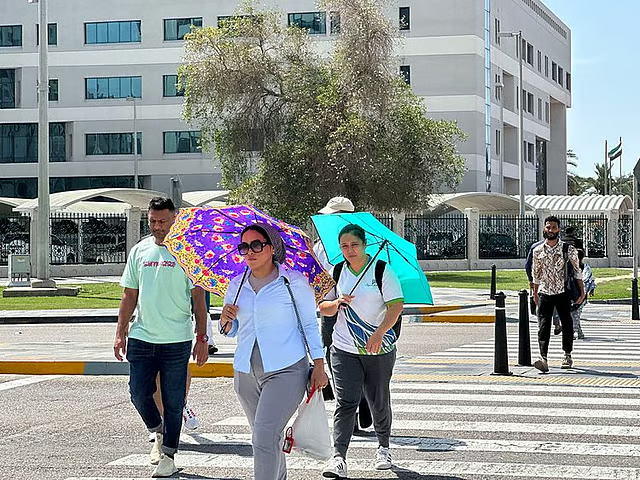
The UAE’s astronomical summer will come to an end on September 23, when the autumnal equinox marks the official start of autumn, although meteorologists classify September as the first month of the autumn season, according to Ibrahim Al Jarwan, Chairman of the Emirates Astronomical Society and a member of the Arab Union for Astronomy and Space Sciences.
Al Jarwan said the country’s hottest period, known in Arabic as Al Qayz, begins to ease in the final third of August with the rising of the star Suhail, long regarded across the region as a traditional sign of gradually cooler weather.
He explained that while temperatures remain high through September, the Indian seasonal low-pressure system weakens progressively during the month.
The UAE continues to be influenced by thermal low-pressure systems extending from central Arabia, bringing active winds that can raise dust and reduce visibility.
At the same time, conditions remain favourable for the formation of convective clouds, particularly over the eastern mountains, with thunderstorms and rainfall occasionally extending into inland parts of the country.
September also sees a seasonal shift in wind patterns, with south-easterly winds prevailing overnight and during the morning before giving way to north-westerly sea breezes in the afternoon and evening.
Humidity gradually increases compared with August, particularly during the second half of the month, creating more favourable conditions for fog and mist to develop in scattered areas across the UAE.
Al Jarwan noted that astronomical summer began with the summer solstice on June 21 and lasts for three months until the autumnal equinox on September 23. During the first half of summer, temperatures typically range between 41°C and 43°Cduring the day but can exceed 50°C in some areas during heatwaves.
In the latter half of the season, from August 11 onwards, higher humidity combines with persistent heat and the seasonal Kous winds to support the formation of towering thunderclouds over the Hajar Mountains, producing the localised summer thunderstorms known as Al Rawayeh.
With much of the summer still ahead, residents are continuing to adapt their routines to the season’s intense heat by shifting outdoor activities to the early morning and evening hours, while increasingly turning to air-conditioned leisure and fitness venues during the day.
Dubai Mallathon, running from 15 June to 15 September, has become one of the city’s flagship summer initiatives, allowing residents to walk and run along designated indoor routes across participating shopping malls during the cooler morning hours. The programme is designed to encourage physical activity throughout the summer despite the high temperatures.
Beyond organised fitness events, shopping malls, indoor attractions, museums, aquariums, family entertainment centres and beaches during the cooler hours remain among the most popular destinations for residents and visitors. As temperatures gradually begin to ease towards late August, outdoor parks, mountain areas in the east of the country and desert destinations are also expected to see increasing numbers of visitors.
GN
UAE
UAE suspends new visas for 3 countries over Ebola

The UAE has announced a series of additional precautionary measures affecting travellers arriving from three African countries as part of efforts to strengthen national preparedness against potential Ebola virus outbreaks.
The measures, jointly announced by the National Emergency Crisis and Disasters Management Authority (NCEMA) and the Federal Authority for Identity, Citizenship, Customs and Port Security (ICP), apply to arrivals from the Democratic Republic of the Congo, Uganda and South Sudan.
Authorities said the decision is part of the country’s preventive and proactive strategy to address developments related to the Ebola virus and safeguard public health.
Under the new measures, all new visas for nationals of the three countries, including visit visas, will be suspended.
Entry into the UAE will also be restricted for travellers arriving from the affected countries, including those who transit through other destinations before reaching the Emirates.
Travellers who have spent more than 21 consecutive days outside the listed countries prior to their arrival in the UAE will be exempt from the restrictions and permitted entry, according to the authorities.
The measures are scheduled to take effect at 1 p.m. on Saturday, 6 June 2026, and may be extended depending on developments in the global health situation.
Despite the restrictions, cargo operations between the UAE and the three countries will continue without interruption. Transit flights will also remain operational, ensuring the continued movement of goods and international air traffic.
The announcement comes as governments around the world continue to monitor Ebola-related developments in parts of Africa.
The disease, which causes severe viral haemorrhagic fever, has prompted heightened surveillance and preparedness measures in several countries whenever outbreaks emerge.
NCEMA and ICP said they would continue to closely monitor global health developments in coordination with local and international partners.
Authorities will assess any potential implications for other countries and implement further measures when necessary, based on approved health standards and risk assessments.
GN


Emirates Specialty Hospital Expands Cancer Care Services in Dubai with Opening of Dedicated Chemotherapy Unit

When Rheumatoid Arthritis Threatened Her Independence: How the Right Diagnosis Helped Her Get Her Life Back

Saudi German Hospital Dubai Launches Mental Health and Wellness Center for Children and Adolescents

Araghchi, Oman Sultan discuss transit, stability in Muscat

UAE’s café culture keeps growing despite price pressure

Netflix to Livestream BTS Comeback Concert
-
 politics6 months ago
Araghchi, Oman Sultan discuss transit, stability in Muscat
-
 UAE10 months ago
UAE’s café culture keeps growing despite price pressure
-
 Entertainment9 months ago
Netflix to Livestream BTS Comeback Concert
-
 Discover9 months ago
Is February 2026 really a once-in -283-years MiracleIn?
-

 Football10 months ago
Algeria, Burkina Faso, Côte d’Ivoire win AFCON 2025 openers
-

 Health10 months ago
NMC Royal Hospital, Khalifa City, performs rare wrist salvage, restoring function for young patient
-

 Health10 months ago
Bascom Palmer Eye Institute Abu Dhabi and Emirates Society of Ophthalmology Sign Strategic Partnership Agreement
-

 Health11 months ago
Emirates Society of Colorectal Surgery Concludes the 3rd International Congress Under the Leadership of Dr. Sara Al Bastaki