
Food
Make the perfect Dubai chocolate bar – recipe
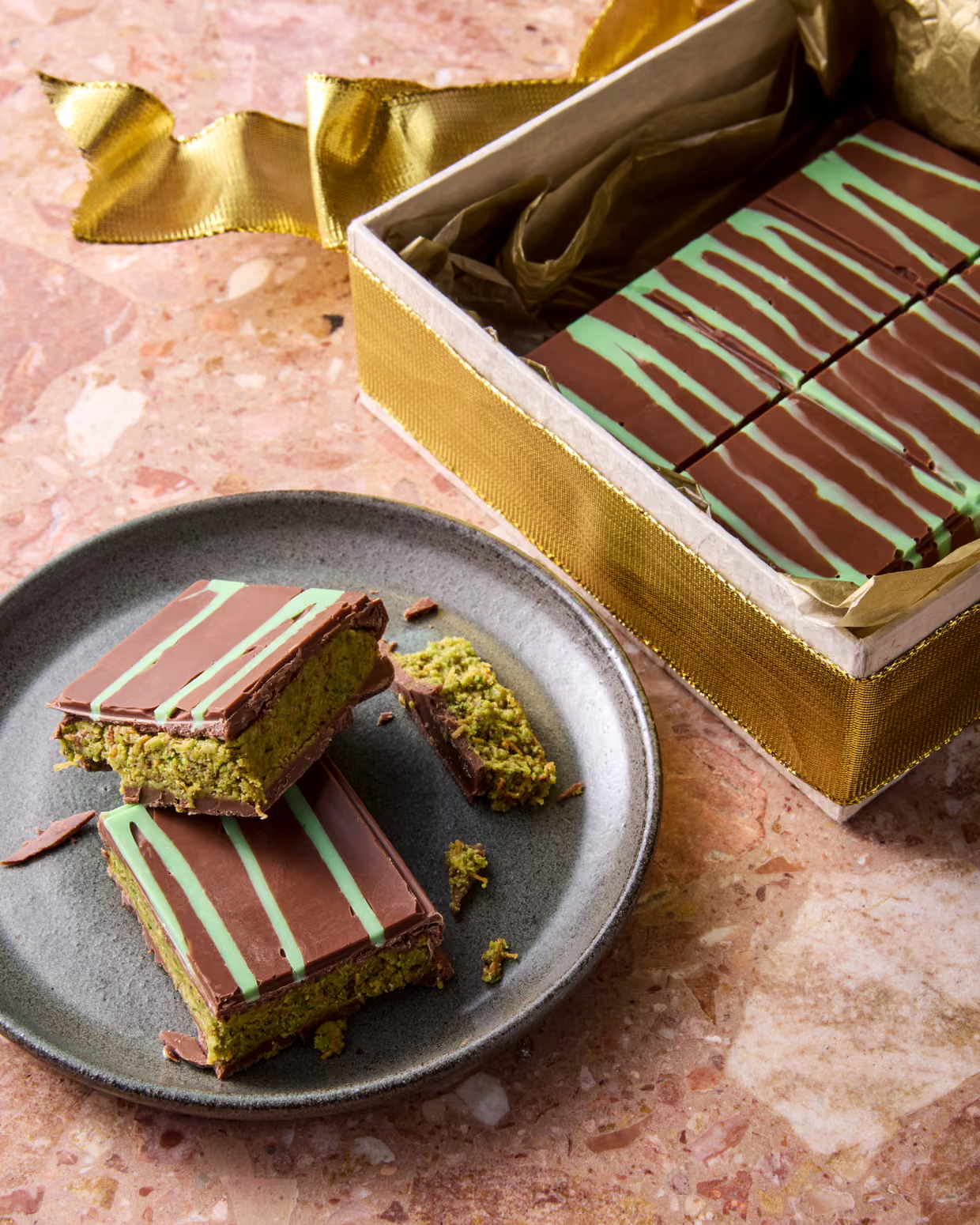
The pistachio-crammed craze makes a superb gift. Our in-house perfectionist tries all the fiddly bits for you …
If you’re asking what on earth chocolate has to do with a city with an average annual temperature of 28C, then you must have been stuck in the desert for the past three years. Because, since its creation in the UAE in 2022, apparently to satisfy chocolatier Sarah Hamouda’s pregnancy cravings for pistachio and pastry, this bar has taken over the world. Though food (among those with the luxury of choice, at least) has never been immune to the absurdities of fashion, the internet has supercharged and globalised the process, so much so that pistachios, which back in January were dubbed “the new pumpkin spice” by this very newspaper, are now everywhere, from Starbucks lattes to Aldi mince pies.
The thing is, however, that whatever your thoughts on green, sugary, coffee-adjacent beverages, Hamouda’s Dubai chocolate developed for Fix Dessert Chocolatier has triumphed, because it really does taste as good as it looks: crunchy pastry, sweet chocolate and rich, slightly savoury nut butter are an incredibly satisfying combination, so a big bar of it is guaranteed to impress under the Christmas tree. Experience demands that I suggest you wrap it in a pet-proof box, however – emergency vet bills are no one’s idea of a great present.
The pistachios
This is the key flavouring – and, probably more importantly as far as the internet is concerned, colouring. The price of pistachios has surged since Dubai chocolate went viral, with the Financial Times reporting in April that global kernel prices had risen by a third “as demand for viral cream-filled bars strains supplies”. Given they weren’t cheap to start with, this isn’t an ideal choice of gift if you’re making presents for reasons of economy; that said, it’s still better value than a scarf they’ll never wear, or some novelty gin they’ll just give to the PTA raffle.
Many recipes call for pistachio cream, or crème as British supermarkets aspirationally style it, an Italian product that caters for the Italian sweet tooth. Not only are many wincingly sugary, but I’ve come across at least one that’s as little as 10% pistachio, so check the label if you’d like to save time by subbing in a ready-made paste here. Just mix it in with the pastry – you’ll need about 350g – and don’t be swayed by the colour, because most are dyed. I used one that was 45% pistachio, but it was sold behind the counter because it was £10 a jar, so you do get what you pay for in this department.
Though I use it in both US website the Kitchn and Swiss grocery giant Migros’ recipes, I come to the conclusion that it’s both better and cheaper to make your own. However, that’s only if you have a food processor to hand – Good Housekeeping, Rama, the creator behind Indicious Kitchen, and our very own Ravneet Gill all start from scratch.
Toast the nuts first, as Rama suggests – in side-by-side comparisons, my testers all remark how much nuttier hers tastes, though this may also be because she uses five times as many nuts as Gill does. That said, I do end up with a lot of leftover filling, so in reality it’s probably more like three times as many. As the pistachios are the point here, I’ve also been generous with them on the basis that there’s little point investing if you don’t use enough actually to taste them.
Green genie: skinned homemade pistacho butter (left) versus unskinned (right).
Rama is also the only person to bother skinning as well as shelling her nuts, which is annoying, given that she uses so many. But it really does make a difference to the colour of the end result, which compels me to recommend you do the same. You can buy vivid green, skinned nuts online, but at a cost, so to start with I’d advise going for the greenest nuts you can find (the ones I buy from Waitrose are greener than the smaller nuts from the Mediterranean food hall I visit in a fruitless search for skinned ones). Then, rub off as much skin as you have the patience for (I wouldn’t blanch them to loosen the skins, unless you’re also committed to drying them out properly afterwards; moisture is the enemy of crunchy pastry.) Rama whizzes her pistachios to a smooth cream, much like the one bought in a jar, while Good Housekeeping and Gill both stick with a coarser rubble of ground nuts, which I prefer – again, it’s all about keeping as much of the pistachio in there as possible, and that goes for texture as well as flavour. For the same reason, I’ve included a few roughly chopped salted nuts, too, but that’s very much not in keeping with Hamouda’s original sweet and velvety version, so feel free to leave them out,.
Though Rama makes absolutely everything else from scratch, she is refreshingly unapologetic about artificially enhancing the colour of the filling. You may shy away from this (though if you’ve admired a Dubai chocolate bar that’s green, rather than beige inside, be aware it’s probably not entirely natural). But bear in mind that the first bite is with the eyes, and a few drops of dye are unlikely to be the naughtiest thing you eat this Christmas. (Note: to make a cheaper alternative, you could use peanut butter, or indeed another nut butter of your choice, and adjust the sugar as necessary.)
The cream
Chopped nuts and crunchy pastry would make for a very dry mouthful indeed, which is why, even if eschewing the jarred creams, it’s imperative to add a few more ingredients to the filling. Gill and Good Housekeeping bind it with melted white chocolate, with the latter also adding double cream, an ingredient that sets off alarm bells in my head. I remember the words of Raphael Bachmann, owner of Confiserie Bachmann in Lucerne, on the Migros website: “It is important to use a high-quality [pistachio] cream containing plenty of pistachios … If the cream contains a lot of water or oil, the ‘angel hair’ will quickly become soft.” Even double cream is more water than anything else, so this is best avoided, yet white chocolate is, inevitably, very sweet. Again, the best solution comes from Rama, who uses milk powder (which gives the rich creaminess of dairy without any of the water) and icing sugar, allowing her to control the sweetness. Depending on what sort of chocolate you use, you may want to add more than I’ve suggested below, but don’t omit the pinch of salt: it’s key to bringing out the savoury flavour of the nuts.
The original bar also contains tahini paste, which brings both creaminess and a bitter edge that helps to stop it tipping over into sickly territory. As this is my version, however, I’ve decided I don’t want anything to muddy the flavour or colour of the nuts I’ve just spent time peeling. So, inspired by Bachmann, who mentions using a neutral oil instead, I’ve replaced it with flavourless coconut oil:, as this is solid at room temperature, it’ll help keep the filling firm enough to slice. Up to you.
The crunch
Kataifi, which looks like vermicelli, has a similar snappy texture to filo, but is made in strands that are perfect for soaking up syrup in dishes such as knafeh and baklava. If you have a specialist grocers nearby, they’ll probably have it in the fridge. Or you can buy it online, or even make it yourself, as Rama does – unless specifically noted otherwise, it’ll require toasting first to crisp it up. You could do this in a hot pan, as in the Kitchn’s recipe, but baking it, as Gill does, makes much more sense; not only does it cook more evenly without constant babysitting, but it can be done at the same temperature and therefore time as the pistachios. I have added butter to the baking tray, however, because, though not strictly necessary, it does taste nice.
If you can’t find kataifi, Gill and Good Housekeeping both mention Shredded Wheat as a substitute, which makes sense given they’re both made from wheat and come in long thin strands. Not being a big consumer of breakfast cereal, however, it’s not until I open the packet that I realise even dry Shredded Wheat is more chewy than crunchy, which makes Bachmann’s cornflakes a better choice, despite the difference in flavour.
The chocolate
Everyone but Gill uses milk chocolate, in obedience to the original FIX bar. Oddly, though I think I’ll prefer her dark version, it does threaten to overpower the filling, so, if you go down that route, don’t go too high with the cocoa content.
Only Rama tempers the chocolate – the process by which, after disrupting them with heat, you rearrange the crystals in a more orderly fashion than just allowing them to solidify haphazardly. I’ve included instructions below, though personally I wouldn’t bother, because all anyone is really interested in here is what’s inside the bar. You may consider it worthwhile. (It also has the benefit of keeping the bar firmer at room temperature, though if yours is melting in December in the UK, you’ve got the heating on too high.)
It’s easier to decorate the top of the bar to disguise any imperfections; the Kitchn’s green-tinged white chocolate is the work of minutes, yet looks surprisingly impressive once set into the rest of the chocolate.
The form
Deep chocolate moulds are easily found in cookware shops and online, but if you don’t have one, or would prefer to give a box of chocolates rather than one oversized bar, Good Housekeeping have you covered with their little Dubai chocolate balls (see the end of the method, if you’re tempted by those). Simple to make, even easier to eat. Otherwise, you’ll need a 25cm x 13½cm x 2cm chocolate bar mould.
Perfect Dubai chocolate
Prep 20 min
Cook 1 hr (assuming you’re skinning the pistachios, which takes about 20 minutes)
Set 3 hr+
Makes 1 large bar, or 18 individual chocolates
1 tbsp butter, or neutral coconut oil (optional)
100g kataifi pastry, roughly chopped, or cornflakes, roughly crushed
200g shelled raw pistachios
20g white chocolate, chopped (optional)
Green food colouring (optional)
160g milk or dark chocolate
2 tbsp neutral coconut oil, melted, or tahini
35g milk powder
20g icing sugar, or to taste
A pinch of salt
20g shelled salted pistachios, peeled and roughly chopped (optional)
25cm x 13½cm x 2cm chocolate bar mould (optional; see the final step if making individual filled chocolates)
Heat the oven to 180C (160C fan)/350F/gas 4 and, if using kataifi, melt the butter or oil on a shallow rimmed baking tray.
Roughly chop the kataifi, toss it in the melted butter, then bake, stirring every 10 minutes so it colours evenly, for about 30 minutes, until golden.
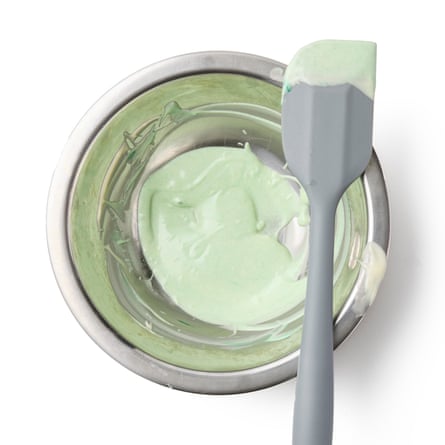
Remove and leave to cool. (If using cornflakes, simply roughly crush them into shards.)
Tip the raw pistachios on to another baking tray large enough to hold them all in a single layer, and bake alongside the kataifi for about 15 minutes, until they smell toasty.
Remove, leave to cool, then, to remove some of the skins, either rub them in a clean tea towel or shake vigorously in a large jar to help dislodge the papery husks, then remove by hand. (This is fiddly, time-consuming work – it took me 20 minutes – and is largely just for the colour, so feel free to skip if you can’t be bothered.) Roughly chop the nuts.
If using white chocolate, melt it in a heatproof bowl set over but not touching a pan of simmering water, then stir in a couple of drops of green food colouring, if using (be sparing, because if you add too much, the chocolate will seize).
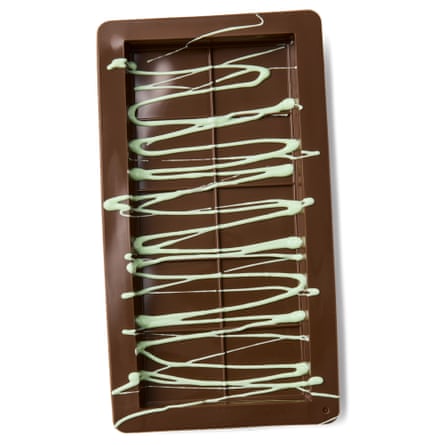
Spoon or drizzle the white chocolate mix over the base of the chocolate bar mould, then put it in the fridge to set while you melt the remaining chocolate (put the mould on a board or baking tray to keep it level).
Chop the milk or dark chocolate (a bread knife is useful here). If you’re tempering it, melt 110g of the chocolate as above, to 40-45C for milk and 46-48C for dark, then stir in the remaining 50g until melted. Cool to 26C for milk and 27C for dark, then heat back to 29C (milk) or 31C (dark) before use. (Alternatively, just melt all the chocolate at once.) Tip just enough of the melted chocolate into the mould thoroughly to coat the white chocolate base, then chill for about 30 minutes until set firm.
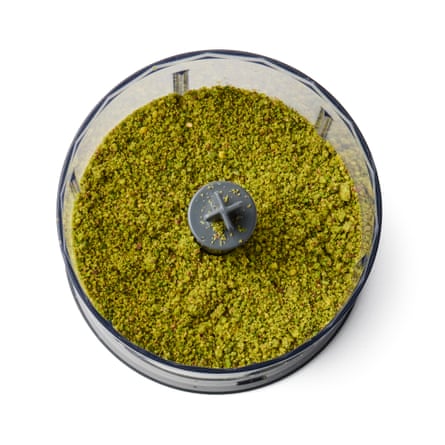
Meanwhile, whizz the chopped pistachios in a food processor or blender until they’re fairly finely ground and beginning to look slightly oily and to clump together, then add the coconut oil or tahini and whizz again to combine. Add the milk powder, icing sugar and a pinch of salt and whizz again. Taste and add more sugar if you’d like it sweeter. If using salted pistachios, roughly chop them, then stir in.
Once you’re ready to fill, stir the kataifi into the pistachio mixture until well combined, then spoon into the chocolate shell and level the top, leaving a small gap around the edge; run a butter knife around the edge to help do this.
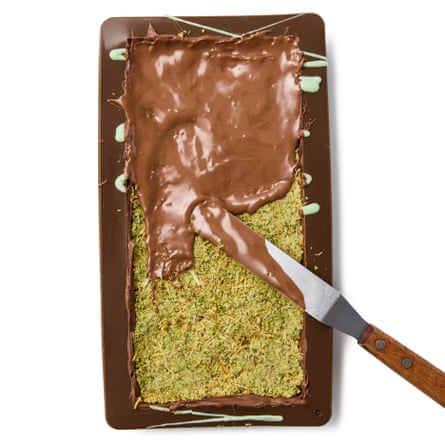
Re-warm the remaining melted chocolate, then pour it all over the top. Tilt the mould to help push the melted chocolate into the sides until the filling is entirely encased in chocolate.
Chill for at least two hours, or until completely set, before turning out.
For individual truffles, make the filling as above, then spoon small, roughly 20g balls of it on to a tray and chill for about 30 minutes, until firm, while you’re melting the milk or dark chocolate as above (depending on your generosity, you may need a little more than specified here). Dip the balls in chocolate to coat, then return to the fridge to set. Decorate with the green white chocolate once firm, or put a whole pistachio on top while the balls are still slightly tacky.
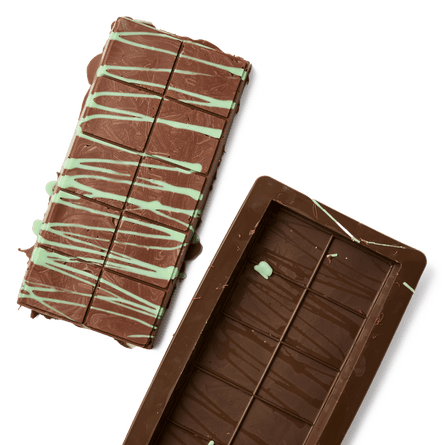
Dubai chocolate; is this one viral trend that’s passed you by, or have you fallen victim to its verdant charms? If you’ve had the original, did it live up to expectations, and how would you customise it to suit your taste (I like the idea of adding spices, for example)?
Story by The Guardian
Discover
Five-second rule is a myth

You drop a piece of cucumber on the floor. Do you immediately throw it in the bin or reassure yourself of the age-old “five-second rule” and reckon it’s fine to pop it in your mouth after a quick rinse?
If you fall into the latter camp, John Tregoning, professor of vaccine immunology at Imperial College London, has some bad news. He refers to three studies into bacteria transfer that all point towards the rule being false.
In the first, scientists looked at what happens when a range of foods (bread, buttered bread, watermelon and gummy bears) were dropped on a range of surfaces (tile, steel, wood, and carpet) that had been coated with bacteria. “They transferred almost immediately,” he says, adding that the worst combination for transfer happened when wet food hit a solid surface (watermelon on tile or steel).
Another study – where cooked sausage was dropped on to surfaces – showed that bacteria transferred on to the meat even if they had been applied to the surface hours earlier. It showed that “if you put a piece of contaminated chicken on to a work surface and then, two hours later, drop your piece of bread on to it, you can still pick up bacteria from it. It’ll be there for about 24 hours,” he says.
The final paper looked at the “five-second rule” for medical objects in the operating room. Perhaps unsurprisingly, it found that if surgeons drop something on the floor, they need to wash that instrument with detergent for it to be safe to use again.
What does all this mean for your fallen cucumber? “I think you have to accept it’s gone,” says Tregoning. Rinsing it with water won’t be enough to guarantee it’s clean. That’s especially the case if you’re particularly susceptible to infections, or if your dog might have walked something terrible through the house (even hours earlier).
THE GUARDIAN
Food
WFP: Middle East conflict driving millions into hunger
The Middle East conflict is pushing millions of people closer to hunger, as rising fuel and transport costs drive up food prices while funding shortfalls force aid agencies to scale back assistance, the U.N. World Food Programme said on Friday.
Joint U.S.-Israeli strikes on Iran in February triggered a regional conflict stretching across the Gulf and into Lebanon, disrupting key shipping routes, including the Strait of Hormuz, forcing vessels to reroute and sharply constraining global energy flows and supply chains.
In March, the WFP forecast as many as 45 million people could fall into acute food insecurity if oil prices remained around $100 per barrel through June. That scenario is now unfolding, the agency said, with benchmark crude prices staying above that level since early March.
Households in Afghanistan, Somalia and Sri Lanka are among the most seriously affected and face mounting pressure due to higher fuel costs, food price spikes, income losses and disrupted trade.
In Somalia, 6.5 million people – roughly a third of the population – are expected to face severe hunger in 2026, while Afghanistan could see 17.4 million people affected, the WFP said. The situation is projected to worsen, with an additional 2.5 million Somalis and 2.3 million Afghans at risk of falling into food insecurity if disruptions persist. Both countries are reliant on imported energy and food.
FOOD SHORTAGES TO HIT VERY VULNERABLE CHILDREN
The Middle East crisis comes amid a deep funding shortfall for aid agencies. The WFP said it expected to serve 1.5 million fewer people globally in 2026, and 9 million fewer if the situation persists for six months.
In Somalia, supplies of nutritious food for children under 5 suffering from moderate malnutrition will run out as soon as July, as the WFP faces an 89% funding gap in the country.
“We are running out of food. The food is not available for distribution, and the ones who will experience the impact of this are going to be very vulnerable children,” said Jean-Martin Bauer, the director of WFP’s Food Security and Nutrition Analysis Service.
The situation is being worsened by supply chain issues, with fewer ships stopping in Somalia because of disruptions which have affected shipping in the Indian Ocean.
Some WFP stocks have also been held up in Salalah Port in Oman, causing critical delays. Soaring jet fuel prices are also leading to higher operational costs for the United Nations Humanitarian Air Service – the only means to safely access hard-to-reach areas, the WFP said.
In Afghanistan, surging fuel prices have driven up aid transport costs as much as fivefold, and delivery times have shot up from 10 days up to as many as 75 days as trucks had to use alternative corridors, the WFP said.
Food
I’m vegetarian. How can I get enough iron?
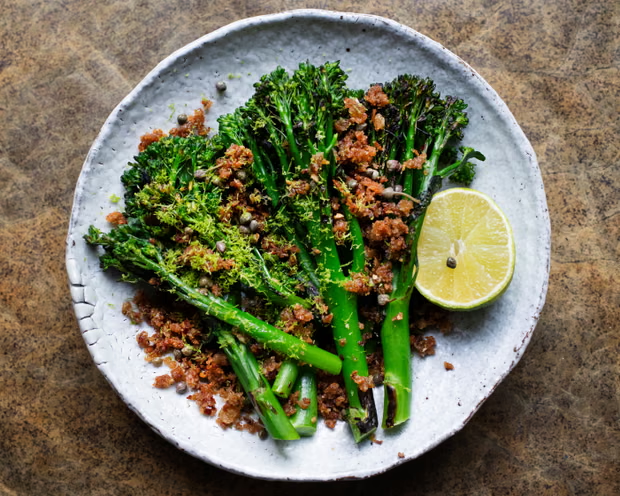
I’ve been advised to increase the iron in my diet but, as a vegetarian preoccupied with getting sufficient protein, I’m at a loss.
June, by email
Last year, a study by Randox Health found that almost one in three women who attended its UK clinics have an iron deficiency, which is to say that June isn’t alone. Yes, there are good sources that vegetarians can tap into, but we first need to address a few key points: “The heme iron you get from animal sources – red meat and darker poultry, say – is in a form that’s slightly better absorbed than non-heme iron, which is found in the likes of beans, tofu and leafy greens,” says Dominique Ludwig, nutritionist and author of No-Nonsense Nutrition. This is where vitamin C is your friend: “When we eat non-heme iron and vitamin C together, it increases absorption, so it might be a case for having peppers or tomatoes with your tofu.” But there’s another potential hitch: “On a vegetarian diet, some of that iron can be blocked from absorption because of things such as phytates [a plant compound found in whole grains, legumes, etc], or tannins in tea and dairy,” Ludwig adds, so it’s not simply about how much iron you’re getting, but how good your absorption is.
“Women aged 19-49 should aim for 14.8mg iron a day, but after menopause that drops to about 8.7mg, which falls in line with men’s requirements,” Ludwig says. “If you’re vegetarian, then, you can’t just be having pesto pasta, you need to be eating beans, lentils, nuts, seeds, soy products, and leafy greens, too.” Tofu can have 3-5mg iron per 100g, cooked lentils 3-4mg, chickpeas 2½-3mg, cashews 6-7mg and sesame seeds 14-15mg. So, much like getting dressed, layering is important.
Oats in the morning are a no-brainer: “A 40g serving will give you 2mg iron, so have them with milled flaxseed and berries for the vitamin C,” Ludwig advises. The same principle applies to the likes of a tofu scramble: “Throw in some kale and tomatoes [again, for the vitamin C] and serve it with wholemeal bread, and you’re looking at about 7mg iron,” Ludwig adds. In other words, your day is getting off to a good start.
Also, seeing as Jane is vegetarian rather than vegan, she has eggs to play with, too, which is good news considering each one contains about 2mg iron. “Try a frittata with cottage cheese and broccoli, then sprinkle over some pumpkin seeds [a fantastic source of iron] before baking.” You can see how this all starts to add up.
Cashews, edamame, dried fruit (apricots, figs, prunes) and that perennial favourite, carrots and hummus, will all help. An evening stir-fry, meanwhile, can bring the odds and ends in your fridge together into an ultra-fast dinner that ups your iron. There are greens (kale, broccoli), of course, but June could also add tofu or seitan, and nuts, perhaps, and serve it with brown rice. “Or add lentils to your pasta, and stir through lots of green veg,” Ludwig adds. It can be easy being green.
The Guardian


Emirates Specialty Hospital Expands Cancer Care Services in Dubai with Opening of Dedicated Chemotherapy Unit

When Rheumatoid Arthritis Threatened Her Independence: How the Right Diagnosis Helped Her Get Her Life Back

Saudi German Hospital Dubai Launches Mental Health and Wellness Center for Children and Adolescents

Araghchi, Oman Sultan discuss transit, stability in Muscat

UAE’s café culture keeps growing despite price pressure

Netflix to Livestream BTS Comeback Concert
-
 politics6 months ago
Araghchi, Oman Sultan discuss transit, stability in Muscat
-
 UAE10 months ago
UAE’s café culture keeps growing despite price pressure
-
 Entertainment9 months ago
Netflix to Livestream BTS Comeback Concert
-
 Discover9 months ago
Is February 2026 really a once-in -283-years MiracleIn?
-

 Football10 months ago
Algeria, Burkina Faso, Côte d’Ivoire win AFCON 2025 openers
-

 Health10 months ago
NMC Royal Hospital, Khalifa City, performs rare wrist salvage, restoring function for young patient
-

 Health10 months ago
Bascom Palmer Eye Institute Abu Dhabi and Emirates Society of Ophthalmology Sign Strategic Partnership Agreement
-

 Health11 months ago
Emirates Society of Colorectal Surgery Concludes the 3rd International Congress Under the Leadership of Dr. Sara Al Bastaki