
UAE
Why gold demand stays strong despite record prices
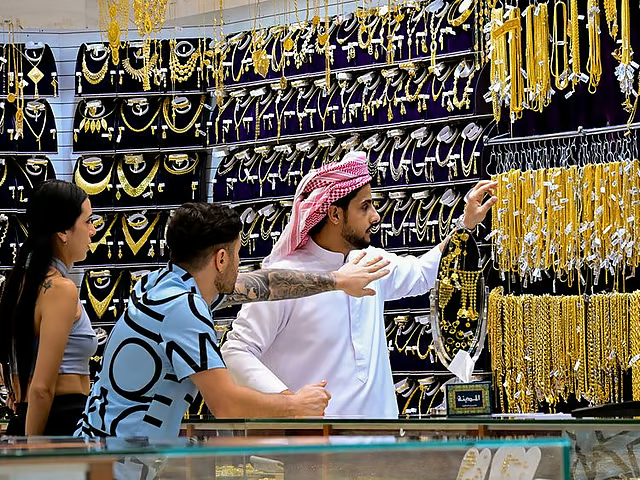
Global demand for gold broke records in 2025 as investors rushed into the metal and prices surged to repeated all-time highs, according to new data from the World Gold Council.
Total gold demand crossed 5,000 tonnes for the first time, helped by heavy buying of bars, coins and gold-backed funds. The gold price set 53 new records during the year, lifting the total value of global gold demand to an unprecedented $555 billion.
Research analysts and market strategists at the World Gold Council described 2025 as a “groundbreaking year for gold,” driven mainly by investment demand and safe-haven buying. (Check latest UAE gold prices here, alongside prices in Saudi Arabia, Oman, Qatar, Bahrain, Kuwait, and India.)
Investors drive gold record boom
Investment was the main force behind gold’s record year.
Global gold exchange-traded funds added 801 tonnes, the second-strongest year on record. Bar and coin buying climbed to a 12-year high, showing that both large investors and everyday buyers were turning to physical gold.
“Safe-haven and diversification motives were consistent themes driving investment interest throughout the year,” the analysts at the World Gold Council said in the report.
They added that price momentum itself pulled more buyers into the market, reinforcing demand across investment products.
For UAE residents, this trend shows up clearly in retail activity. Bar and coin demand across the Middle East rose in 2025, with the UAE recording a year-on-year increase in physical investment buying.
Jewellery buys fell, spending rose
Record prices made jewellery harder to afford.
Global jewellery demand fell sharply in volume terms as buyers reduced how much gold they could purchase. Yet the total amount of money spent on gold jewellery still climbed to a record $172 billion, as higher prices more than offset lower volumes.
“A decline in jewellery demand volumes was entirely expected in the environment of successive record gold price highs,” the WGC market strategists noted. They said interest in gold jewellery remained strong even as buyers adapted to higher prices.
In the Middle East, jewellery demand volumes declined, including in the UAE, where purchases eased as costs rose. Yet spending values moved higher, reflecting continued cultural and investment interest in gold despite affordability pressures.
For many buyers, this meant choosing lighter pieces, trading old jewellery for new, or shifting part of their budget into small bars and coins.
Central banks stayed big buyers
Another major support came from central banks. Official institutions bought 863 tonnes of gold during 2025. While slightly lower than the previous two years, purchases remained historically high and spread across many countries.
“Central bank purchases remain historically elevated and geographically widespread,” the research analysts added. Their continued buying reinforced gold’s role as a reserve asset during a year marked by geopolitical tension, market volatility and currency uncertainty.
How this impacts UAE gold buyers
For UAE residents, the numbers reflect what many have already felt in shops and trading platforms.
Gold jewellery costs more, so buyers are purchasing less weight or turning to exchanges and upgrades. At the same time, interest in small bars, coins and digital gold products continues to grow as people look for ways to protect savings.
The World Gold Council expects investment demand to remain strong into 2026, supported by global uncertainty and ongoing central bank buying, while jewellery volumes may stay under pressure if prices remain high.
For everyday buyers, the message is simple. Gold is no longer just an ornament. For many in the UAE, it is increasingly a financial decision.
GN
UAE
Iranian drone targets ‘du’ telecom building in Fujairah
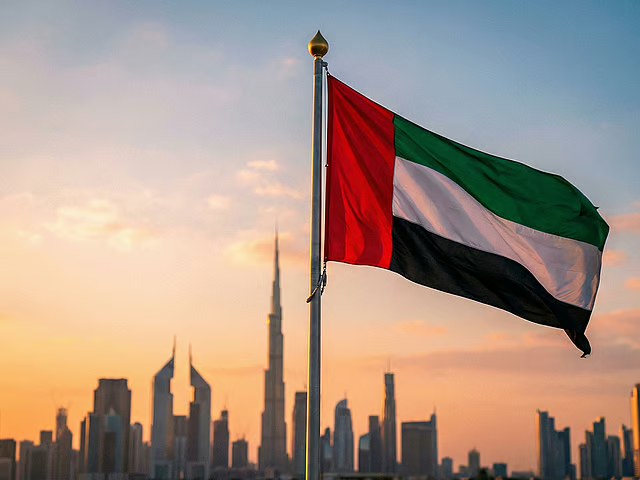
The competent authorities in Fujairah announced that they are responding to an incident resulting from the targeting of a du telecommunications building in the emirate by a drone launched from Iran.
The Fujairah Media Office stated that no injuries have been reported.
One injured in Abu Dhabi after air defence interception
Authorities in Abu Dhabi are managing an incident at Rinn Systems Company in Musaffah—ICAD City after shrapnel fell following a successful air defence interception. A Ghanaian national sustained moderate injuries in the incident.
Officials urged the public to rely solely on official sources for updates and to avoid spreading rumors or unverified information.
UAE responds to a series of Iranian threats today
UAE residents received a series of mobile alerts from the Ministry of Interior on Monday confirming that the situation across the country is currently safe following multiple missile and drone threats. Authorities thanked residents for their cooperation and reassured the public that normal activities can now resume.
Authorities urged residents to remain vigilant, follow safety guidance, and monitor official channels for further updates as the situation develops.
GN
UAE
UAE Remains strong one month after Iran’s attacks
One month after the launch of Iran’s aggressive missile and drone attacks against the United Arab Emirates and several Gulf states—beginning on February 28, 2026—targeting both civilian and military infrastructure in the UAE as part of a broader regional escalation that included strikes on ports and critical facilities, the contours of a complex landscape are becoming increasingly clear.
This landscape reflects an unprecedented level of military escalation, met by a highly efficient Emirati response and a firm political and diplomatic stance underscoring that the UAE’s security and sovereignty are non-negotiable.
Key features of the Iranian escalation over the past month
Scale of attacks: Data indicates that the UAE has been the primary target of the Iranian assaults since February 28, with 2,156 attacks out of a total of 4,391 recorded across Gulf states, involving missiles and unmanned aerial systems.
Nature of targets: The strikes focused on vital facilities, ports, oil installations, and civilian areas, causing material damage and operationaldisruptions.
The UAE’s Position: The UAE has affirmed before international forums that these acts constitute a flagrant violation of international law and have deliberately targeted civilian infrastructure, thereby undermining energy security and global supply chains.
Diplomatically, Sheikh Abdullah bin Zayed Al Nahyan, Minister of Foreign Affairs, has engaged in consultations with international counterparts to address the repercussions of this escalation.
In a statement delivered by Jamal Al Musharakh, Permanent Representative of the UAE to the United Nations Office and other international organizations in Geneva, before the UN Human Rights Council, the UAE stressed that the ongoing Iranian attacks—exceeding 2,000 ballistic and cruise missiles as well as drones—have targeted vital civilian facilities, airports, residential areas, and other civilian sites in blatant violation of national sovereignty and international humanitarian law.
The UAE emphasized that what is unfolding is not merely a military escalation, but a systematic and reckless pattern of behavior that undermines the foundations of the international order and threatens regional and global stability—particularly through the targeting of infrastructure directly linked to civilian safety, energy security, the global economy, and supply chains.
Unprecedented escalation: Figures reveal the scale
Over the past month, the UAE has faced one of the largest waves of aerial threats in its modern history. Official statistics highlight the scale of escalation:
- 378 ballistic missiles
- 15 cruise missiles
- 1,835 drones
Despite the intensity, air defense systems successfully intercepted the vast majority of these threats, reflecting the country’s advanced military and technological readiness.
However, the attacks were not without impact. Falling debris and a limited number of projectiles that penetrated defenses caused material damage in various locations.
Multinational casualties: The human toll
The human cost reveals the harshest dimension of these attacks. The total number of casualties stands at:
- 11 fatalities
- 171 injured individuals from 29 nationalities
The victims include:
- Two members of the UAE Armed Forces who were killed in the line of duty
- A Moroccan civilian contractor working with the armed forces
- Eight civilians of Pakistani, Nepali, Bangladeshi, Palestinian, and Indian nationalities
These figures reflect the UAE’s diverse societal fabric and underscore the broad humanitarian impact of the attacks on civilians from multiple backgrounds.
Civilian and strategic targets
Official sources confirmed that the attacks targeted—or attempted to target—a range of critical sites, including:
- Airports and aviation infrastructure
- Energy and fuel facilities
- Residential areas
- Commercial zones
Several incidents were reported in Abu Dhabi and Dubai, including fires caused by drones near key facilities, as well as damage resulting from falling debris.
This pattern of targeting suggests an attempt to inflict both economic and psychological impact by striking at the core of daily life and essential infrastructure.
Effective response: High state of readiness
Despite the intensity of the attacks, the UAE demonstrated a high level of crisis management and threat response through:
- Advanced air defense systems that intercepted most incoming threats
- Integrated coordination between military and security agencies
- Rapid response by emergency and civil defense teams
- Near-continuity of critical operations, particularly in the aviation sector
This preparedness significantly minimized losses and ensured the stability of daily life.
A firm Emirati stance: Rejection and accountability
Politically and diplomatically, the UAE’s position has been clear and consistent from the outset, emphasizing that these attacks constitute:
- A blatant act of aggression and a violation of international law
- A direct threat to regional and global security
- Acts of terrorism targeting civilians and infrastructure
The UAE at the United Nations: Active diplomacy
At the international level, the UAE has intensified efforts to present its case to the global community by:
- Providing official briefings on the nature and consequences of the attacks
- Calling for the activation of international accountability mechanisms
- Stressing the need to protect civilians and critical infrastructure
This approach reflects a strategy that combines operational firmness with legal and diplomatic engagement.
Abu Dhabi’s message: Resilience and continuity
After a month of escalation, Abu Dhabi’s message is unequivocal:
- National security is a red line
- Aggression will not break the nation’s resolve
- The path of development will continue uninterrupted
Despite the severity of the attacks and their deliberate nature, the UAE affirms that these challenges will not undermine its stability, but rather reinforce its commitment to its principles and its capacity to confront crises with resilience and determination.
GN
COMMUNITY
Abu Dhabi debris kills 2, injures 3
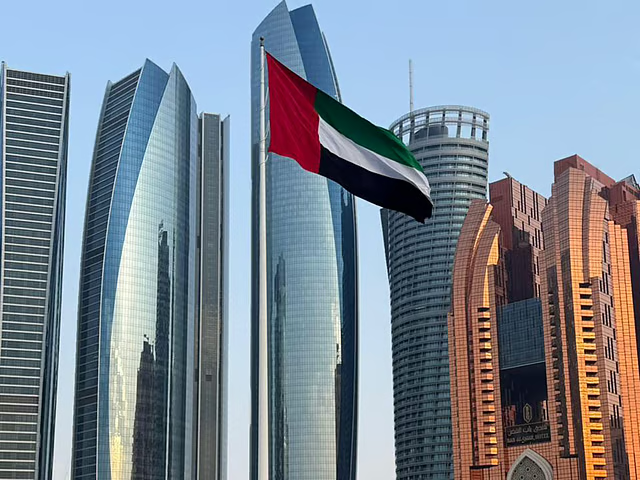
Abu Dhabi authorities have responded to an incident in Sweihan Street, where falling debris from a successfully intercepted ballistic missile caused casualties and property damage.
The incident resulted in the deaths of two unidentified individuals, injuries to three others, and damage to several vehicles. Officials have confirmed that emergency services were promptly on the scene.
Authorities have urged the public to rely solely on official sources for information and to avoid spreading rumours or unverified reports.
UAE air defences intercept Iranian attacks
Thursday morning, the Ministry of Defence (MOD) confirmed that its air defence systems successfully intercepted incoming missiles and unmanned aerial vehicles (UAVs) launched from Iran. Authorities added that the situation remains under close monitoring and urged the public to rely only on official government sources for updates.
On 25 March 2026, UAE air defence systems engaged nine UAVs launched from Iran, part of ongoing regional hostilities. Since the onset of what the MOD described as blatant Iranian aggression, UAE air defences have successfully intercepted 357 ballistic missiles, 15 cruise missiles and 1,815 UAVs targeting the country.
Casualties and impact
The latest incident in Abu Dhabi adds to the toll, bringing total deaths to 11, with 2 killed and 3 injured today from falling debris after a successfully intercepted missile. These sustained attacks have previously resulted in casualties among both military personnel and civilians.
Three members of the UAE armed forces have been martyred in the line of duty, while six foreign nationals — including Pakistani, Nepali, Bangladeshi and Palestinian nationals — were killed in separate incidents linked to missile and UAV debris.
A total of 166 people were injured, with cases ranging from minor to severe across multiple nationalities.
Authorities continue to monitor the situation closely and reiterate that residents should follow official updates and avoid sharing unverified information.
GN


Does more testosterone mean more muscle?

Anna Wintour’s Vogue cover is a power play
xAI sues Colorado over AI law

Is February 2026 really a once-in -283-years MiracleIn?

Algeria, Burkina Faso, Côte d’Ivoire win AFCON 2025 openers

NMC Royal Hospital, Khalifa City, performs rare wrist salvage, restoring function for young patient
-
Discover3 months ago
Is February 2026 really a once-in -283-years MiracleIn?
-
 Football4 months ago
Algeria, Burkina Faso, Côte d’Ivoire win AFCON 2025 openers
-
 Health3 months ago
NMC Royal Hospital, Khalifa City, performs rare wrist salvage, restoring function for young patient
-

 Health4 months ago
Bascom Palmer Eye Institute Abu Dhabi and Emirates Society of Ophthalmology Sign Strategic Partnership Agreement
-

 Health5 months ago
Emirates Society of Colorectal Surgery Concludes the 3rd International Congress Under the Leadership of Dr. Sara Al Bastaki
-

 Health5 months ago
Born Too Soon: Understanding Premature Birth and the Power of Modern NICU Care
-

 Lifestyle5 months ago
Saudi Arabia Lifestyle Trends 2025: What You Need to Know About Fitness, Wellness, Healthy Eating & Self-Care Growth
-

 Football5 months ago
Globe Soccer Awards 2025 nominees announced as voting opens in Dubai