
Tech news
Best Nintendo Switch 2 Games to Play in 2026
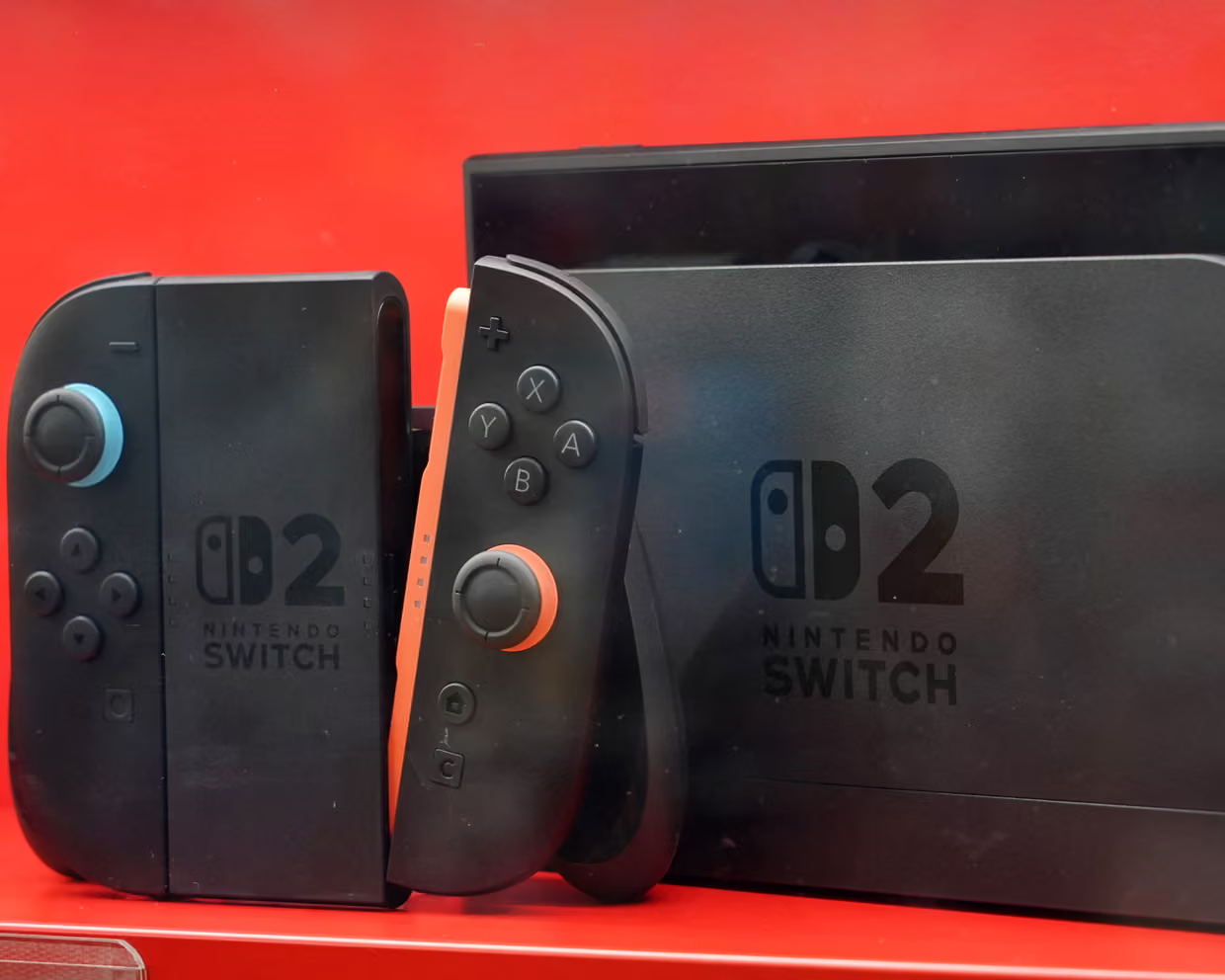
Nintendo’s newest console has been out for a less than a year but it already boasts an impressive catalogue of excellent new games, as well as a variety of enhanced Switch greats. Here’s our selection of the 15 best titles currently on offer, ranging from family favourites to grittier, more adult challenges.
Animal Crossing: New Horizons – Switch 2 edition

Originally released in 2020, Nintendo’s lovable life simulator has you cast away on a tropical island, building a home, making friends and inviting other players around for a cup of tea. The new version for Switch 2 (available 15 January) overhauls the visuals and multiplayer connectivity, as well as adding support for the Switch 2 camera.
Why we love it: “Your days are spent chasing bugs, chopping wood, arranging furniture and watering flowers, not scrounging for food/water/weapons and fighting people.”
Donkey Kong Bananza

The beloved ape teams up with his previous kidnap victim Pauline (no hard feelings, obviously) in this literally smashing subterranean adventure. The rules of the platform genre are cast aside as walls and floors are pulverised by Kong’s massive fists.
Why we love it: “I can see Bananza having a second life as an executive stress reliever; a virtual rage room where you heave exploding boulders at cliffs to reduce them to pockmarked swiss cheese.”
Final Fantasy Tactics: The Ivalice Chronicles

Originally released in 1997, Final Fantasy Tactics was a battle-focused take on the role-playing adventure series, cutting exploration in favour of tense, contained fight scenes. The Ivalice Chronicles features updated visuals as well as fresh voice acting and difficulty levels, perfectly modernising a PlayStation classic.
Why we love it: “[It] offers a model for resistance, and also a commentary on the struggle of opposition in such turbulent times.”
Hades II

The sequel to 2020’s brilliant mythological action game brings us new lead character Melinoë, a witch who must defeat the god of time and his retinue of sexy, chaotic boss characters. As before, dying returns you to the beginning, but you always reanimate and begin again, lessons learned and experience gained.
Why we love it: “[Jen] Zee’s new character illustrations are, if anything, likely to inspire even more aggressively thirsty fan art and fanfic. And writer Greg Kasavin’s wonderful script is wittier, wiser and flirtier than ever.”
Hollow Knight: Silksong

One of the biggest hits of 2025, this platform adventure sequel drags insectoid princess Hornet into the haunted realm of Pharloom, where relentless enemies and fiendishly tough puzzles await. Nightmarishly difficult and compelling, it’s up there with the greatest Metroidvania titles of all time.
Why we love it: “I’m captivated by Silksong. I’ve spent 15 hours on it in three days, and it has made my thumbs hurt.”
Kirby and the Forgotten Land

The first 3D platforming adventure for Hal Laboratory’s long-running hero sees Kirby wake up in a magical world terrorised by a gang of animals known as the Beast Pack. The Switch 2 edition updates the visuals and adds a whole new story.
Why we love it: “From scaling overgrown tower blocks to navigating ghost-ridden haunted house rides in a creature-infested theme park, it feels endlessly inventive.”
The Legend of Zelda: Tears of the Kingdom – Switch 2 edition

The follow-up to 2017’s Breath of the Wild returns us to the world of Hyrule, now shattered by a cataclysmic event. Familiar locations are radically changed, fresh secrets and quests are revealed, and a new physics engine lets you build incredible contraptions.
Why we love it: “The sense of freedom here is intoxicating. The kingdom of Hyrule is vast and full of diversions, and being able to move freely between the skies and the ground down below is a thrill that never wears off.”
Mario Kart World

A new beginning for Nintendo’s beloved karting series sees a vast open world to race in, alongside gorgeous circuits, cars, characters and abilities. Implementation of the Switch 2’s GameChat system makes online play more sociable – and the music is incredible.
Why we love it: “It really is an impressively welcoming game, this, generous and detailed and unfailingly fun, different but with the same spirit.”
Metroid Prime Remastered

Arguably one of the greatest first-person sci-fi shooters ever made, Metroid Prime was a huge hit on the GameCube in 2002 before receiving a wonderful remaster on the Switch. Series hero Samus Aran finds herself on the poisoned planet of Tallon IV, exploring its haunted biomes and fighting hideous space creatures. Inspired by Ridley Scott’s Alien, it is tense, complex and often scary – things we rarely expect from a Nintendo title.
Why we love it: “Sometimes, you play a game from a decades ago and think, this might actually hit better now. Metroid Prime Remastered is one of those games.”
Pokémon Legends: Z-A

In the sprawling, Paris-esque Lumiose City, a team of young trainers set out to climb the ranks of the biggest Pokémon tournament in town. Arriving as an eager newcomer, you must help them – and save the city from rogue mega-evolved Pokémon. A fresh, interesting take on the series, with more lively battles, an open world to explore and, of course, hundreds of Poké-friends to make along the way.
Why we love it: “It looks better than every other Pokémon game I’ve played, and if I could show this to my 11-year-old self playing on a monochrome Game Boy screen, she’d lose her mind.”
Simogo Legacy Collection

In the early days of the Apple App Store, Swedish studio Simogo made some of the most fascinating, beautifully designed touchscreen games of all time, from rhythm action platformers to folk horror adventures. This collection brings them all together with extra features, including early prototypes of the games.
Why we love it: “These games, in all their varied playfulness, are full of longing: for a lover, for meaning, for a chance to write your own ending. Play them and dream about a world where it all went differently.”
Skate Story

Imagine Tony Hawk’s Pro Skater, but set in a demonic underworld that you must escape by rolling through bizarre crystalline hellscapes while pulling off bodacious moves. A surreal and spiritual take on the skating sim.
Why we love it: “Beyond the ravishing visuals, what’s most striking is the exquisite fluidity, the delicious ‘gamefeel’ of the actual skateboarding.”
Split Fiction
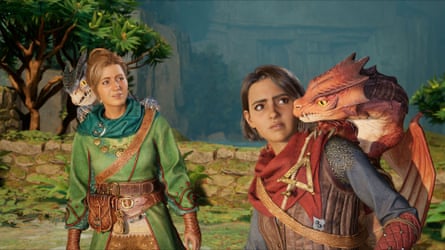
Two authors – one writing sci-fi, the other fantasy – are sucked into their own stories when a virtual reality machine goes awry. From the makers of the award-winning It Takes Two, this is another cooperative adventure in which players work in tandem to solve ingenious puzzles.
Why we love it: “One level could be all-action space-blasting, the next will have you puzzling through a fantasy jungle as transforming animals, and an unexpected diversion will have you working together to wriggle sentient hotdogs into buns.”
Street Fighter 6

The warriors return for another showdown, featuring classic combatants and new fighters, such as drunken boxer Jamie and graffiti ninja Kimberly. The special moves are eye-popping and the gorgeous, hyper-colourful visuals hit you harder than Ryu’s hadouken.
Why we love it: “It’s bursting at the seams with things to do, assured in its gameplay, and wrapped in a stylish, colourful, confident swagger that the game can absolutely back up.”
Two Point Museum

Design the perfect museum then send out explorers to discover artefacts in the latest management game from the makers of the equally great Two Point Hospital and Two Point Campus. The simulation is complex and demanding but it’s softened by lovely comic touches.
Why we love it: “Takes all the lessons from the previous games and builds on them to make a thoughtful and hugely entertaining contribution to the management sim genre.”
The Guardian
Tech news
Which countries are banning social media for Kids?
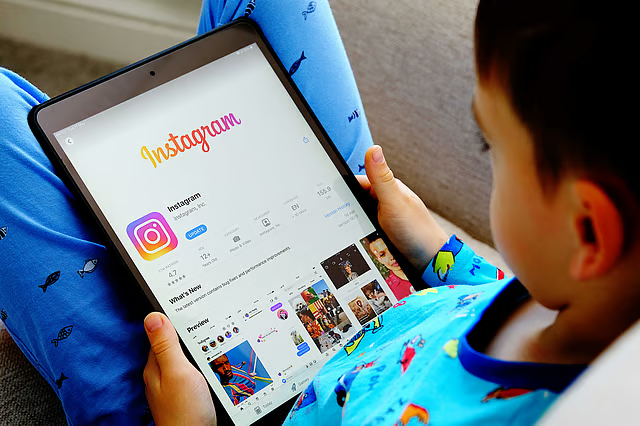
The United Kingdom became the latest country to ban social media for children, under-16s will be barred from platforms including TikTok, Instagram, Snapchat, Facebook, YouTube, and X.
The UK follows Australia which became the world’s first country to pass a social media ban for children.
Since then, a wave of countries have either passed legislation or are actively moving to do so, citing growing concerns over cyberbullying, addiction, mental health, and children’s exposure to predators online.
Rather than simply tightening rules around content moderation and age verification, a number of governments are opting for outright bans on access for under-16s. Here is a full breakdown of every country that has banned or is moving to ban social media for children.
Countries that have banned or are moving to ban social media for children
1. United Kingdom
Prime Minister Sir Keir Starmer announced a ban on June 15, 2026, prohibiting children under 16 from accessing major social media platforms including TikTok, Instagram, Snapchat, Facebook, YouTube, and X. Messaging apps such as WhatsApp and Signal are exempt. Tech companies will be required to prevent under-16s from creating accounts, and existing profiles are expected to be deactivated.
2. Australia
Australia was the first country in the world to pass a social media ban for children, with legislation taking effect in December 2025. The minimum age to hold an account on designated platforms, including Facebook, Instagram, TikTok, Snapchat, X, Reddit, Twitch, and Kick, is 16.
3. Indonesia
Indonesia became the first non-Western country to enforce age-based digital restrictions, with its ban for under-16s taking effect on March 28, 2026. High-risk platforms, including YouTube, TikTok, Instagram, Facebook, X, Threads, Bigo Live, and Roblox are required to deactivate underage accounts. Non-compliance could result in fines, temporary suspensions, or loss of market access.
4. Malaysia
Malaysia’s ban came into force on June 1, 2026 under the Child Protection Code of the Online Safety Act. Major platforms must restrict registrations for under-16s and implement age verification using government-issued identity documents. Existing underage users have a six-month window for age verification, with one month to transfer data if they are found to be under 16.
5. Türkiye
The Turkish parliament passed legislation in April 2026 requiring social media platforms to block under-15s from creating accounts, introduce parental controls, and rapidly remove harmful content. Online gaming companies must also appoint a local representative. The bill awaits sign-off from President Recep Tayyip Erdoğan before passing into law.
6. Greece
Greece will ban social media for children under 15 from January 1, 2027, with Prime Minister Kyriakos Mitsotakis citing rising anxiety, sleep deprivation, and addiction among minors. The government is also pushing for an EU-wide ban and is working on mandatory identity verification for all users to reduce online harassment.
7. France
France has drafted legislation to introduce a “digital majority” at age 15, blocking major social platforms for younger children unless explicit parental consent is given. The bill has advanced through both the Senate and lower house, but has been referred to the European Commission to ensure compliance with EU digital law.
8. Canada
Canada’s proposed Safe Social Media Act (Bill C-34) would ban under-16s from social media unless platforms implement approved safeguards. It also targets AI chatbots and requires the rapid removal of harmful content, including non-consensual intimate images within 24 hours of it being flagged. The bill is in its early legislative stages.
9. Norway
Norway plans to introduce a bill to parliament by the end of 2026 that would raise the minimum age for social media use from 15 to 16, placing legal responsibility for age verification on tech companies rather than young users.
10. Spain
Spain is proposing an Australia-style ban for under-16s, with platforms required to implement rigorous, real verification barriers rather than simple checkbox consent. Tech executives could face criminal liability if illegal or hateful content is not removed promptly. Parliamentary approval is still required.
11. Denmark
Denmark proposed legislation in 2025 to set the minimum social media age at 15, with a provision allowing 13- and 14-year-olds to access platforms with explicit parental consent. A digital identity app linked to the national ID system is being developed to enforce age verification. Platforms that fail to comply face heavy fines.
12. Germany
Germany is debating a national ban, with the governing conservatives proposing a limit for under-16s and the Social Democratic Party pushing for restrictions on under-14s. No legislation has passed yet.
What about the UAE?
The UAE has not introduced a blanket ban but enforces a strict Child Digital Safety Law (Federal Decree-Law No. 26 of 2025).
From January 2027, all digital platforms targeting UAE users, including TikTok, Instagram, and Roblox, must prohibit data collection on under-13s without parental consent, strip predatory algorithms, restrict contact with strangers, and filter content by age.
Parents and guardians are legally required to ensure children are registered on age-appropriate platforms and to activate parental controls.
GN
Tech news
SpaceX IPO could make Elon Musk world’s first trillionaire

Elon Musk announced plans Wednesday for one of the biggest stock sales ever by taking public a space company that is currently losing billions of dollars a year.
A filing shows that his SpaceX lost $2.6 billion from operations last year on $18.7 billion in revenue, and the losses kept piling up at the start of this year, too.
The prospectus did not put a dollar figure on the amount Musk hopes to raise, but various reports have put it at $75 billion or so. An offering of that size would easily surpass the current title holder, Saudi Aramco, the oil giant that went public seven years ago and raised $26 billion.
SpaceX, formally known as Space Exploration Technologies Corp., has said the money will help finance projects to put people on the moon and Mars in its quest to make humans an intergalactic species as they face existential threats that could wipe out civilization.
“We do not want humans to have the same fate as dinosaurs,” the filing states.
In addition to making reusable rockets to hurl astronauts into orbit, SpaceX has other businesses, some successful, some struggling – and with plenty of questions marks.
The document shows that Starlink, the world’s largest satellite communications company, is a big source of cash for the company, generating $4.4 billion in operating income last year. The business uses 10,000 satellites in low orbit to provide internet service to 10 million people in 150 countries and territories.
Among the struggling businesses are two Musk units that were recently acquired by SpaceX – his social media platform X, formerly Twitter, and his artificial intelligence business, xAI. Those purchases were blasted by some SpaceX investors as bailouts because they are big money losers.
The prospectus said its AI business lost $6.4 billion in operations last year.
The original SpaceX business, making rockets and staging launches, has been helped by massive government contracts, which raises questions that could come back to haunt the company. Given Musk’s close relation to the Trump administration, government ethics lawyers and watchdogs have asked if he has gotten special treatment to win taxpayer money and whether that good luck will run out once President Donald Trump is out office.
SpaceX has won contracts worth $6 billion from NASA and the Defense Department and other government agencies in the past five years, according to USAspending.gov. The company noted in its filing that a fifth of its revenue last year was from the federal government.
Musk was the biggest donor to Trump’s presidential campaign and is still a big backer despite their sometimes rocky relationship after his stewardship of the government cost-cutting effort called DOGE early last year.
Like many corporate CEOs, Musk’s compensation will go far beyond his annual salary, which was $54,080 in 2025 and has remained unchanged since 2019, according to the filing.
The prospectus says stock grants for him would be sliced into 15 nearly equal amounts – 67 million shares each – and would vest only as the company achieves preset market cap goals. In addition to the Martian colony, SpaceX’s stock market value would have to reach $7.5 trillion for him to receive the full award.
He would get even more stock awards if SpaceX manages to get giant data centers the size of football fields in space.
The document shows Musk will be able to exert big control over the business.
It says he and certain other shareholders will receive shares in a special class of stock that gives them 10 votes for each share they hold. Those shareholders will be able, among other things, to elect a majority of the company’s board of directors.
“This will limit or preclude your ability to influence corporate matters and the election of our directors,” SpaceX said in a warning to prospective investors.
SpaceX will be able to pitch the offering to investors – in what’s known in Wall Street parlance as a “road show” – 15 days after making its prospectus public. In this case, that works out to June 4.
GN
Tech news
Google pushes Gemini deeper into Android ahead of Apple AI reboot
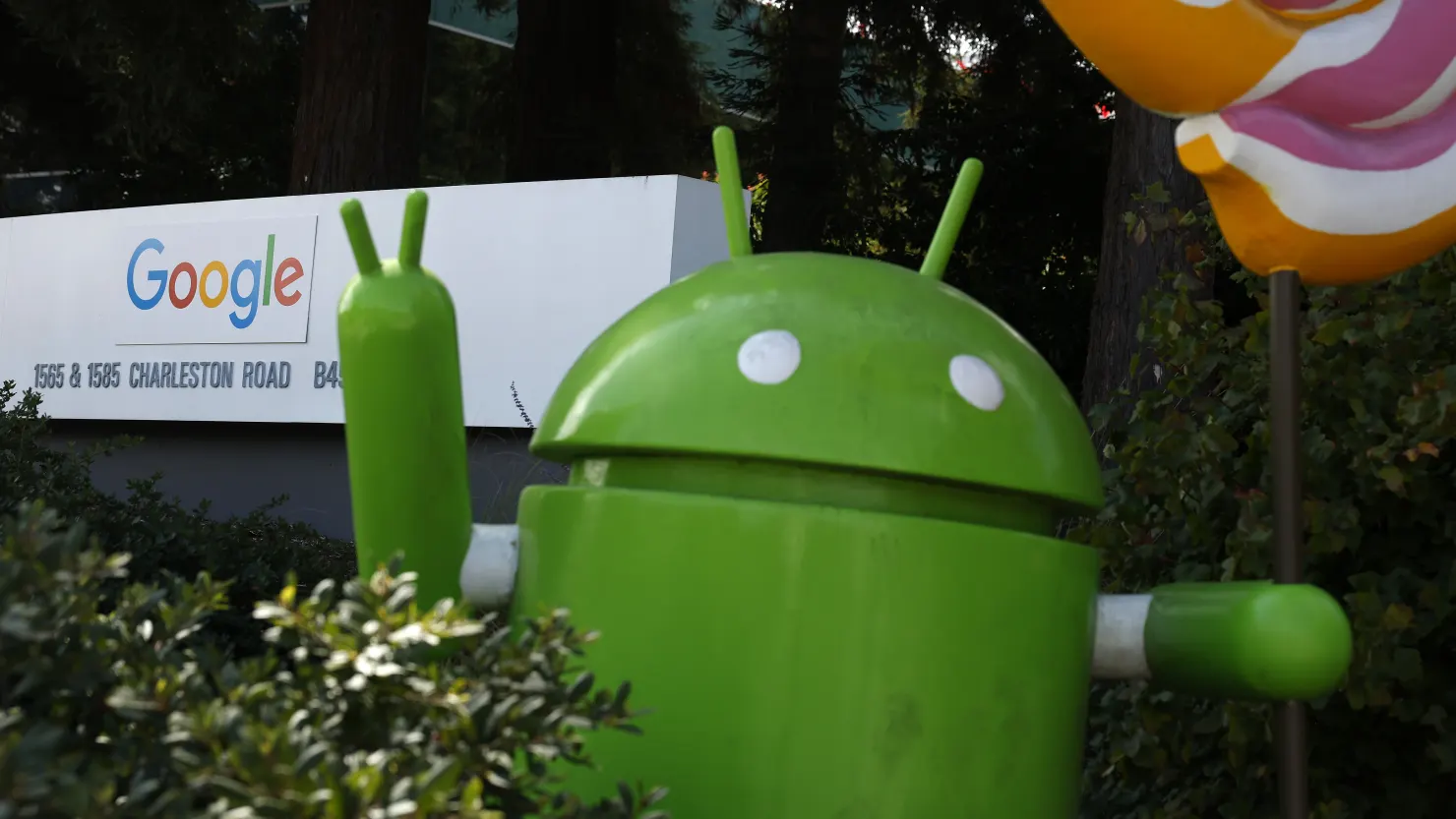
Google is using its latest Android rollout to make Gemini less of a chatbot and more of an operating layer across the phone, browser, car and laptop, just weeks before Apple is expected to show its own Gemini-powered Apple Intelligence reboot at WWDC.
Ahead of its Google I/O developer conference next week, the company previewed a number of Android updates, including AI-powered app automation, a smarter version of Chrome on Android, new tools for creators, a redesigned Android Auto experience, and a sweeping set of new security features.
Alphabet is counting on Gemini to help Google compete directly with OpenAI and Anthropic in the market for artificial intelligence models and services, while also serving as the AI backbone across its expansive portfolio of products, including Android. Meanwhile, Gemini is powering part of Apple’s new AI strategy, giving Google a role in the iPhone maker’s reset even as it races to prove its own version of personal AI on the phone is further along.
Sameer Samat, who oversees Google’s Android ecosystem, told CNBC that Google is rebuilding parts of Android around Gemini Intelligence to help users complete everyday tasks more easily.
“We’re transitioning from an operating system to an intelligence system,” he said.
As part of Tuesday’s announcements. Google said Gemini Intelligence will be able to move across apps, understand what’s on the screen and complete tasks that would normally require a user to jump between multiple services. That means Android is moving beyond the traditional assistant model, where users ask a question and get an answer, and acting more like an agent.
For instance, Google says Gemini can pull relevant information from Gmail, build shopping carts and book reservations. Samat gave the example of asking Gemini to look at the guest list for a barbecue, build a menu, add ingredients to an Instacart list and return for approval before checkout.
A big concern surrounding agentic AI involves software taking action on a user’s behalf without permissions. Samat said Gemini will come back to the user before completing a transaction, adding, “the human is always in the loop.”
Four months after announcing its Gemini deal with Google, Apple is under pressure to show a more capable version of Apple Intelligence, which has been a relative laggard on the market. Apple has long framed privacy, hardware integration and control of the user experience as its advantages.
Google’s Android push is designed to show it can bring AI deeper into the device experience while still giving users control over what Gemini can see, where it can act and when it needs confirmation.
The app automation features will roll out in waves, starting with the latest Samsung Galaxy and Google Pixel phones this summer, before expanding across more Android devices, including watches, cars, glasses and laptops later this year.
The company is also redesigning Android Auto around Gemini, turning the car into another major surface for its assistant. Android Auto is in more than 250 million cars, and Google says the new release includes its biggest maps update in a decade and Gemini-powered help with tasks like ordering dinner while driving.
Alphabet’s AI strategy has been embraced by Wall Street, which has pushed the company’s stock price up more than 140% in the past year, compared to Apple’s roughly 40% gain. Investors now want to see how Gemini can become more central to the products people use every day.
CNBC


Emirates Specialty Hospital Expands Cancer Care Services in Dubai with Opening of Dedicated Chemotherapy Unit

When Rheumatoid Arthritis Threatened Her Independence: How the Right Diagnosis Helped Her Get Her Life Back

Saudi German Hospital Dubai Launches Mental Health and Wellness Center for Children and Adolescents

Araghchi, Oman Sultan discuss transit, stability in Muscat

UAE’s café culture keeps growing despite price pressure

Netflix to Livestream BTS Comeback Concert
-
 politics6 months ago
Araghchi, Oman Sultan discuss transit, stability in Muscat
-
 UAE10 months ago
UAE’s café culture keeps growing despite price pressure
-
 Entertainment9 months ago
Netflix to Livestream BTS Comeback Concert
-
 Discover9 months ago
Is February 2026 really a once-in -283-years MiracleIn?
-

 Football10 months ago
Algeria, Burkina Faso, Côte d’Ivoire win AFCON 2025 openers
-

 Health10 months ago
NMC Royal Hospital, Khalifa City, performs rare wrist salvage, restoring function for young patient
-

 Health10 months ago
Bascom Palmer Eye Institute Abu Dhabi and Emirates Society of Ophthalmology Sign Strategic Partnership Agreement
-

 Health11 months ago
Emirates Society of Colorectal Surgery Concludes the 3rd International Congress Under the Leadership of Dr. Sara Al Bastaki