
Food
25 of the world’s best sandwiches
Is there a food more humble yet universally adored than the sandwich?
And while one person’s go-to hamburger snack might be another’s katsu sando or chivito, there’s hardly a country on the planet that doesn’t turn to some type of bread with something stuffed inside it to cure a craving.
Traveling the world’s sandwiches is, in a way, like traveling the world.
To help narrow your choices for the sandwich to plan your next trip around, here are 25 of the world’s best sandwiches:
Bocadillo de jamón Ibérico, Spain
There are ho-hum ham sandwiches and then there’s this simple handheld featuring some of the world’s finest jamón, luxurious Iberian ham from acorn-fed pigs. The thinly sliced meat is piled on crusty bread that’s brushed or drizzled with extra virgin olive oil. Fresh tomatoes and perhaps some cheese can be added, but the ham is undoubtedly the star of this show.
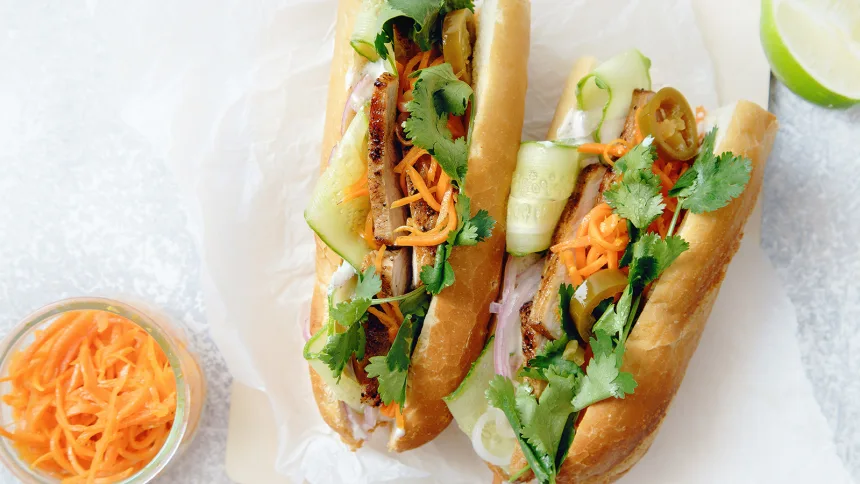
A culinary remnant of French colonialism, the baguette sandwich was reinterpreted to their own taste by the Vietnamese. Bánh mì are now sold from food carts on nearly every street corner in Ho Chi Minh City and across Vietnam and are widely loved well beyond the country’s borders.
The classic version is pork-based, starring chả lụa (Vietnamese-style pork roll), shredded pickled carrots, pickled daikon, cilantro leaves, mayonnaise and other ingredients. You can find variations with tofu and thinly sliced lemongrass chicken, too. The taste is crunchy, fresh, savory and utterly delicious.
Torta ahogada, Mexico
This “drowned” sandwich is the most popular street food in Guadalajara, the capital of Mexico’s Jalisco state. Chopped pork is tucked into crusty bread influenced by the French occupation in the 1860s, then drowned in a spicy red sauce that’s said to have become a tradition by accident when a sandwich fell into the sauce
Tramezzino, Italy
While originally from Turin, Venice has taken this popular lunchtime bar snack to the next level — properly stuffing English tea style-triangles of white bread with fillings that include everything from olives and tuna, soft boiled eggs and vegetables to piles of crispy prosciutto with truffle.
Bars all over Venice pull out platters of tramezzini at lunchtime. If you’re doing things right, you’re enjoying them canal-side with a glass of local wine.
Shawarma, Middle East
Shawarma’s name comes from the Arabic word for “turning” — a reference to how this favorite Middle Eastern sandwich’s meaty filling cooks on a vertical spit. In adaptations that spread to the Mediterranean and Europe, shawarma has been reinterpreted as gyro in Greece or doner kebab in Germany, via Turkey.
While there are many variations of this popular street food, its base is grilled spiced meat (usually chicken, lamb or beef) shaved from the rotisserie and tucked into a light sleeve of pita bread, topped with things such as tomatoes, onions and parsley and perhaps tahini sauce and hot sauce, too.
Pambazo, Mexico
Tortillas might first come to mind when it comes to Mexico. But one of the country’s most famous antojitos (street snacks or appetizers) is the pambazo, a favorite street food sandwich from Veracruz and Puebla said to have been inspired by the shape of a Mexican volcano
It’s a seriously filling thing featuring bread tinted red thanks to a soak in slightly spicy guajillo sauce. Open up wide for the potatoes and Mexican chorizo inside, topped with lettuce, cheese and cream.
Muffaletta, New Orleans, United States
Italian immigrants who settled into New Orleans’ Lower French Quarter in the late 19th and early 20th century are to thank for inventing this quintessential New Orleans sandwich made from round, sesame-covered loaves of Sicilian bread that can easily outsize your head.
Inside the muffaletta, layers of chopped olives, Genoa salami, ham and various cheeses (often with Swiss and provolone) mingle to mouthwatering effect.
Chivito, Uruguay
While this Uruguayan sandwich’s name translates to “little goat,” that ruminant’s meat is decidedly absent from this decadent assemblage of thinly sliced steak (called churrasco), ham, bacon, lettuce, mayonnaise and melted mozzarella.
iled high into a roll that’s similar to a hamburger bun or ciabatta, the chivito is customarily topped off with a fried egg – just to make sure you don’t leave hungry.
Pan bagnat, France
If you like a good salade Niçoise, chances are you’ll be a fan of the pan bagnat — a sandwich that similarly hails from Nice in the South of France and is made using crusty pain de campagne, a boulangerie favorite.
Sliced in half (but not completely through), the bread hinges open to reveal layers of raw vegetables, anchovies, olives, sliced hard boiled eggs, chunks of tuna and liberally applied olive oil, salt and pepper. Bon appétit, indeed.
Smørrebrød, Denmark
Beloved all over Scandinavia but particularly iconic for being one of Denmark’s national dishes, this open-faced sandwich translates to “buttered bread” — but smørrebrød is so much more.
With rye bread as the typical base, toppings include scores (perhaps hundreds) of combinations that range from curried or pickled herring and tiny pink shrimp to sliced boiled eggs and rare roast beef atop a layer of butter. In true Scandi style, smørrebrød goes big on aesthetics, too — the sandwiches are as pretty to look at as they are delicious to eat. Spatlo, South Africa
Particularly linked to the Gauteng province and Johannesburg, South Africa’s spatlo sandwich (often called kota, loosely translated as quarter) is made from a quarter loaf of bread that’s been hollowed out and stacked to the max with meat and much more.
Inside, find seasoned fries, cheese, bacon, polony (bologna), Russian-style sausage and perhaps a heaping of spicy atchar sauce (made from green mangoes) and a fried egg.
Montreal smoked meat sandwich, Canada
Carnivores say oui to this seriously stacked sandwich from Quebec made with smoked beef brisket layered between slices of light rye bread and drizzled with tangy yellow mustard.
The best briskets used in a true Montreal smoked meat sandwich are said to soak for up to two weeks in brine and savory aromatics such as coriander, peppercorn and garlic before being smoked and hand-sliced to go down in eternal sandwich glory.
Po’boy, New Orleans, United States
A classic belly buster that traces its roots to New Orleans, the po’boy (aka poor boy) is rumored to have been invented to feed the city’s streetcar drivers during a 1929 strike.
The history remains fuzzy, but the taste of this sandwich certainly is not.
Folks who sink their teeth into this mayonnaise-laden French bread stuffed with fried oysters (or perhaps fried shrimp or roast beef) and piled with lettuce, tomato and pickles is in for one beautifully delicious mess.
Fricassé, Tunisia
With a comforting deep fried yeast bun for an exterior and a savory mashup of tuna, potatoes and boiled egg inside, this North African sandwich delivers a filling feed in a deceptively small package.
unisia’s favorite picnic and street food sandwich, the fricassé, often gets livened up with additions such as sliced black olives, preserved lemon and harissa – the ubiquitous spicy condiment in this part of the world made from dried red chili peppers, garlic and a spice mix that usually includes caraway, cumin and coriander seed.
Cuban sandwich, Cuba/United States
Originally a luxury item in Cuba, according to Andy Huse, the author of a book on the Cuban sandwich, this Florida favorite is cause for constant debate in Miami and Tampa, where purists spar over its fundamental ingredients as well as its origin.
Whether you take yours with salami (à la Tampa) or not (à la Miami), this sandwich layered with boiled ham, roasted pork, pickles, mustard, Swiss cheese and butter and pressed between pieces of fluffy Cuban bread is a simple, hearty and most often affordable feed.
Cucumber sandwich, United Kingdom
On the dainty side of the sandwich spectrum, cucumber sandwiches are a traditional English afternoon tea staple, often spotted on the same tiered platters with scones and mini-pastries.
Extra soft white bread with the crusts removed gets layered with razor-thin English cucumbers (peeled, please, then lightly salted and drained), butter, a light dusting of fine pepper and perhaps a spray of fresh herbs such as dill. Cut the sandwich into neat triangles and pair with a pot of tea.
Chip butty, United Kingdom
The opposite of elegant, the chip butty means business – after all, this is a sandwich sheathed in buttered white bread and stuffed with fries (aka chips in its native Britain) that seem to carve out their own space in all that soft goodness.
Said to trace its roots all the way back to the 1860s and a seaside fish and chips shop in Lancashire, England, the chip butty can be doused with optional condiments ranging from ketchup and malt vinegar to mayonnaise.
Katsu sando, Japan
A deep-fried pork cutlet – pounded and breaded with panko and tucked into a fluffy Japanese white milk bread called shokupan – is the base for this cult-favorite, convenience store snack from Japan.
Considered yōshoku cuisine (Western-influenced), katsu sando is usually garnished with ribbons of cabbage and comes in chicken and egg salad (tamago) versions, too.
Reuben, United States
Ask people from Nebraska, and they’ll say the Reuben was invented there by a local grocer looking to feed a band of hungry poker players. In New York, the story goes that the sloppily sinful sandwich on rye bread was named for the founder of New York’s Reuben Restaurant.
What’s not disputable is the goodness crammed inside a Reuben – sliced corned beef, sauerkraut, Swiss cheese and Russian or Thousand Island-style dressing. You’ll need napkins. Lots.
Croque monsieur/madame, France
An archetypal sandwich from France that originated as “un snack” in French cafes, this crunchy (croquant) marvel comes in female and male incarnations (madame et monsieur).
or the croque monsieur, slices of white bread are stuffed with thinly sliced ham and emmental or gruyere, often dipped into egg batter, buttered and pan fried. For the croque madame, the egg component is served fried atop the sandwich.
Philly cheesesteak, Philadelphia, United States
Mouthwateringly simple, the City of Brotherly Love’s most beloved sandwich is a delectable hot mess layered with ribeye steak sliced thin, oozing sheets of provolone and sauteed peppers and onions to your liking.
Purists insist the Philly cheesesteak is enveloped inside a hoagie bun. But if you’re whipping one up at home, any thick white bread is sure to be satisfying.
Broodje haring, Netherlands
Like a taste of the salty North Sea distilled into sandwich form, this classic Dutch sandwich is for serious seafood fans only.
Served cold, broodje haring features crunchy baguette-style bread filled with thin slices of chilled herring that’s been cured in salt and piled with diced onions. Depending on where you are in the Netherlands, it might have sliced gherkins, too. Look for it anywhere there’s a market at the stalls called vishandels.
Falafel pita, Middle East
You won’t miss meat in this vegetarian staple of Middle Eastern cuisine. The falafel pita is exactly what its name suggests. Crunchy fried balls of falafel – made from soaked, ground-up chickpeas mixed with herbs – are pushed into a warm and fluffy pita pocket and brightened up with lettuce, tomatoes, tangy tahini sauce and other additions that might include chili sauce and hummus.
You’ll find people lining up for this sandwich on the streets of Beirut, Amman and many other places across the Middle East and beyond.
Choripán, Argentina
Sausages splashed with mustard and chimichurri sauce are the savory makings of this classic Argentinean mouthful whose name is a mash-up of chorizo (sausage) and pan (bread).
Choripán’s origins are thought to trace back to the country’s cowboys called gauchos, known for their grilled meat asados. But today, the casual and filling sandwich is found beyond Buenos Aires and the Andes at food carts, futbol games and restaurants across South America. It’s best enjoyed hot off the grill.
Lobster roll, New England, United States
New Englanders hold their humble lobster roll dear – a summertime coastal treat piled with big chunks of steamed lobster meat that’s often mixed with lemon juice, mayonnaise and herbs and tucked into a roll resembling a hot dog bun.
You can find them at seafood restaurants across the United States. But a classic lobster shack on the stretch of coastline from Maine to Connecticut will make for a scenic backdrop that’s hard to beat.
CNN TRAVEL
Discover
Five-second rule is a myth

You drop a piece of cucumber on the floor. Do you immediately throw it in the bin or reassure yourself of the age-old “five-second rule” and reckon it’s fine to pop it in your mouth after a quick rinse?
If you fall into the latter camp, John Tregoning, professor of vaccine immunology at Imperial College London, has some bad news. He refers to three studies into bacteria transfer that all point towards the rule being false.
In the first, scientists looked at what happens when a range of foods (bread, buttered bread, watermelon and gummy bears) were dropped on a range of surfaces (tile, steel, wood, and carpet) that had been coated with bacteria. “They transferred almost immediately,” he says, adding that the worst combination for transfer happened when wet food hit a solid surface (watermelon on tile or steel).
Another study – where cooked sausage was dropped on to surfaces – showed that bacteria transferred on to the meat even if they had been applied to the surface hours earlier. It showed that “if you put a piece of contaminated chicken on to a work surface and then, two hours later, drop your piece of bread on to it, you can still pick up bacteria from it. It’ll be there for about 24 hours,” he says.
The final paper looked at the “five-second rule” for medical objects in the operating room. Perhaps unsurprisingly, it found that if surgeons drop something on the floor, they need to wash that instrument with detergent for it to be safe to use again.
What does all this mean for your fallen cucumber? “I think you have to accept it’s gone,” says Tregoning. Rinsing it with water won’t be enough to guarantee it’s clean. That’s especially the case if you’re particularly susceptible to infections, or if your dog might have walked something terrible through the house (even hours earlier).
THE GUARDIAN
Food
WFP: Middle East conflict driving millions into hunger
The Middle East conflict is pushing millions of people closer to hunger, as rising fuel and transport costs drive up food prices while funding shortfalls force aid agencies to scale back assistance, the U.N. World Food Programme said on Friday.
Joint U.S.-Israeli strikes on Iran in February triggered a regional conflict stretching across the Gulf and into Lebanon, disrupting key shipping routes, including the Strait of Hormuz, forcing vessels to reroute and sharply constraining global energy flows and supply chains.
In March, the WFP forecast as many as 45 million people could fall into acute food insecurity if oil prices remained around $100 per barrel through June. That scenario is now unfolding, the agency said, with benchmark crude prices staying above that level since early March.
Households in Afghanistan, Somalia and Sri Lanka are among the most seriously affected and face mounting pressure due to higher fuel costs, food price spikes, income losses and disrupted trade.
In Somalia, 6.5 million people – roughly a third of the population – are expected to face severe hunger in 2026, while Afghanistan could see 17.4 million people affected, the WFP said. The situation is projected to worsen, with an additional 2.5 million Somalis and 2.3 million Afghans at risk of falling into food insecurity if disruptions persist. Both countries are reliant on imported energy and food.
FOOD SHORTAGES TO HIT VERY VULNERABLE CHILDREN
The Middle East crisis comes amid a deep funding shortfall for aid agencies. The WFP said it expected to serve 1.5 million fewer people globally in 2026, and 9 million fewer if the situation persists for six months.
In Somalia, supplies of nutritious food for children under 5 suffering from moderate malnutrition will run out as soon as July, as the WFP faces an 89% funding gap in the country.
“We are running out of food. The food is not available for distribution, and the ones who will experience the impact of this are going to be very vulnerable children,” said Jean-Martin Bauer, the director of WFP’s Food Security and Nutrition Analysis Service.
The situation is being worsened by supply chain issues, with fewer ships stopping in Somalia because of disruptions which have affected shipping in the Indian Ocean.
Some WFP stocks have also been held up in Salalah Port in Oman, causing critical delays. Soaring jet fuel prices are also leading to higher operational costs for the United Nations Humanitarian Air Service – the only means to safely access hard-to-reach areas, the WFP said.
In Afghanistan, surging fuel prices have driven up aid transport costs as much as fivefold, and delivery times have shot up from 10 days up to as many as 75 days as trucks had to use alternative corridors, the WFP said.
Food
I’m vegetarian. How can I get enough iron?
I’ve been advised to increase the iron in my diet but, as a vegetarian preoccupied with getting sufficient protein, I’m at a loss.
June, by email
Last year, a study by Randox Health found that almost one in three women who attended its UK clinics have an iron deficiency, which is to say that June isn’t alone. Yes, there are good sources that vegetarians can tap into, but we first need to address a few key points: “The heme iron you get from animal sources – red meat and darker poultry, say – is in a form that’s slightly better absorbed than non-heme iron, which is found in the likes of beans, tofu and leafy greens,” says Dominique Ludwig, nutritionist and author of No-Nonsense Nutrition. This is where vitamin C is your friend: “When we eat non-heme iron and vitamin C together, it increases absorption, so it might be a case for having peppers or tomatoes with your tofu.” But there’s another potential hitch: “On a vegetarian diet, some of that iron can be blocked from absorption because of things such as phytates [a plant compound found in whole grains, legumes, etc], or tannins in tea and dairy,” Ludwig adds, so it’s not simply about how much iron you’re getting, but how good your absorption is.
“Women aged 19-49 should aim for 14.8mg iron a day, but after menopause that drops to about 8.7mg, which falls in line with men’s requirements,” Ludwig says. “If you’re vegetarian, then, you can’t just be having pesto pasta, you need to be eating beans, lentils, nuts, seeds, soy products, and leafy greens, too.” Tofu can have 3-5mg iron per 100g, cooked lentils 3-4mg, chickpeas 2½-3mg, cashews 6-7mg and sesame seeds 14-15mg. So, much like getting dressed, layering is important.
Oats in the morning are a no-brainer: “A 40g serving will give you 2mg iron, so have them with milled flaxseed and berries for the vitamin C,” Ludwig advises. The same principle applies to the likes of a tofu scramble: “Throw in some kale and tomatoes [again, for the vitamin C] and serve it with wholemeal bread, and you’re looking at about 7mg iron,” Ludwig adds. In other words, your day is getting off to a good start.
Also, seeing as Jane is vegetarian rather than vegan, she has eggs to play with, too, which is good news considering each one contains about 2mg iron. “Try a frittata with cottage cheese and broccoli, then sprinkle over some pumpkin seeds [a fantastic source of iron] before baking.” You can see how this all starts to add up.
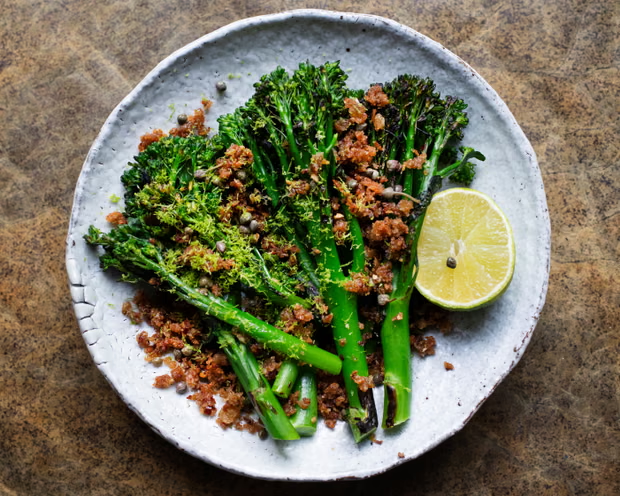
Cashews, edamame, dried fruit (apricots, figs, prunes) and that perennial favourite, carrots and hummus, will all help. An evening stir-fry, meanwhile, can bring the odds and ends in your fridge together into an ultra-fast dinner that ups your iron. There are greens (kale, broccoli), of course, but June could also add tofu or seitan, and nuts, perhaps, and serve it with brown rice. “Or add lentils to your pasta, and stir through lots of green veg,” Ludwig adds. It can be easy being green.
The Guardian


Beyond Uniforms and Lunchboxes: Is Your Child Healthy and Ready for School?

Back to the Heat: Why Returning to the UAE Can Leave Holidaymakers Feeling Exhausted


UAE’s café culture keeps growing despite price pressure

Araghchi, Oman Sultan discuss transit, stability in Muscat

Is February 2026 really a once-in -283-years MiracleIn?
-
 UAE8 months ago
UAE’s café culture keeps growing despite price pressure
-
 politics4 months ago
Araghchi, Oman Sultan discuss transit, stability in Muscat
-
Discover7 months ago
Is February 2026 really a once-in -283-years MiracleIn?
-

 Entertainment7 months ago
Netflix to Livestream BTS Comeback Concert
-

 Football8 months ago
Algeria, Burkina Faso, Côte d’Ivoire win AFCON 2025 openers
-

 Health8 months ago
NMC Royal Hospital, Khalifa City, performs rare wrist salvage, restoring function for young patient
-

 Health8 months ago
Bascom Palmer Eye Institute Abu Dhabi and Emirates Society of Ophthalmology Sign Strategic Partnership Agreement
-

 Health9 months ago
Emirates Society of Colorectal Surgery Concludes the 3rd International Congress Under the Leadership of Dr. Sara Al Bastaki