
UAE
Zayed Award for Human Fraternity Announces 2026 Honorees:
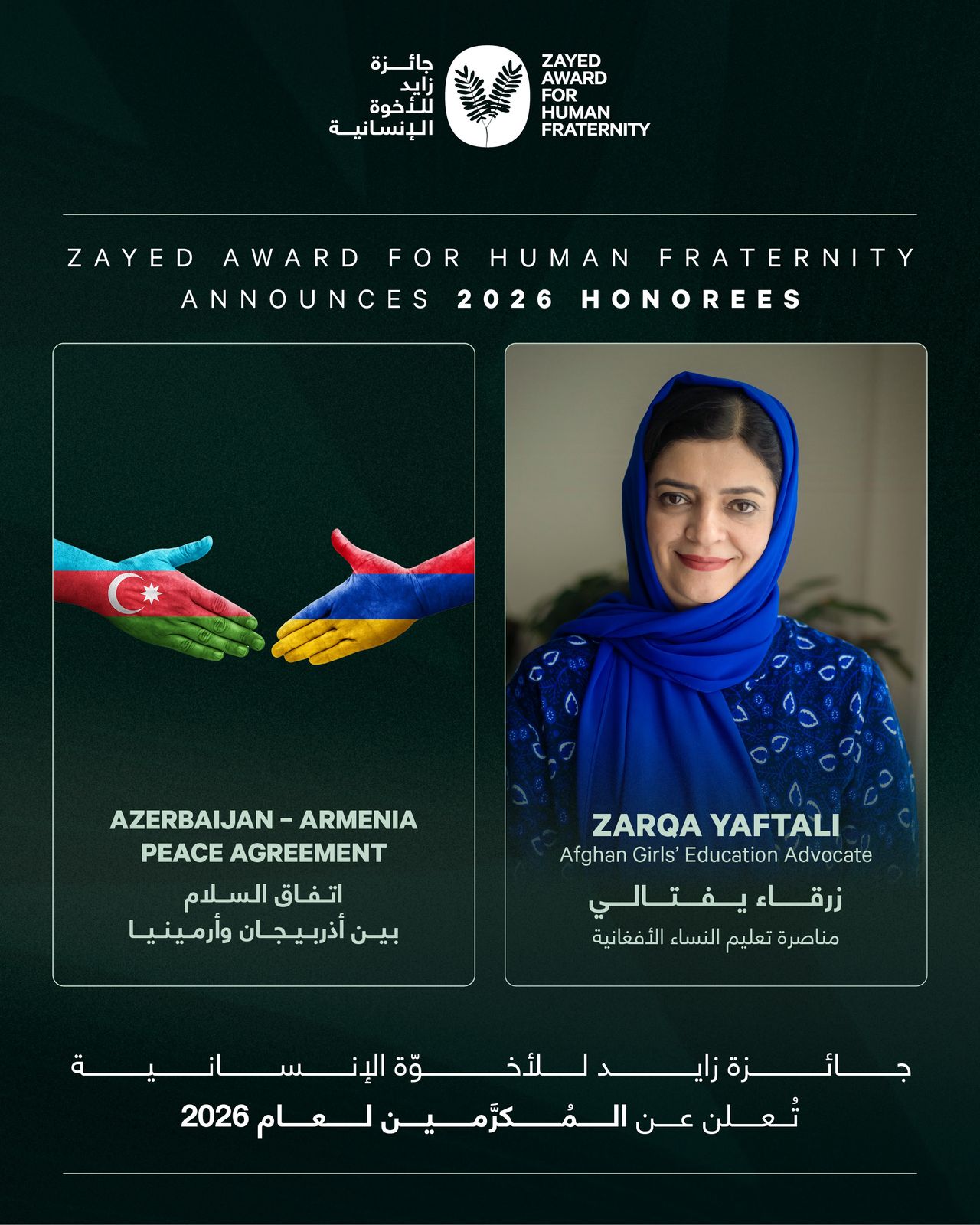
Armenia–Azerbaijan peace agreement
Afghan girls’ education advocate Zarqa Yaftali
Abu Dhabi, United Arab Emirates / January 19, 2026—The Zayed Award for Human Fraternity announced today the honorees of the prize’s 2026 edition: the historic peace agreement between the Republic of Armenia and the Republic of Azerbaijan, and Afghan girls’ education advocate Zarqa Yaftali – marking the first award recipients from the Caucasus and Afghanistan, respectively.
A landmark decision guided by visionary leadership toward ending decades of conflict and humanitarian suffering in the Caucasus, the Agreement on Establishment of Peace and Inter-State Relations between the Republic of Armenia and the Republic of Azerbaijan is being honored as a process of peace, dialogue, normalization, and conflict resolution undertaken by the two states, which underscores that reconciliation is not a single act, but a sustained journey.
A woman of courage with a lifelong dedication to protecting the right to education for women and children, Ms. Zarqa Yaftali is being honored for providing educational resources, psychosocial support, and community-based services to over 100,000 people in Afghanistan and beyond – providing hope and knowledge to girls living in restrictive environments.
H.E. Nikol Pashinyan, Prime Minister of the Republic of Armenia, called the award a “great honor” in recognition of the efforts undertaken to help establish peace in the Caucasus region, and a sincere acknowledgement of everyone who contributed to bringing this historic agreement to fruition.
H.E. Pashinyan expressed confidence that this recognition will have a tangible impact both within Armenia and beyond, and will contribute to strengthening trust between Armenia and Azerbaijan, emphasizing that this historic shared moment of recognition is of great significance and will support the path to peace.
He stressed that this achievement is not the result of an individual effort, but rather the outcome of collective work involving many inside and outside Armenia, adding that the essence of this achievement is due, first and foremost, to Armenia’s political team, government, parliament, and the society that supports the peace agreement. “That we [Armenia and Azerbaijan] are sharing this award reflects a mutual and collective achievement,” H.E. Pashinyan added.
H.E. Ilham Aliyev, President of the Republic of Azerbaijan, expressed his appreciation for the Zayed Award for Human Fraternity’s recognition of the peace agreement and extended his gratitude to the 2026 award judging committee for honoring efforts to establish peace in the South Caucasus region and the world.
H.E. Aliyev noted that the recognition holds special significance as the award bears the name of the late Sheikh Zayed bin Sultan Al Nahyan, founder of the United Arab Emirates, in addition to the support of His Holiness Pope Leo XIV, head of the Catholic Church, and His Eminence Ahmed Al-Tayeb, Grand Imam of Al-Azhar, making the recognition by this global award a “double honor.”
For her part, Zarqa Yaftali said she felt “deeply excited and overwhelmed with emotion,” expressing sincere gratitude to the Zayed Award for Human Fraternity judging committee.
Ms. Yaftali said that being selected as a 2026 honoree represents “a powerful and meaningful message” for women in Afghanistan, bringing hope and encouragement to many Afghan women—especially students in online schools and young women enrolled in peace, security, and leadership courses.
The 2026 honorees were selected by an independent global judging committee composed of distinguished figures and experts in dialogue and coexistence, namely: former President of the European Council and former Prime Minister of Belgium His Excellency Charles Michel, former Chairperson of the African Union Commission and former Prime Minister of Chad His Excellency Moussa Faki Mahamat, UNICEF Executive Director Catherine Russell, Head of the Administration of the President of the Republic of Uzbekistan Her Excellency Saida Mirziyoyeva, Prefect of the Dicastery for Culture and Education at the Holy See His Eminence Cardinal José Tolentino de Mendonça, and Secretary-General of the Zayed Award for Human Fraternity His Excellency Judge Mohamed Abdelsalam.
H.E. Judge Mohamed Abdelsalam, judging committee member and Secretary-General of the Zayed Award for Human Fraternity, said: “This year, the Zayed Award for Human Fraternity committee selected the historic peace agreement between Armenia and Azerbaijan, which embody the award’s mission and objectives in promoting and fostering a culture of dialogue and coexistence, marking a pivotal milestone in advancing global peace and a major diplomatic achievement – turning the page on nearly four decades of tension and conflict in the Caucasus and laying a strong foundation for a safer, shared future for both peoples.”
For her part, UNICEF Executive Director Catherine Russell said: “The committee was honored to recognize Ms. Zarqa Yaftali for her tireless efforts and leadership to protecting Afghan girls’ right to education and advancing women’s empowerment, despite facing tremendous challenges.”
H.E. Saida Mirziyoyeva affirmed that the announcement of the 2026 honorees embodies a global moral commitment to the principles of peace and human dignity. She emphasized that this recognition conveys a renewed message of hope to the international community and reaffirms the capacity of human fraternity to foster meaningful and enduring change.
The 2026 recipients will be honored on February 4, 2026 – coinciding with UN-recognized International Day of Human Fraternity – at the annual award ceremony, to be held at the Founder’s Memorial in Abu Dhabi, United Arab Emirates, at 7 p.m. UAE time. The ceremony will be livestreamed on the award’s social media channels: Zayed Award for Human Fraternity – YouTube
Inspired by the signing of the Document on Human Fraternity by the late His Holiness Pope Francis, 266th head of the Catholic Church, and His Eminence Ahmed Al-Tayeb, Grand Imam of Al-Azhar, in Abu Dhabi in 2019 and the humanitarian legacy of the late Sheikh Zayed bin Sultan Al Nahyan, founder of the United Arab Emirates, the Zayed Award for Human Fraternity recognizes individuals and organizations for outstanding contributions to building a more peaceful, harmonious, and compassionate world based on the values of human fraternity.
Since 2019, the award has honored 19 recipients from 19 countries: His Holiness Pope Francis (honorary recipient); Grand Imam of Al-Azhar Ahmed Al-Tayeb (honorary recipient); UN Secretary-General António Guterres; French-Moroccan activist against extremism Latifa Ibn Ziaten; Their Majesties King Abdullah II bin Al Hussein and Queen Rania Al Abdullah of the Hashemite Kingdom of Jordan; Haitian humanitarian organization the Foundation for Knowledge and Liberty (FOKAL); Italian organization the Community of Sant’Egidio; Kenyan peacebuilder Shamsa Abubakar Fadhil; Indonesian charitable organizations Nahdlatul Ulama and Muhammadiyah; Egyptian world-renowned cardiac surgeon Professor Sir Magdi Yacoub; Chilean NGO founder Sister Nelly León Correa; Prime Minister of Barbados the Honorable Mia Amor Mottley; American food relief organization World Central Kitchen; and Ethiopian-American teenage health innovator Heman Bekele.
UAE
Emirati Women’s Day: Hamda Al Mansoori takes UAE-grown ventures from AI and manufacturing to cross-border partnerships
From AI agents and smart manufacturing to investment opportunities in Syria and partnerships with Chinese companies, the Emirati entrepreneur is building businesses designed to scale beyond the UAE.
As the UAE marks Emirati Women’s Day, a new generation of Emirati women is emerging not only as leaders within established industries, but as founders, investors and technology builders creating businesses with ambitions far beyond the country’s borders.
Among them is Hamda Al Mansoori, an Emirati entrepreneur whose business interests span a notably diverse range of sectors — from manufacturing and jewellery to artificial intelligence, digital transformation, investment, consulting and business development.
Through ventures including The Black Box Group, Z2A Group Holding and Outworks, Al Mansoori is building an ecosystem that brings together industry, technology and investment, with the UAE serving as its base for regional and international expansion.
Where manufacturing meets technology
Through The Black Box Group, Al Mansoori has pursued a business model that increasingly blurs the line between traditional industries and emerging technologies.
The group’s activities span manufacturing and jewellery as well as business development, branding, digital solutions, enterprise resource planning systems, AI-powered business automation, logistics and expansion strategies.
Technology has also made its way onto the manufacturing floor.
Artificial intelligence is being incorporated into jewellery production processes to help monitor different stages of manufacturing, analyse operations, identify potential issues and track material loss — with the broader objective of improving efficiency and product quality.
The scale of the ambition became more visible during the group’s participation in Make it in the Emirates 2026, where it announced a pipeline of projects and opportunities worth more than $10 million.
The figure points to a broader strategy: building UAE-based businesses that can develop locally while being structured for expansion into international markets.
Betting on the next generation of AI
Alongside manufacturing, Al Mansoori has moved into one of the fastest-evolving areas of the global technology industry: AI agents.
Through Outworks, the focus is on enterprise artificial intelligence and developing solutions that can take AI beyond answering questions or assisting employees.
AI agents are designed to carry out defined tasks and workflows within organisations, interact with systems and enterprise knowledge, and support operations under established permissions and controls.
For governments, financial institutions and large corporations, however, the race to adopt AI is increasingly about more than capability.
Data sovereignty, cybersecurity, governance and human oversight are becoming central to how organisations decide where and how artificial intelligence can be deployed.
It is an area in which UAE technology companies have an opportunity to compete: not simply by adopting global AI products, but by developing enterprise solutions from the Emirates that address the specific requirements of governments and businesses in the region and potentially beyond.
Looking beyond the UAE
Al Mansoori’s interests extend beyond technology.
Through Z2A Group Holding, her activities include investment strategy, business development and exploring opportunities in regional and international markets.
One of the markets under consideration is Syria, where the group participated as part of a UAE delegation visiting Damascus for economic meetings and discussions around potential investment opportunities.
Areas being explored include industry, tourism and economic development, with an emphasis on identifying opportunities for longer-term projects and partnerships.
The approach reflects a wider investment philosophy that looks beyond capital alone, combining investment, technology, business expertise, project development and knowledge transfer.
For UAE companies looking outward, such markets can represent an opportunity not merely to invest, but to participate in developing businesses and sectors at an earlier stage of growth.
Building bridges with China
At the same time, Al Mansoori’s businesses are expanding their international network through cooperation and partnerships with companies outside the region, including Chinese firms across areas related to technology, manufacturing and business development.
China’s position in advanced manufacturing, technology and global supply chains makes such relationships increasingly relevant for UAE businesses seeking international expertise and scalable industrial capabilities.
The opportunity lies in connecting those capabilities with the UAE’s strengths as a business, investment and technology hub — potentially creating projects that combine international technology and expertise with businesses developed and managed from the Emirates.
It is a model that reflects the increasingly international character of UAE entrepreneurship: build from the UAE, partner globally and expand into new markets.
The UAE remains the launchpad
Despite the diversity of sectors and geographies, the UAE remains at the centre of Al Mansoori’s business strategy.
The country’s investments in artificial intelligence, advanced manufacturing and the digital economy, coupled with its push to attract global businesses and capital, have created an environment in which local entrepreneurs can think beyond the domestic market from the outset.
Al Mansoori’s portfolio reflects that shift.
Rather than building her career around a single industry, her ventures bring together manufacturing, AI, technology, investment, consulting and international partnerships.
The common thread is the attempt to create businesses that can originate in the UAE while competing and expanding internationally.
Emirati Women’s Day: From empowerment to creating opportunities
Al Mansoori’s story takes on particular relevance as the country celebrates Emirati Women’s Day.
The conversation around women’s empowerment in the UAE is increasingly moving beyond representation and leadership positions.
Emirati women are today founding companies, developing technology, directing investment, entering new markets and negotiating international partnerships.
From manufacturing operations incorporating artificial intelligence to enterprise AI agents, and from exploring investment opportunities in Syria to developing relationships with Chinese and international businesses, Al Mansoori’s journey reflects the increasingly global outlook of a new generation of Emirati entrepreneurs.
And perhaps that is one of the more significant stories to emerge this Emirati Women’s Day: Emirati women are no longer only taking their place in the industries of the future — they are increasingly helping to build them, from the UAE to the world.
UAE
When will summer end in the UAE?
The UAE’s astronomical summer will come to an end on September 23, when the autumnal equinox marks the official start of autumn, although meteorologists classify September as the first month of the autumn season, according to Ibrahim Al Jarwan, Chairman of the Emirates Astronomical Society and a member of the Arab Union for Astronomy and Space Sciences.
Al Jarwan said the country’s hottest period, known in Arabic as Al Qayz, begins to ease in the final third of August with the rising of the star Suhail, long regarded across the region as a traditional sign of gradually cooler weather.
He explained that while temperatures remain high through September, the Indian seasonal low-pressure system weakens progressively during the month.
The UAE continues to be influenced by thermal low-pressure systems extending from central Arabia, bringing active winds that can raise dust and reduce visibility.
At the same time, conditions remain favourable for the formation of convective clouds, particularly over the eastern mountains, with thunderstorms and rainfall occasionally extending into inland parts of the country.
September also sees a seasonal shift in wind patterns, with south-easterly winds prevailing overnight and during the morning before giving way to north-westerly sea breezes in the afternoon and evening.
Humidity gradually increases compared with August, particularly during the second half of the month, creating more favourable conditions for fog and mist to develop in scattered areas across the UAE.
Al Jarwan noted that astronomical summer began with the summer solstice on June 21 and lasts for three months until the autumnal equinox on September 23. During the first half of summer, temperatures typically range between 41°C and 43°Cduring the day but can exceed 50°C in some areas during heatwaves.
In the latter half of the season, from August 11 onwards, higher humidity combines with persistent heat and the seasonal Kous winds to support the formation of towering thunderclouds over the Hajar Mountains, producing the localised summer thunderstorms known as Al Rawayeh.
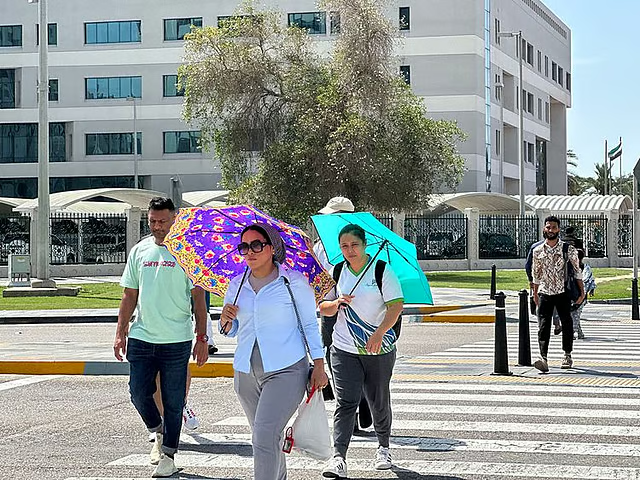
With much of the summer still ahead, residents are continuing to adapt their routines to the season’s intense heat by shifting outdoor activities to the early morning and evening hours, while increasingly turning to air-conditioned leisure and fitness venues during the day.
Dubai Mallathon, running from 15 June to 15 September, has become one of the city’s flagship summer initiatives, allowing residents to walk and run along designated indoor routes across participating shopping malls during the cooler morning hours. The programme is designed to encourage physical activity throughout the summer despite the high temperatures.
Beyond organised fitness events, shopping malls, indoor attractions, museums, aquariums, family entertainment centres and beaches during the cooler hours remain among the most popular destinations for residents and visitors. As temperatures gradually begin to ease towards late August, outdoor parks, mountain areas in the east of the country and desert destinations are also expected to see increasing numbers of visitors.
GN
UAE
UAE suspends new visas for 3 countries over Ebola
The UAE has announced a series of additional precautionary measures affecting travellers arriving from three African countries as part of efforts to strengthen national preparedness against potential Ebola virus outbreaks.
The measures, jointly announced by the National Emergency Crisis and Disasters Management Authority (NCEMA) and the Federal Authority for Identity, Citizenship, Customs and Port Security (ICP), apply to arrivals from the Democratic Republic of the Congo, Uganda and South Sudan.
Authorities said the decision is part of the country’s preventive and proactive strategy to address developments related to the Ebola virus and safeguard public health.
Under the new measures, all new visas for nationals of the three countries, including visit visas, will be suspended.
Entry into the UAE will also be restricted for travellers arriving from the affected countries, including those who transit through other destinations before reaching the Emirates.
Travellers who have spent more than 21 consecutive days outside the listed countries prior to their arrival in the UAE will be exempt from the restrictions and permitted entry, according to the authorities.
The measures are scheduled to take effect at 1 p.m. on Saturday, 6 June 2026, and may be extended depending on developments in the global health situation.
Despite the restrictions, cargo operations between the UAE and the three countries will continue without interruption. Transit flights will also remain operational, ensuring the continued movement of goods and international air traffic.
The announcement comes as governments around the world continue to monitor Ebola-related developments in parts of Africa.
The disease, which causes severe viral haemorrhagic fever, has prompted heightened surveillance and preparedness measures in several countries whenever outbreaks emerge.
NCEMA and ICP said they would continue to closely monitor global health developments in coordination with local and international partners.
Authorities will assess any potential implications for other countries and implement further measures when necessary, based on approved health standards and risk assessments.
GN


Emirates Specialty Hospital Expands Cancer Care Services in Dubai with Opening of Dedicated Chemotherapy Unit

When Rheumatoid Arthritis Threatened Her Independence: How the Right Diagnosis Helped Her Get Her Life Back

Saudi German Hospital Dubai Launches Mental Health and Wellness Center for Children and Adolescents

Araghchi, Oman Sultan discuss transit, stability in Muscat

UAE’s café culture keeps growing despite price pressure

Netflix to Livestream BTS Comeback Concert
-
 politics6 months ago
Araghchi, Oman Sultan discuss transit, stability in Muscat
-
 UAE10 months ago
UAE’s café culture keeps growing despite price pressure
-
 Entertainment9 months ago
Netflix to Livestream BTS Comeback Concert
-
 Discover9 months ago
Is February 2026 really a once-in -283-years MiracleIn?
-

 Football10 months ago
Algeria, Burkina Faso, Côte d’Ivoire win AFCON 2025 openers
-

 Health10 months ago
NMC Royal Hospital, Khalifa City, performs rare wrist salvage, restoring function for young patient
-
 Health10 months ago
Bascom Palmer Eye Institute Abu Dhabi and Emirates Society of Ophthalmology Sign Strategic Partnership Agreement
-

 Health11 months ago
Emirates Society of Colorectal Surgery Concludes the 3rd International Congress Under the Leadership of Dr. Sara Al Bastaki