
Sports
The World Cup’s best shirts are already 30 years old
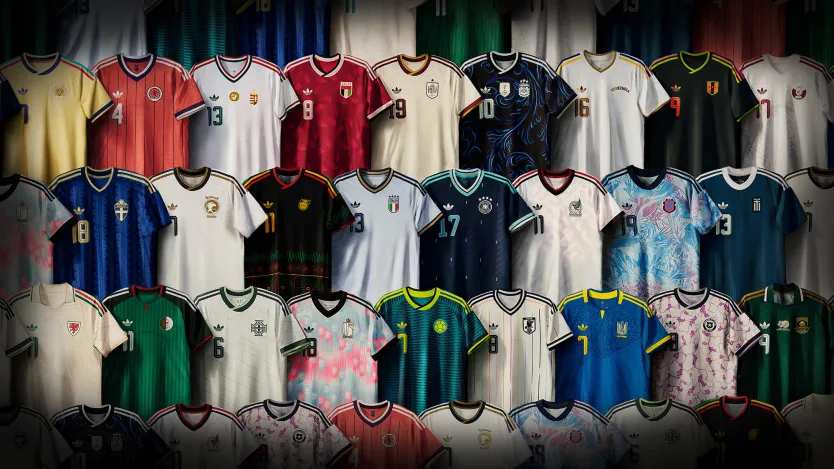
Over the next few days, something unusual will be happening across Spanish soccer. Nearly 40 men’s professional clubs in La Liga’s top two divisions will take to the field wearing retro-looking uniforms inspired by their respective histories. The kits were first unveiled at Madrid Fashion Week and are part of a campaign celebrating the country’s love for the sport. It is a fitting prelude.
Ten weeks later, the largest World Cup in history will be held across the US, Canada and Mexico — 48 teams, 104 matches, the most expansive commercial stage the sport has ever assembled. And many players will be wearing nostalgia-laden gear: Adidas recently unveiled new away kits embracing a “90s aesthetic” but designed in a “modern, contemporary way.” They will also bear the brand’s famous trefoil motif — for the first time in more than three decades.
The past is no longer just being collected, but worn, remade and reimagined.
The shirts that changed everything
To understand how soccer arrived here, you have to go further back than expected. “Proper fan replica shirts weren’t widely available until the 1970s,” said Alex Ireland, author of “Pretty Poly: The History of the Football Shirt.” “It was really only in the nineties where they became more broadly acceptable to go to the pub in.
Umbro’s England away shirt for Euro 96 arguably led the shift from uniform to everyday wear. The two-tone blue striped shirt was designed to pair with jeans — an early acknowledgement that the its life extended beyond the pitch. Technology did the rest. Advances in fabric printing allowed designers to embed complex graphics directly onto material, turning shirts into moving canvases. The result was the most visually inventive decade in the sport’s sartorial history.
“Everyone remembers their first World Cup,” said Sam Handy, General Manager of Football at Adidas. “Those kits get embedded in your memory structures — this is what football looks like.”
Mine was Italia 90 and the West Germany home shirt (pictured at the top) — black, red and gold geometric abstraction across the chest — what remains the holy grail among collectors. Norwegian collector Even Nesset describes something close to involuntary recall: “That shirt gives me a kind of false memory of 1990 — from seeing it, from watching YouTube clips of it being worn on the pitch.” England’s third shirt from the same year — sky blue with distinct geometric patterns, and inseparable from New Order’s hit song “World in Motion” — is listed on Cult Kits’ for $480.
While England didn’t wear the shirt on the pitch itself, its fan favorite status and the team’s semi-final run and subsequent penalty shootout defeat to West Germany, who would go on to win the World Cup, helped ensured its legacy, alongside the more classic white home shirt.
“When a brand takes risks in design and embeds it with a decent run for the team, you have a chance of creating something very visually sticky,” said Handy. Nesset distills it further, classifying “the crazy shirts, bold enough to seem wrong at first (USA 1994, Jamaica 1998, Mexico 1998), and the beautiful shirts, quietly perfect (Colombia 1990, Italy 1994).”
Those shirts spent decades in the margins — traded through flea markets and early eBay. Then, over the past two decades, something structural happened. Dedicated platforms — Classic Football Shirts, Cult Kits, Vintage Football Shirts, Saturdays Football and others — transformed an informal network into a scaled, trusted, global market. Founded by fans who couldn’t find the shirts they wanted, they built what they needed, evolving passion projects into lucrative businesses.
David Jones, co-founder of Cult Kits, describes a buyer base that has transformed. “Seventy percent buy for nostalgia — the players you pretended to be growing up. The rest have discovered soccer kits in a fashion sense.”
But this movement runs deeper than celebrity adoption. Psychologist Clay Routledge calls it “historical nostalgia” — a documented longing for eras you never inhabited. His research found 68% of Gen Z adults experience it, and far from being regressive, he argues it is future-oriented: a way of resolving present dissatisfaction by reaching toward something that feels more real. Football shirts are not alone in this. “It’s the same reason we see 100 different Marvel films,” Ireland explained, “you’ve got instant buy-in, a connection that means you don’t need to figure out if you like it. From rebooted franchises, fashion houses mining their archives and generation alpha raised on blended noughties pop, the same force is reshaping culture more broadly.
Cultural critic Simon Reynolds describes the broader condition as “Retromania” — we live in a state of atemporality where 1994 and 2026 exist on the same screen simultaneously. The World Cup crystallizes this. Each tournament is a sealed, re-watchable world — a month of soccer frozen in time. A generation that wasn’t alive for France 98 can spend a weekend inside it on YouTube, emerging with genuine emotional attachments to objects they never encountered in real time.
The summer everything arrives at once
“This is a defining era of soccer culture,” said Handy, “and the jersey is perhaps its clearest expression.” The trefoil — last seen on a World Cup shirt in 1990 — has recently appeared on special edition shirts and now, 25 World Cup competition kits.“We’re just trying to do it all — the past and the future — and letting it all exist at the same time,” Handy added.
Mat Davis, founder of Saturdays Football, has watched the arc from the inside. As the vintage market for men’s soccer jerseys commoditized beneath him — “you search by price, not ‘wow, that’s a unique shirt’” — he pivoted toward original product and, most recently, a partnership with Adidas, embroidering mini versions of the newly released away shirts onto Saturdays Football’s signature caps. Amplification for him, authenticity for Adidas.
Nowhere is that more resonant than with the then-divisive, now cult-classic Adidas-designed US men’s national team’s (USMNT) 94 away shirt. That shirt — a washed-denim effect with diagonally placed white stars — was reportedly met with silence when Adidas first unveiled it to the squad, followed by nervous laughter. Retailers were equally unsure, yet all 50,000 replica kits produced were sold. The bold design would eventually stand the test of time, partly because the team surprised many by reaching the round of 16, wearing the jersey during some of their biggest tournament moments. More than three decades later, the brand has recentlyreleased a lifestyle collection of jerseys, jackets, shorts, hats and even a pair of Samba trainers basedon the memorable design. Nike, who have dressed the team since 1995, designed its 2026 kits in close collaboration with players. They will be worn by all 27 US Soccer teams — men’s, women’s and youth — unifying players under one cohesive, visual identity for the first time. In some ways, the curvy red and white stripes have a similarly bold, visual language to those scattered stars of the Adidas 1994 shirt.
Rather than legacy, Handy says design becomes aninfinite loop: iconic styles becoming part of the visual canon, to be drawn from in perpetuity.
This summer, that loop closes on home soil. Major League Soccer, founded in 1993 as part of the US’ bid to host its first World Cup the following year, has helped the sport reportedly overtake baseball as America’s third favorite sport, according to a survey by The Economist. The World Cup returns not to a country where professional soccer is a novelty, but to one that has quietly, irreversibly, made the game its own.
USMNT midfielder Tyler Adams put the stakes plainly: “I want to have that kit you look back at in 30 years and you’re like, that’s still the best one.” This summer, someone in the crowd will be wearing a vintage jersey from 1994 or a reissue, while others will be wearing updated ones designed to be coveted decades later.
Inside the collar of Belgium’s Adidas away shirt, a hidden line of text aptly reads: “Ceci n’est pas un maillot.” This is not a jersey. Well, not just a jersey anymore.
CNN
Sports
UAE Cycling Federation and AB Investment Sign Partnership to Support National Teams and Emerging Talent
Agreement reflects the UAE’s commitment to supporting sport and advancing cycling development
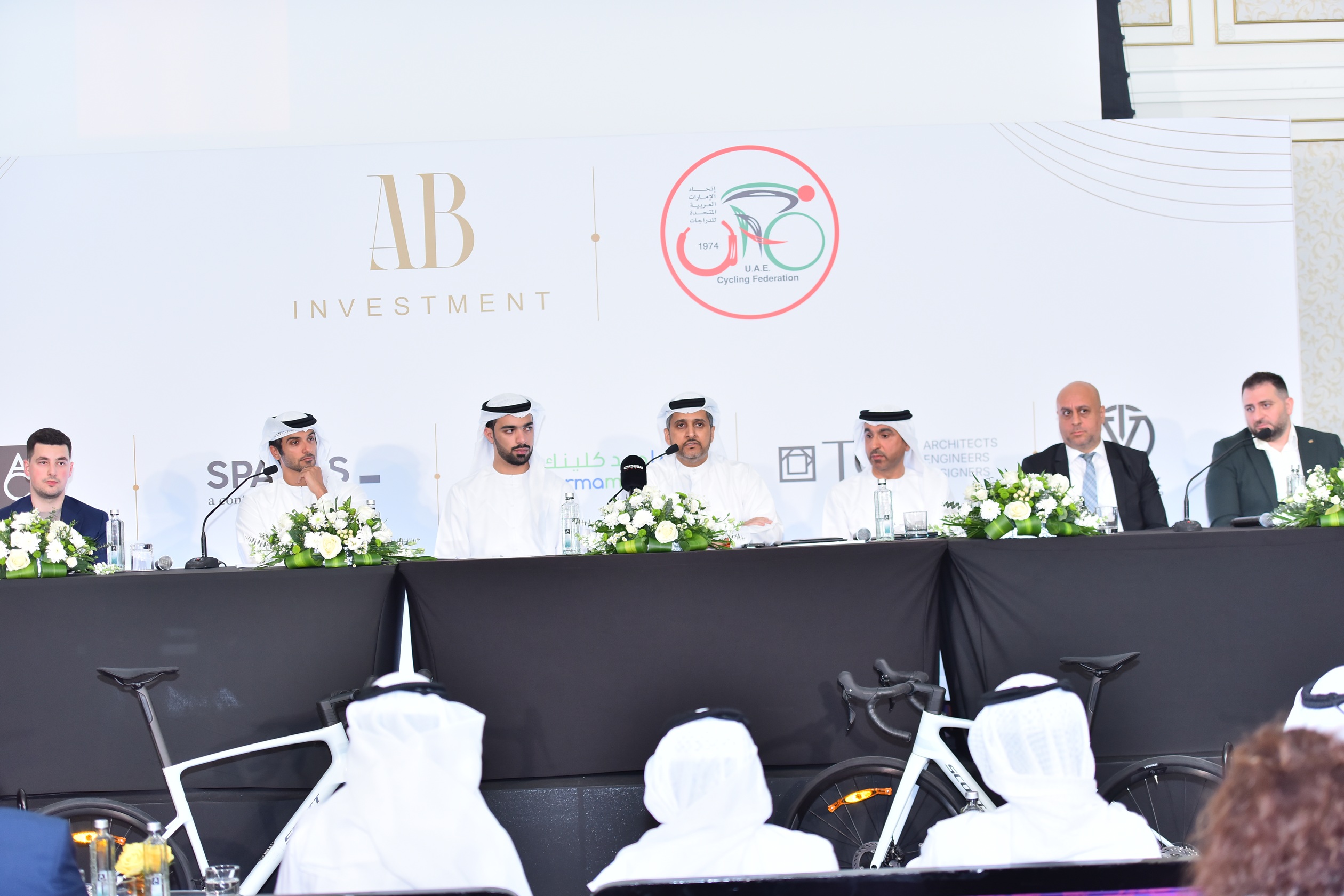
Dubai, 1 September 2026: The UAE Cycling Federation and AB Investment have signed a strategic partnership and sponsorship agreement aimed at supporting national teams and clubs, developing athletes’ capabilities, and nurturing emerging Emirati talent to further strengthen the UAE’s presence in cycling competitions at local, regional, and international levels.
The agreement reflects the importance placed by the UAE and its wise leadership on sport and the continued support provided to national federations and teams. It also recognises the role of sport in developing individuals, empowering young people, and promoting the values of discipline, determination, teamwork, and national pride.
The agreement was announced during a press conference held at Palazzo Versace Dubai in the presence of H.E. Eng. Mansoor Juma Bu Osaiba, Chairman of the UAE Cycling Federation; Dr Butti Al Marri, Founder and Chairman of AB Investment; and Mohammed Butti Al Marri, Vice Chairman of AB Group.
The event was also attended by members of the Federation’s Board of Directors, representatives of cycling clubs, athletes, supporting organisations, partners, and members of the media.
The agreement was signed by H.E. Eng. Mansoor Juma Bu Osaiba and Mohammed Butti Al Marri, marking the beginning of a new phase of cooperation to support the Federation’s programmes and plans.
Bu Osaiba said the agreement represents an important addition to the Federation’s efforts to develop cycling, support national teams and clubs, and provide an environment that enables Emirati athletes to improve their capabilities and compete across various championships.
He added that the progress achieved by UAE cycling in international rankings, together with its results in overseas competitions, reflects the significant support provided to sport in the country and the continuous efforts of national teams, clubs, athletes, coaches, and administrators.
He said the partnership with AB Investment would support the Federation’s plans to expand participation in cycling, identify promising talent, and strengthen national team development programmes, enhancing the competitiveness of Emirati athletes and their ability to achieve further success.
Dr Butti Al Marri said the partnership stems from AB Investment’s belief in investing in people, supporting young talent, and contributing to the continued development of sport in the UAE.
He said the UAE has established a leading model for supporting athletes and providing them with the resources and opportunities required to succeed, noting that supporting national teams and clubs helps build generations capable of representing the country with distinction.
Dr Al Marri added that the partnership aims to support the Federation’s future plans and assist Emirati cyclists in achieving further success, strengthening the UAE’s position on the regional and international sporting stage.
Mohammed Butti Al Marri said the agreement reflects AB Group’s commitment to supporting sporting and community initiatives, as well as its belief in the role of sport in developing future generations and promoting ambition, excellence, and national pride.
He added that the Group looks forward to a long-term collaboration with the UAE Cycling Federation to support national teams and clubs, empower emerging talent, and help athletes transform their ambitions into tangible achievements.
During the event, Dr Butti Al Marri was named Honorary President of the UAE Cycling Federation in recognition of his support for the Federation and its future plans. Dr Anwar Al Hammadi was also granted honorary membership of the Federation in recognition of his contributions and support for sporting initiatives.
Dr Al Marri expressed his appreciation for the honorary appointment and reaffirmed his commitment to working with the Federation’s Board and its partners to support the continued development of cycling in the UAE.
The conference included a presentation highlighting the UAE Cycling Federation’s journey, key milestones, and achievements, as well as the progress made by national teams in strengthening the UAE’s presence in regional and international cycling.
Memoranda of Understanding were also signed with several supporting organisations, including Dermamed Clinic, represented by its Founder and Consultant Dermatologist, Dr Anwar Al Hammadi; VT & K Consultancy, represented by its Founder and Chairman, Vagif Tariverdiyev; Aqua Carpatica UAE, represented by Dr Hassan Mokdad; The Mister Holding Group, represented by its Founder and Chairman, Mohammed Al Maqoudi; and The Top Group, represented by its Co-Founder and CEO, Ragheed Al Tahan.
Representatives of the supporting organisations emphasised the importance of coordinated efforts to advance UAE sport, create further opportunities for athletes, and support initiatives and programmes that contribute to the continued development and success of cycling.
The press conference concluded with a media question-and-answer session addressing the partnership’s objectives, future plans, and role in supporting national teams, clubs, and emerging cycling talent.
Sports
Harry Kane breaks Ronaldo’s record
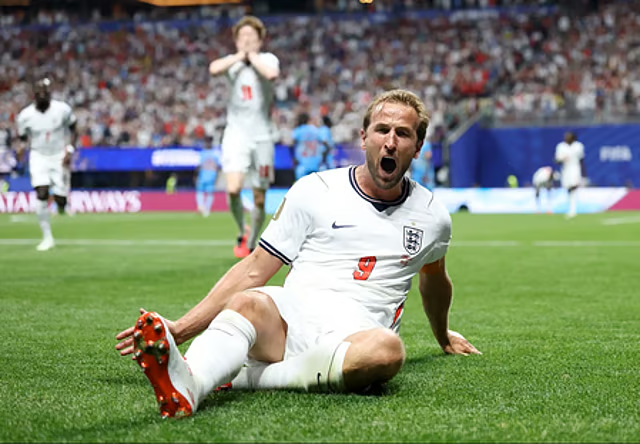
Harry Kane produced another captain’s performance as England came from a goal down to beat DR Congo and book their place in the Round of 16 of the 2026 FIFA World Cup.
After falling behind, Thomas Tuchel’s side responded through their skipper, who struck twice to complete the turnaround.
Kane’s first goal came from a superb Anthony Gordon cross, with the England captain powering a header into the net. His second was even better. Gordon, who had replaced Marcus Rashford in the second half, slipped a pass into Kane’s path, and the striker unleashed a thunderous first time strike that gave the goalkeeper no chance.
The brace took Kane to 12 goals in FIFA World Cup finals, further cementing his place among the tournament’s greatest goalscorers.
It also marked another remarkable milestone in what has become one of the greatest individual goalscoring seasons in football history.
Kane has now scored 72 goals for club and country during the 2025 and 26 season, overtaking Cristiano Ronaldo’s best ever goalscoring campaign.
Only Lionel Messi has ever produced a better goalscoring season among football’s modern greats.
The highest scoring campaigns are now:
- Lionel Messi (2011 and 12): 82 goals in 69 games
- Harry Kane (2025 and 26): 72 goals in 62 games
- Lionel Messi (2012 and 13): 69 goals in 62 games
- Cristiano Ronaldo (2011 and 12): 69 goals in 69 games
England will now face Mexico in the Round of 16 as they continue their quest for World Cup glory. With Kane in the form of his life and rewriting the record books almost every game, the Three Lions will be confident of going even deeper into the tournament.
GN
Sports
Can Morocco win the World Cup?
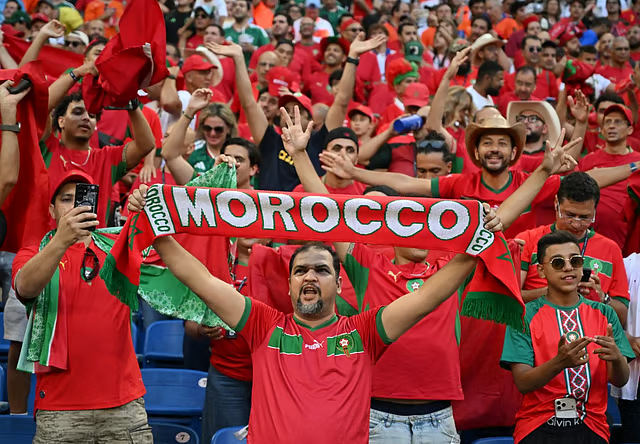
Just past midnight in Monterrey, Achraf Hakimi had already missed his penalty, and Morocco’s World Cup looked like it might be sliding into another so-near-yet-so-far story. Then goalkeeper Yassine Bounou flung himself to his right, Crysencio Summerville’s spot-kick was gone, and Ismael Saibari stepped up to thump in the winner.
Morocco had beaten the Netherlands on penalties. Another major European side undone from 12 yards, and across Africa and the Arab world, the same question grew louder. Can Morocco actually win the World Cup?
It is not a fanciful question anymore. No African nation has ever won the tournament, and before Morocco’s run in 2022 none had even reached the semi-finals. Yet here they are again, deep into the knockouts and refusing to play the underdog.
A shootout to remember
A quick note on the format, because 2026 is different. This is the first World Cup with 48 teams rather than 32, which adds an extra knockout round, the last 32, before the competition reaches its more familiar stages.
After finishing second in Group C behind Brazil, drawing with the Brazilians and beating Scotland and Haiti, Morocco met the Netherlands in that last-32 tie. It looked to be slipping away when Cody Gakpo put the Dutch ahead on 72 minutes. It was an emotional goal for Gakpo, who had taken to the pitch just days after he and his partner shared the news that they had lost their unborn son.
Morocco refused to fold. In the first minute of stoppage time, defender Issa Diop climbed highest to glance in an equaliser and drag the tie to extra time. Soufiane Rahimi nearly settled it there and then, only for Netherlands goalkeeper Bart Verbruggen to produce a stunning save at point-blank range.
So it went to penalties, and penalties have quietly become Morocco’s speciality. They even missed two of their own, Neil El Aynaoui clipping the bar and Hakimi failing to convert, but Bounou’s save from Summerville handed Saibari the chance to win it. He took it, 3-2. The whole thing echoed Qatar four years ago, when Morocco knocked out Spain in exactly the same nerveless fashion, with Bounou the hero then too.
How they finished fourth in Qatar
To understand why belief runs so high, you have to go back to 2022. That run remains the proudest chapter in African and Arab football history.
Under coach Walid Regragui, Morocco topped a tough group that included former finalists Croatia and a strong Belgium side. They drew 0-0 with Croatia, then beat Belgium 2-0 and Canada 2-1 to go through.
The knockouts turned them into a phenomenon. They beat Spain on penalties, then edged Cristiano Ronaldo’s Portugal 1-0 thanks to a towering Youssef En-Nesyri header, becoming the first African or Arab team ever to reach a World Cup semi-final. France, the defending champions, ended the dream 2-0, and Croatia won the third-place play-off 2-1. Morocco finished fourth, and back home the scenes did not look like those of a beaten team.
New coach, same belief
The twist this time is the man in charge. Regragui, the architect of the Qatar miracle, stepped down in March 2026. In his place came Mohamed Ouahbi, previously the head coach of Morocco’s under-23s and stepping into a senior role for the very first time.
The timing, just months before a World Cup, unsettled plenty of fans. The ambition, though, has not dimmed. “We have all the ingredients that we need to become the best nation,” Ouahbi told reporters after the Haiti win, pushing his players to believe in the title itself rather than settle for another respectable run.
It is the same drum Regragui banged in Qatar, when he asked simply, “Why shouldn’t we dream of winning the World Cup?”
The players carrying the dream
Every great run needs a talisman, and Morocco’s is Hakimi. The captain plays his club football for Paris Saint-Germain, with whom he won the Champions League last season, and he is widely rated among the best right-backs on the planet. “I think we are capable of doing it,” he told the talk show ABtalks before the Netherlands game, adding that an African winner would send the country “crazy with joy.”
He is far from alone. Brahim Díaz, a gifted playmaker at Real Madrid who switched his international allegiance from Spain to Morocco, supplies much of the creativity. Saibari, a midfielder in superb form, arrived at the tournament with three group-stage goals and then buried the winning penalty. And in Bounou, Morocco have the shootout specialist that opponents have learned to dread.
A deeper bench this time
Perhaps the most important difference from 2022 is what sits on the bench. Tournaments are long and gruelling, and squads win them as much as starting elevens do.
Where Regragui leaned on a settled core, Ouahbi can summon genuine game-changers. Against the Netherlands it was the substitutes who turned the tie. Rahimi almost won it in extra time, and Chemsdine Talbi coolly scored his penalty in the shootout. Younger midfielders such as Ayyoub Bouaddi and El Aynaoui give the team fresh legs in the closing stages, something Morocco simply did not have last time.
Hakimi puts the team spirit down to something less tactical. “We have fun, dance, laugh, play cards,” he said, describing a dressing room he calls one big family.
Next match
The reward for beating the Dutch is a last-16 meeting with co-hosts Canada in Houston on 4 July, with a place in the quarter-finals on the line. Facing one of the host nations means a partisan crowd and a little extra pressure, but it is a tie Morocco will fancy.
Beyond that, the tournament’s heavyweights start to appear. Nobody in the Moroccan camp seems remotely fazed. “We came here for a reason,” Ouahbi said. “We can play against anyone.”
After Spain, after the Netherlands, after a fourth-place finish that once looked like the ceiling, fans are now hoping history will be made.
GN


Emirates Specialty Hospital Expands Cancer Care Services in Dubai with Opening of Dedicated Chemotherapy Unit

When Rheumatoid Arthritis Threatened Her Independence: How the Right Diagnosis Helped Her Get Her Life Back

Saudi German Hospital Dubai Launches Mental Health and Wellness Center for Children and Adolescents

Araghchi, Oman Sultan discuss transit, stability in Muscat

UAE’s café culture keeps growing despite price pressure

Netflix to Livestream BTS Comeback Concert
-
 politics6 months ago
Araghchi, Oman Sultan discuss transit, stability in Muscat
-
 UAE10 months ago
UAE’s café culture keeps growing despite price pressure
-
 Entertainment9 months ago
Netflix to Livestream BTS Comeback Concert
-
 Discover9 months ago
Is February 2026 really a once-in -283-years MiracleIn?
-
 Football10 months ago
Algeria, Burkina Faso, Côte d’Ivoire win AFCON 2025 openers
-

 Health10 months ago
NMC Royal Hospital, Khalifa City, performs rare wrist salvage, restoring function for young patient
-
 Health10 months ago
Bascom Palmer Eye Institute Abu Dhabi and Emirates Society of Ophthalmology Sign Strategic Partnership Agreement
-

 Health11 months ago
Emirates Society of Colorectal Surgery Concludes the 3rd International Congress Under the Leadership of Dr. Sara Al Bastaki