Discover
The benefits of crying

Crying is often seen as a negative emotion. Indeed, some regard sobbing as a sign of weakness. But when we shed tears we can be happy, sad, angry, frustrated, and moved. In fact, there’s a whole lot more to having a good weep than meets the eye.
Why cry?
Crying can benefit both your body and your mind. But how, exactly?
Crying detoxifies the body
Tears can detoxify the body in a number of different ways. For example, reflex tears can flush away debris, like smoke, dust, and grit, from your eyes. And what about those annoying loose eyelashes?
Continuous tears
Continuous tears lubricate your eyes and help protect them from infection. They help maintain the function of tear ducts and keep eyes wet enough to be comfortable without overflowing.
Emotional tears
The effects of emotional tears are more beneficial than you might think. Tears shed as a result of an emotional reaction containing stress hormones like cortisol and other toxins. Unless flushed away, these toxins can wreak havoc on the body. Having a good cry therefore reduces overall stress levels.
Crying helps to self-soothe
According to many psychologists, crying may be one of your best mechanisms to self-soothe.
Crying as a form of emotional regulation
Self-soothing is considered to be a form of emotion regulation; it activates the parasympathetic nervous system (PNS), which in turn helps your body rest and digest.
Crying dulls pain
Having a good cry can help ease physical and emotional pain. When we cry for long periods, our bodies release oxytocin and endogenous opioids, otherwise known as endorphins.
A sense of well-being
Once these feel-good chemicals are released, your body may go into what’s best described as a numb stage. Oxytocin is a powerful hormone normally released when people snuggle up, have intimacy, or bond socially. It therefore gives you a sense of calm or well-being. In fact, its another example of how crying is a self-soothing action.
Crying improves mood
Research suggests that along with helping to ease pain, crying, specifically sobbing, may even improve your mood. In fact, indulging in a spot of weeping now and again is seen as a positive way of lifting one’s spirits. But how does this work?
Cool down
When you cry, you often take in several quick breaths of cool air. Breathing in cooler air can help regulate and even lower the temperature of your brain. The same thing can happen when you yawn. The bottom line is that a cool brain is more pleasurable to your body and mind than a warm brain. Indulging in a sobbing session now and again can therefore boost your mood.
Crying rallies support
Crying is triggered by a range of feelings—from empathy and surprise, to anger and grief. Whatever the reason, opening up the flood gates is a way to let those around you know you are in need of support. This is known as an interpersonal benefit.
Interpersonal benefit
Crying is what’s known as attachment behavior. One only has to hear a baby cry to realize it’s in need of some tender loving care. Likewise, adults cry to obtain comfort and care from others. But this only works if you have a strong social support network to fall back on when the chips are down.
Crying helps you recover from grief
It’s never easy getting your heart and head around the death of a loved one, and crying is often an important part of the grieving process.
The grieving process
The grieving process can be protracted, and involves periods of sorrow, numbness, guilt, and anger. Everyone deals with loss in their own way. Crying can help you process and accept bereavement, and works the same way as shedding tears to dull pain and improve mood.
Cry to restore emotional balance
We all cry for different reasons. It could be in response to something sad, or even funny. Tears can also flow in times of stress, or as a result of being scared or threatened. But what induces the need to cry in situations like these?
A way to recover
It’s all about restoring emotional balance. Crying is sometimes necessary in order to reestablish physical and mental equilibrium. For example, when you’re incredibly happy or frightened about something and cry, it may be your body’s way to recover from experiencing such a strong and overwhelming emotion.
Crying helps a baby breathe
Babies cry. We all know that. But do you know why an infant’s first cry out of the womb is a very important one?
A cry baby is a healthy baby
The first cry of a baby is something that signifies its entry into the world. More importantly, it indicates that a baby is breathing on its own and that its lungs have immediately adapted to life outside the womb.
Crying also helps a baby sleep
Crying may also help babies breathe better at night. While crying at night can of course be an indicator that a baby may be hungry, or in distress, there is also something called controlled crying. Here’s how it works.
Controlled crying
Sometimes referred to as controlled comforting, controlled crying is a sleep training method where parents or caregivers allow an infant to cry for gradually increasing increments of time before returning to comfort them. This encourages babies to learn to self-soothe and fall asleep on their own.
Crying improves communication
The tears of babies and children are often a cry for help or reassurance, and targeted towards a parent or caregiver. Adults have adapted this biological function to an emotional one.
Grown-up tears
Put simply, crying improves communication. Grown-up tears, like vocal sobs, mainly convey the message that they are in need of someone’s help. Indeed, it’s a positive reaction to a state of helplessness.
Crying forges bonds
We communicate with tears. It’s a show of emotion, and vulnerability. If you trust someone enough to cry around them, then you’re demonstrating that you feel close to them. Indeed, crying forges bonds.
Share your tears
The act of crying becomes a more complex social function as people get older. Shedding tears in front of somebody can illicit an empathetic response and an emotional connection. But people rarely cry in front of strangers. Instead, tears are shared with those we’re closest to.
Happy crying helps relax the body
A level of heightened arousal due to positive feelings can lead to crying, so- called tears of joy. Crying occurs during extreme positive emotions indeed, like happiness, wonder, and awe.
Crying has major physical effects
While crying can be the bridge that leads to a more restful state (the self-soothing effect), the act of crying itself is highly arousing. This is because crying is not only an emotional act—it’s a physical one.
Emotional and physical ‘workout’
Sure, shedding tears can release toxins, as already noted. But sobbing uncontrollably can induce headache, a runny nose, blotchy skin, sweating, and full-body shakes. In other words, having a good cry actually gives your body a pretty good physical ‘workout.’
Crying lowers blood pressure
If you need to cry, do it. Holding back the tears can increase heart rate and blood pressure. Crying and venting is a cathartic experience, after which blood pressure and pulse rate slowly lowers.
How much should you cry
There are no guidelines for how much crying is too much. Frequency can vary dramatically by age, culture, and gender. For example, the amount babies cry peaks at six weeks, drops off dramatically around age two, and continues to decrease as they get older. But what about adults?
How often do we need to cry to be healthy?
According to 2017 data published by the American Psychological Association, the average time adults spend crying yearly is approximately two hours and a half. To break that down, the average number of times a year that women cry emotional tears is anywhere between 30 to 64, as as compared with five to 17 times per year for men.
Sources: (Frontiers in Psychology) (Science Direct) (ABC) (Healthline) (American Psychological Association)
Story by Stars Insider

Discover
Do Vitamin C Serums Boost Sun Protection?

Sunscreen does two important jobs. It is largely used for its UVB protection benefits – blocking the rays that cause sunburn and are a major contributor to the development of skin cancer. But it also blocks UVA radiation, filtering out the rays that lead to signs of ageing.
Vitamin C does neither of these things, says Rosalind Simpson, a professor of dermatology at the University of Nottingham. That said, it is thought to help prevent sun damage in a different way.
“Antioxidants such as vitamin C have become a hot topic,” Simpson says. “People are really interested in whether they can improve skin appearance by neutralising free radicals created by UV exposure and pollution. Those free radicals contribute to the breakdown of collagen and loss of skin firmness.”
Whereas sunscreen acts as a kind of UV filter, antioxidants are thought to provide an additional line of defence. UVA exposure generates unstable free radicals in the skin, which can damage cells by disrupting their structures, and Vitamin C is believed to stop them doing this.
A 1996 study examined the effectiveness of antioxidants, including vitamins C and E, with and without sunscreen, in protecting against UV-induced skin damage. It found that vitamin C appeared to enhance protection against UVA-induced skin damage, but only when used alongside sunscreen. The researchers concluded that antioxidants may provide additional protection when combined with established sun-protection products.
“Nothing is a substitute for a good quality, broad-spectrum sunscreen with UVA and UVB protection and sensible habits when in the sunshine,” says Simpson.
That means wearing sunscreen, reapplying it regularly, and limiting direct sun exposure during the hottest parts of the day.
The Guardian
Discover
Five-second rule is a myth
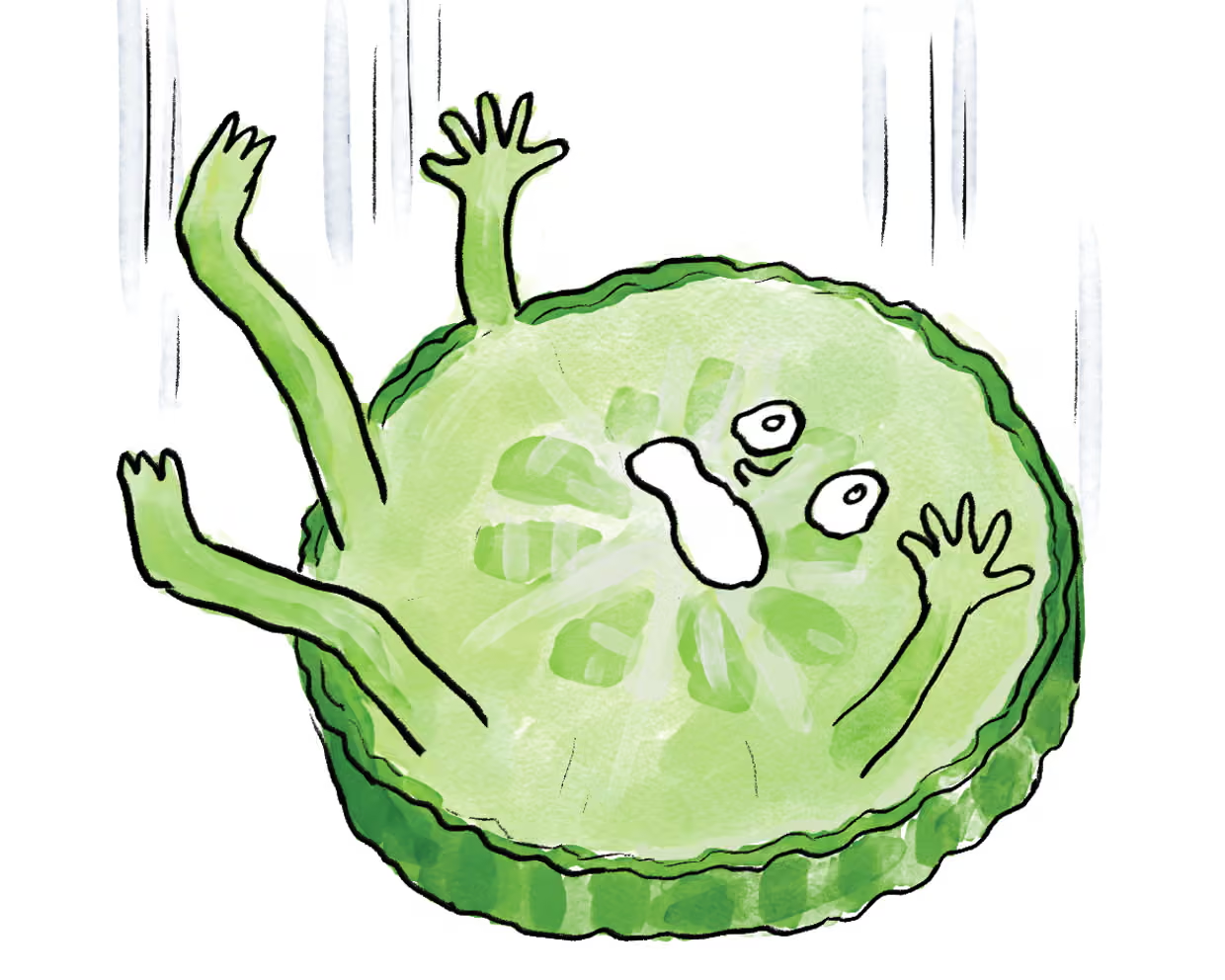
You drop a piece of cucumber on the floor. Do you immediately throw it in the bin or reassure yourself of the age-old “five-second rule” and reckon it’s fine to pop it in your mouth after a quick rinse?
If you fall into the latter camp, John Tregoning, professor of vaccine immunology at Imperial College London, has some bad news. He refers to three studies into bacteria transfer that all point towards the rule being false.
In the first, scientists looked at what happens when a range of foods (bread, buttered bread, watermelon and gummy bears) were dropped on a range of surfaces (tile, steel, wood, and carpet) that had been coated with bacteria. “They transferred almost immediately,” he says, adding that the worst combination for transfer happened when wet food hit a solid surface (watermelon on tile or steel).
Another study – where cooked sausage was dropped on to surfaces – showed that bacteria transferred on to the meat even if they had been applied to the surface hours earlier. It showed that “if you put a piece of contaminated chicken on to a work surface and then, two hours later, drop your piece of bread on to it, you can still pick up bacteria from it. It’ll be there for about 24 hours,” he says.
The final paper looked at the “five-second rule” for medical objects in the operating room. Perhaps unsurprisingly, it found that if surgeons drop something on the floor, they need to wash that instrument with detergent for it to be safe to use again.
What does all this mean for your fallen cucumber? “I think you have to accept it’s gone,” says Tregoning. Rinsing it with water won’t be enough to guarantee it’s clean. That’s especially the case if you’re particularly susceptible to infections, or if your dog might have walked something terrible through the house (even hours earlier).
THE GUARDIAN
Discover
Saudi Arabia’s Tawakkalna app offers Hajj services in 19 languages

Saudi Arabia’s national digital platform Tawakkalna is providing Hajj-related government services in 19 languages for pilgrims and workers during the 1447H Hajj season, as part of wider efforts to improve the pilgrimage experience through advanced digital solutions.
The initiative comes within the efforts of the Saudi Data and Artificial Intelligence Authority to strengthen integration between government service entities during Hajj and support pilgrims throughout their journey, from arrival in the Kingdom and entry into Mecca and the holy sites to visits to the Prophet’s Mosque in Madinah and departure back to their home countries.
The app supports Arabic, English, Indonesian, Hindi, Urdu, Turkish, French, Bengali, Persian, Malay, Russian, Chinese, Filipino, German, Dutch, Japanese, Italian, Spanish and Portuguese.
Pilgrims can access a range of services through the platform, including Hajj permits linked to the unified digital Hajj permit platform “Tasreeh”, as well as permits related to entering Mecca, work authorisations, volunteer permits and vehicle permits issued by various government entities.
According to officials, Tawakkalna is designed to serve as a trusted digital companion for pilgrims by supporting daily movement and offering a smoother and safer digital experience during Hajj and visits to Madinah after the pilgrimage.
The app also allows users to book visits to Al Rawdah Al Sharifah through the Nusuk gateway service integrated into the platform.
Additional services available during Hajj include multilingual access to the Arafah sermon, an emergency assistance service called “Assefni”, live weather updates for the holy sites, Qibla direction, prayer times and digital Quran services.
Saudi authorities said the services are part of broader efforts aligned with the Pilgrim Experience Programme under Saudi Vision 2030, which prioritises improving services for pilgrims and Umrah performers through smart technology solutions.
The Tawakkalna platform currently offers more than 1,300 services in cooperation with over 350 government entities across sectors including health, education, justice, tourism and professional services, with more than 35 million users registered on the app.
GN


Emirates Specialty Hospital Expands Cancer Care Services in Dubai with Opening of Dedicated Chemotherapy Unit

When Rheumatoid Arthritis Threatened Her Independence: How the Right Diagnosis Helped Her Get Her Life Back

Saudi German Hospital Dubai Launches Mental Health and Wellness Center for Children and Adolescents

Araghchi, Oman Sultan discuss transit, stability in Muscat

UAE’s café culture keeps growing despite price pressure

Netflix to Livestream BTS Comeback Concert
-
 politics6 months ago
Araghchi, Oman Sultan discuss transit, stability in Muscat
-
 UAE10 months ago
UAE’s café culture keeps growing despite price pressure
-
 Entertainment9 months ago
Netflix to Livestream BTS Comeback Concert
-
 Discover9 months ago
Is February 2026 really a once-in -283-years MiracleIn?
-

 Football10 months ago
Algeria, Burkina Faso, Côte d’Ivoire win AFCON 2025 openers
-

 Health10 months ago
NMC Royal Hospital, Khalifa City, performs rare wrist salvage, restoring function for young patient
-

 Health10 months ago
Bascom Palmer Eye Institute Abu Dhabi and Emirates Society of Ophthalmology Sign Strategic Partnership Agreement
-

 Health11 months ago
Emirates Society of Colorectal Surgery Concludes the 3rd International Congress Under the Leadership of Dr. Sara Al Bastaki