
Education
Most schools set to close early as UAE Friday prayer time changes in 2026

Short Fridays are likely to become shorter for UAE students as most schools across the country are likely to close early on Fridays from January 2026 following the announcement of standardised Friday prayer timings nationwide.
The General Authority of Islamic Affairs, Endowments and Zakat announced on Tuesday that Friday sermons and prayers will be held at 12.45pm from January 2, 2026. The decision standardises prayer timing across the country to support better organisation and ensure consistency for all worshippers. (But why were the prayer timings changed? Here are four reasons)
School principals told Gulf News on Wednesday that most educational institutions will need to adjust their Friday schedules to ensure Muslim students reach home in time for prayers.
Schools are now awaiting formal instructions from education authorities to implement schedule changes ahead of the January 2026 deadline.
KHDA begins survey
School principals said the Knowledge and Human Development Authority (KHDA) in Dubai has begun a survey in Dubai schools to understand how the change may affect teaching hours and potential adjustments.
Lyudmyla Klykova, principal of Hampton Heights International School in Al Twar, said: “KHDA is collecting feedback through a survey to gauge the impact on school timings, teaching hours, and operational adjustments.”
Gulf News has reached out to KHDA for further comments.
Meanwhile, Klykova said the school is reviewing several options for schedule adjustments.
“The revised Friday prayer time will require adjustments to our schedule for primary and lower secondary. This may involve modifying break times or lesson durations,” Klykova said.
“We are currently reviewing options with the senior leadership team to ensure smooth implementation while maintaining instructional quality.”
She said that Friday dismissal times may change depending on how lessons and breaks are adjusted. “No final decision has been made yet. Once finalised, parents will receive a confirmed update. Our goal is minimal disruption to learning,” she added.
Regional timing challenges
Qurat Ul Ain, principal of International Indian School in Ajman, highlighted the complexities schools face across different emirates.
“Schools will have to change their Friday working hours and we are awaiting clarity and instructions from the Ministry of Education,” she said.
She pointed out that schools in Ajman already face challenges regarding Friday dispersal.
“In Ajman, prayer time is at 1.15pm while it is at 12.15pm in Sharjah. For schools in Ajman, it has been a challenge to disperse students from Sharjah early. So, we allow Sharjah buses to leave first on Fridays.”
City vs rural scenario
Fareesa Azeem, principal of Al Marfa International Private School in Abu Dhabi‘s Al Dhafra region, said the change in prayer time will definitely affect school timings.
“A lot depends upon student transport and ensuring they reach home before prayers,” Azeem said.
“Currently, we disperse at 12 o’clock as there is no big traffic issues on outskirts. With the new prayer timing at 12.45pm, we would need to leave around 11.45am. Schools in Abu Dhabi city will have to close even earlier due to the traffic challenges. We are awaiting official guidance from ADEK (Abu Dhabi Department of Education and Knowledge). A circular from ADEK would provide clarity for all schools.”
ADEK’s early survey
Mohammad Gaffar from Al Ain Juniors Schools in Al Ain said his institution currently disperses primary and high school students at 10.40am due to existing challenges, while kindergarten students leave at 12 noon.
Though he hopes the prayer time change may have minimal impact on his school, he said official guidelines would clarify the situation.
“We had raised our concerns with ADEK earlier seeking guidelines to have meaningful learning on Fridays,” he said.
Gaffar said ADEK had conducted a survey on Friday school timings some months ago. “I think more inputs will be taken in view of the new announcement about the prayer time change.”
Story by Gulf News
Education
UAE moves spring break for schools and universities

The UAE on Wednesday announced an early spring break for students in schools and universities.
The Ministry of Education and the Ministry of Higher Education and Scientific Research on Wednesday announced that spring break will begin for schools and universities from Monday, March 9, until Sunday, March 22.
The break applies to all students and academic and administrative staff across public and private schools as well as universities. Classes and official working hours will resume on Monday, March 23.
The Ministry of Education and the Ministry of Higher Education and Scientific Research Announce Spring Break for Students and Academic and Administrative Staff Across Schools and Universities in UAE
This follows the approval of the Education, Human Development and Community Development Council (EHCD).
Earlier dates
In 2025, the UAE introduced a unified school calendar covering both public and private schools nationwide.
The previously approved spring break was from March 16 to 29 as per the official school calendar for the 2025–2026 academic year applying to all public and private schools across the country. The last day of class before the break was March 13.
The new decision taken amid the blatant Iranian aggression on the country will see students ending their online classes this weekend and moving on to the spring break.
On Tuesday, the Ministry of Education and the Ministry of Higher Education and Scientific Research had extended distance learning across the country until Friday, March 6 with teaching and learning to continue remotely under ongoing assessment frameworks.
Safe environment
The government had clarified that it wants the education process to continue in a safe environment for the student community.
“We’re making sure education isn’t missing a beat by rolling out remote learning systems, guaranteeing students stay on track in their academic journey across all grades,” Dr Saif Al Dhaheri, official spokesperson for the National Crisis and Emergency Management Authority (NCEMA), had said during a government media briefing on the current developments in the country on Tuesday.
“We want our students to keep learning in a safe and steady environment, ensuring that education never skips a beat,” he added.
GN
Education
UNESCO selects Sharjah for pioneering early childhood education initiative
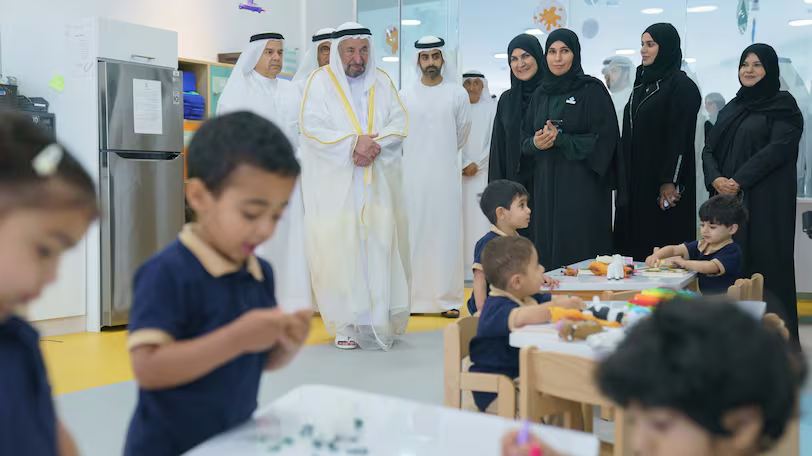
Sharjah has been chosen by the United Nations Educational, Scientific and Cultural Organization (UNESCO) to participate in the pilot phase of its Early Childhood Care and Education – Progress Assessment and Transformation Tool (ECCE-PATT), marking a major milestone for the Emirate’s early childhood sector.
The selection highlights Sharjah’s continuous efforts to strengthen early childhood systems through evidence-based policies, effective governance, and high-quality care and education services. It also underscores the Emirate’s reputation as a regional model for early childhood development.
This recognition follows Sharjah’s role in hosting the Regional Conference on Early Childhood Care and Education in the Arab States in June 2023. The event, held under the patronage of the Sharjah Family and Community Council, in collaboration with UNESCO’s Multisectoral Regional Office for the Arab States, brought together key stakeholders including the Sharjah Private Education Authority, the Sharjah Education Academy, and the Sharjah Child Friendly Office.
Sharjah’s integrated approach earns global recognition
UNESCO’s invitation reflects the Emirate’s comprehensive approach to early childhood development, combining supportive policies, strong governance, quality education provision, and close coordination among institutions. The ECCE-PATT pilot in Sharjah will produce a detailed self-assessment of the early childhood sector, documenting achievements, identifying gaps, and sharing promising practices as a reference for the region.
Dr. Muhadditha Al Hashimi, Chairperson of the Sharjah Private Education Authority and President of the Sharjah Education Academy, said: “UNESCO’s selection of Sharjah for this pilot aligns with the vision of His Highness Sheikh Dr. Sultan bin Muhammad Al Qasimi. We are committed to advancing excellence in early childhood education. The outcomes of this assessment will guide targeted improvements, ensuring our children benefit from the highest international standards, in close collaboration with UNESCO.”
Dr. Borhene Chakroun, Director of the Division for Policies and Lifelong Learning Systems at UNESCO, added: “Lifelong learning starts in the earliest years. Sharjah’s pilot of the ECCE-PATT tool will provide the evidence needed to strengthen early childhood systems, support school readiness, and enhance lifelong learning opportunities. This initiative demonstrates Sharjah’s leadership in placing early childhood at the heart of education transformation.”
High-level dialogue to shape regional policies
In a related development, the Sharjah Private Education Authority and the Sharjah Education Academy, in partnership with UNESCO, will host a high-level closed policy dialogue during the Pre-Conference Day of the Sharjah International Summit on Improvement in Education, scheduled for February 14–15, 2026 at the Sharjah Education Academy campus.
The session will bring together senior policymakers, experts, and representatives from the UAE, the Gulf region, and the Arab world, alongside international organisations and academic institutions. Participants will discuss Sharjah’s pilot findings, share knowledge, and develop actionable recommendations to strengthen early childhood systems, curriculum, and policy alignment across the region.
With these initiatives, Sharjah reaffirms its commitment to placing children at the centre of development, creating an education system that nurtures growth, learning, and the future success of the next generation.
GN
Education
Middlesex University-owner eyes bigger growth in Saudi Arabia
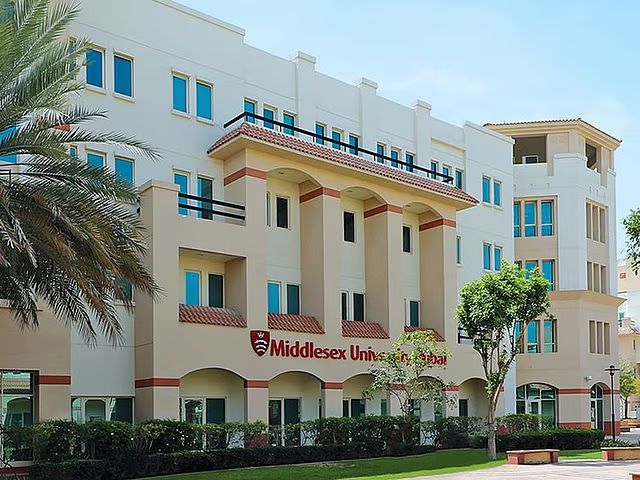
Saudi Arabia-listed Almasar Alshamil Education has unveiled plans to expand its special needs education network across Saudi Arabia and bring international universities into the Kingdom, as it accelerates regional growth following its Tadawul listing.
The company said its 2026 agenda centres on scaling physical infrastructure, broadening academic offerings, and deepening partnerships across Saudi Arabia and the UAE.
The roadmap follows Almasar’s decision late last year to list 30 per cent of its share capital on the Saudi Exchange. The group operates across special needs education and care services in Saudi Arabia and private higher education in the UAE.
Majed Al Mutairi, chief executive officer of Almasar Alshamil Education, said the listing has strengthened the company’s platform for expansion across both markets. “The beginning of a new year is a moment to reflect on responsibility and opportunity. Following our successful listing on the Saudi Exchange, we enter the year with a strong platform for growth and a clear mandate to deliver impact.
“As education continues to play a central role in Saudi Arabia’s Vision 2030 and UAE Vision 2030, our focus remains on scaling inclusive, future-ready education that delivers real outcomes for learners and society,” he said.
Special needs expansion
Saudi Arabia will remain the primary growth market, with Almasar planning to open new Special Needs Education and Care centres and schools in multiple regions. The expansion builds on its Human Development Company platform, which currently operates 39 daycare centres, 14 schools and three clinics serving about 8,000 beneficiaries.
The company said new facilities will focus on specialised education, rehabilitation and residential services. It also plans to expand digital systems used for standardised rehabilitation programmes, outcome measurement and personalised care delivery.
Almasar said it intends to bring reputed international universities into Saudi Arabia in the coming years as part of a broader higher education push. The company did not disclose potential partners, capital commitments or timelines.
Higher education build-out
The move would mark a shift beyond its current Saudi focus on special needs education into mainstream higher education provision. Almasar positioned the plan as aligned with national efforts to expand domestic university capacity.
In the UAE, Almasar plans to expand programmes across its university portfolio, which includes Middlesex University Dubai, Abu Dhabi University and Liwa University. The group said it will continue building degrees in artificial intelligence, business analytics, cybersecurity and applied sciences.
New programmes linked to labour market demand are also in development. The company said employability, applied learning and internationalisation will remain core priorities supported by industry partnerships and work-integrated learning.
Technology, partnerships
Almasar said AI-enabled learning tools, data analytics platforms and digital research systems will play a larger role in teaching and student services. It positioned technology as central to both higher education delivery and special needs care operations.
The company also said partnership development will underpin growth across Saudi Arabia and the UAE. Planned collaboration areas include international academic alliances, private-sector training partnerships and public-sector engagement.
Almasar reported revenue of SAR 336 million in the first nine months of 2025, representing 24 percent year-on-year growth, with EBITDA of SAR 129 million. Total students and beneficiaries reached about 28,000 across Saudi Arabia and the UAE.
The company said the Tadawul listing strengthens its ability to fund expansion across special needs education and higher education. Its longer-term strategy centres on building an integrated education platform spanning early intervention, schooling, university education and workforce pathways.
GN


Private Credit Investors Rush to Withdraw
UAE moves spring break for schools and universities

How Etihad Rail ferried 350+ UAE passengers back home with Saudi help

Is February 2026 really a once-in -283-years MiracleIn?

Algeria, Burkina Faso, Côte d’Ivoire win AFCON 2025 openers

Bascom Palmer Eye Institute Abu Dhabi and Emirates Society of Ophthalmology Sign Strategic Partnership Agreement
-
Discover1 month ago
Is February 2026 really a once-in -283-years MiracleIn?
-
 Football2 months ago
Algeria, Burkina Faso, Côte d’Ivoire win AFCON 2025 openers
-
 Health3 months ago
Bascom Palmer Eye Institute Abu Dhabi and Emirates Society of Ophthalmology Sign Strategic Partnership Agreement
-

 Health2 months ago
NMC Royal Hospital, Khalifa City, performs rare wrist salvage, restoring function for young patient
-

 Health4 months ago
Emirates Society of Colorectal Surgery Concludes the 3rd International Congress Under the Leadership of Dr. Sara Al Bastaki
-

 Football3 months ago
Globe Soccer Awards 2025 nominees announced as voting opens in Dubai
-

 Health4 months ago
Born Too Soon: Understanding Premature Birth and the Power of Modern NICU Care
-

 Health2 months ago
Decline in Birth Rate in the UAE