
Discover
Anna Wintour’s Vogue cover is a power play
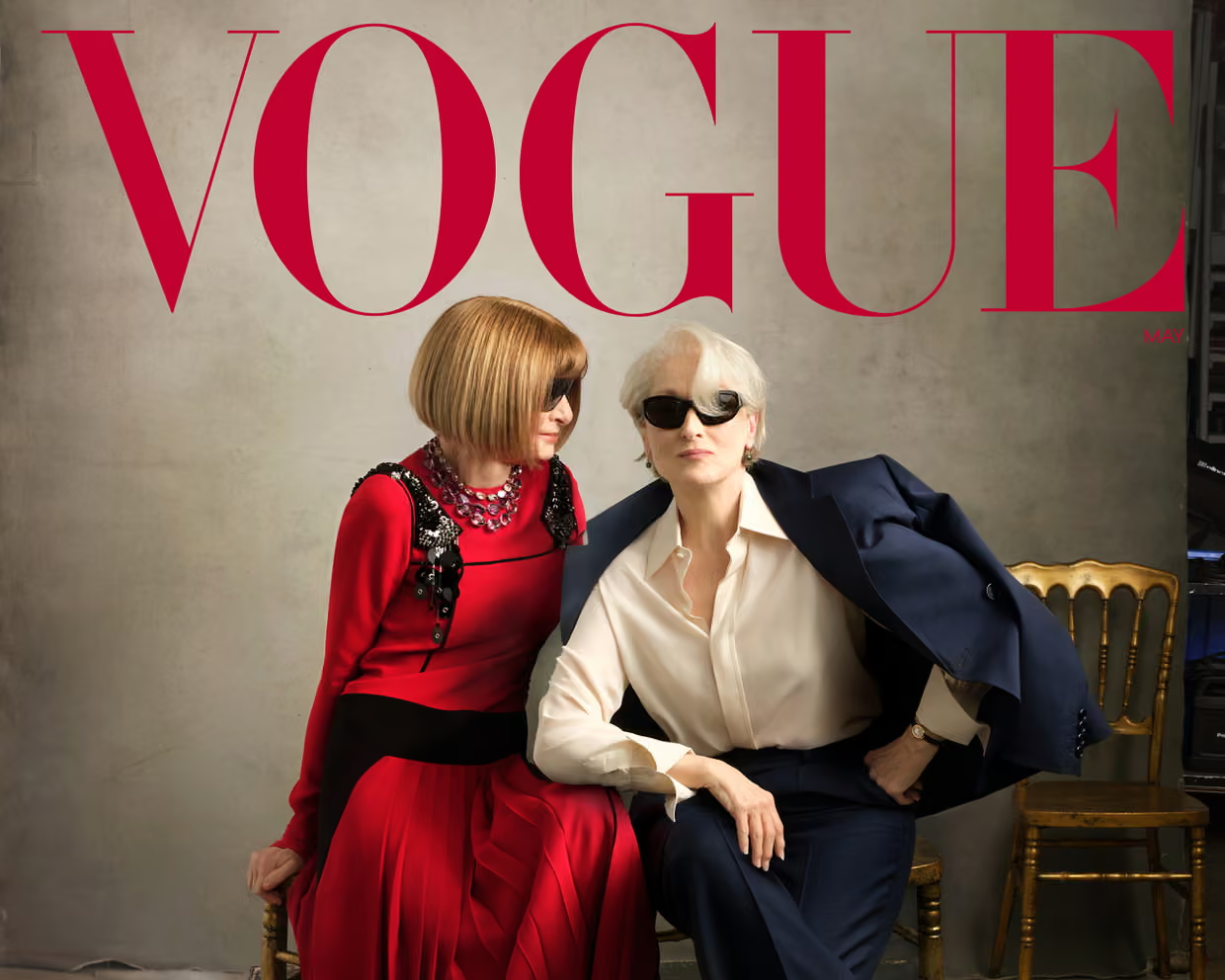
In the world of magazines, when someone announces they’re leaving a job, their colleagues will traditionally present them with their own personalised mock-up of the magazine’s front cover. Perhaps their face is superimposed on the body of a previous celebrity cover star. There are probably some witty cover lines referencing memorable office moments or their favourite snacks. It’s a rite of passage – and this week, Anna Wintour was bestowed with her very own cover. But instead of a jokey imitation bidding her adieu, it was the real, glossy deal, coming to a newsstand near you on 28 April.
In a somewhat surprising effort to promote the forthcoming The Devil Wears Prada 2, Vogue’s May issue sees Wintour share the cover with Meryl Streep, whose steely Miranda Priestly, editor-in-chief of the fictional title Runway, is said to have been inspired by Wintour. “Seeing Double. When Miranda met Anna” reads the cover line. While Wintour has fronted various industry titles, including Interview in 1993 and Ad Week in 2017, it’s the first time an editor has placed themselves as the subject. In another fun twist, both Wintour and Streep are wearing Prada.
First teased via Vogue’s Instagram on Tuesday, within seconds the image had gone viral, amassing, at the time of writing, more than 1.2m likes. “Maaj” commented the model Gigi Hadid. “Just so good” added the actor Mindy Kaling, while the 10k-plus other comments from the general public span everything from “Actually groundbreaking”, in reference to Priestly’s immortal florals line from the original film, to “Getting this framed”.
Rather than just plugging the highly anticipated sequel, though, Wintour’s newsstand appearance serves as something more significant (of course it does, this is Wintour we’re talking about): it’s her own personal power move, and a klaxon for the next phase of Anna Wintour. The cover comes just 10 months after she announced she was “stepping back” as editor-in-chief of Vogue and six months after she promoted Chloe Malle to head of editorial content. What better way to affirm that she is still very much in control of the magazine she has helmed for close to four decades than by appearing on its cover?
When Wintour first revealed she was relinquishing her editor-in-chief title, many misconstrued it as a step down. Her cover appearance now hammers home that it was no such thing. Her current role as chief content officer for Condé Nast and global editorial director for the magazine allows her to retain the ultimate authority while leaving the day-to-day running to Malle.
Mark Borkowski, a press consultant and author, describes Wintour’s appearance on the cover as “a hell of a smart move”. “This is very much about Wintour not letting go of her power,” he says. “A lot of people in these types of jobs recognise they are sitting in a chair that has power. Wintour doesn’t believe that. She believes she is the power. She’s not a personality that’s going to fade away into the background.”
Even the ideation of the cover hints at the authority Wintour still wields. Writing in her editor’s letter, Malle outlines how it came about. She was in the backseat of Wintour’s personal town car (a nice power play by Wintour, and reminiscent of the first film) running ideas for the next batch of covers past her (a tacit hint that all the big decisions still need to be approved by Wintour) when Malle first suggested the idea. Wintour initially shot it down, saying: “That’s very flattering, Chloe, but it’s not really my style.” It then, so the story goes, fell to Streep to persuade her. Wintour called the Hollywood star directly (another not-so-subtle power move).
Wintour was dismissive of the first film when it came out in 2006. Although she did attend the premiere – wearing Prada, no less – she was cagey about her reaction. In 2024, at the opening of the musical version in London, she told the BBC that it was “for the audience and for the people I work with to decide if there are any similarities between me and Miranda Priestly”.
However, more recently she has seemed happier to engage, suggesting that Priestly is very much “a caricature” and a highly enjoyable and very fun one at that. The various social media videos that accompany the shoot drive this idea home. Streep stays in character, while Wintour plays herself. We see her fumble her lines and get the giggles. She is warm and witty, a sharp contrast to the icy Priestly.
We first saw her toy with the idea at the Oscars in March, where she jokingly referred to Anne Hathaway as “Emily”, a nod to Emily Blunt’s character in the film. Meanwhile, the next read in the Vogue Book Club is the novel by Lauren Weisberger that inspired the film. Borkowski suggests these stunts hint that Wintour is beginning to separate herself from brand Vogue. “Her life has been defined by Vogue,” he says. “Back in the day she was recognisable by a very distinctive haircut and a pair of dark glasses. She was a cypher. But now it’s all about the narrative of the personal brand.” She is, he says, “getting involved in the film because she sees it as something that can establish Anna Wintour, the brand”.
The Guardian
Discover
Do Vitamin C Serums Boost Sun Protection?
Sunscreen does two important jobs. It is largely used for its UVB protection benefits – blocking the rays that cause sunburn and are a major contributor to the development of skin cancer. But it also blocks UVA radiation, filtering out the rays that lead to signs of ageing.
Vitamin C does neither of these things, says Rosalind Simpson, a professor of dermatology at the University of Nottingham. That said, it is thought to help prevent sun damage in a different way.
“Antioxidants such as vitamin C have become a hot topic,” Simpson says. “People are really interested in whether they can improve skin appearance by neutralising free radicals created by UV exposure and pollution. Those free radicals contribute to the breakdown of collagen and loss of skin firmness.”
Whereas sunscreen acts as a kind of UV filter, antioxidants are thought to provide an additional line of defence. UVA exposure generates unstable free radicals in the skin, which can damage cells by disrupting their structures, and Vitamin C is believed to stop them doing this.
A 1996 study examined the effectiveness of antioxidants, including vitamins C and E, with and without sunscreen, in protecting against UV-induced skin damage. It found that vitamin C appeared to enhance protection against UVA-induced skin damage, but only when used alongside sunscreen. The researchers concluded that antioxidants may provide additional protection when combined with established sun-protection products.
“Nothing is a substitute for a good quality, broad-spectrum sunscreen with UVA and UVB protection and sensible habits when in the sunshine,” says Simpson.
That means wearing sunscreen, reapplying it regularly, and limiting direct sun exposure during the hottest parts of the day.
The Guardian
Discover
Five-second rule is a myth
You drop a piece of cucumber on the floor. Do you immediately throw it in the bin or reassure yourself of the age-old “five-second rule” and reckon it’s fine to pop it in your mouth after a quick rinse?
If you fall into the latter camp, John Tregoning, professor of vaccine immunology at Imperial College London, has some bad news. He refers to three studies into bacteria transfer that all point towards the rule being false.
In the first, scientists looked at what happens when a range of foods (bread, buttered bread, watermelon and gummy bears) were dropped on a range of surfaces (tile, steel, wood, and carpet) that had been coated with bacteria. “They transferred almost immediately,” he says, adding that the worst combination for transfer happened when wet food hit a solid surface (watermelon on tile or steel).
Another study – where cooked sausage was dropped on to surfaces – showed that bacteria transferred on to the meat even if they had been applied to the surface hours earlier. It showed that “if you put a piece of contaminated chicken on to a work surface and then, two hours later, drop your piece of bread on to it, you can still pick up bacteria from it. It’ll be there for about 24 hours,” he says.
The final paper looked at the “five-second rule” for medical objects in the operating room. Perhaps unsurprisingly, it found that if surgeons drop something on the floor, they need to wash that instrument with detergent for it to be safe to use again.
What does all this mean for your fallen cucumber? “I think you have to accept it’s gone,” says Tregoning. Rinsing it with water won’t be enough to guarantee it’s clean. That’s especially the case if you’re particularly susceptible to infections, or if your dog might have walked something terrible through the house (even hours earlier).
THE GUARDIAN
Discover
Saudi Arabia’s Tawakkalna app offers Hajj services in 19 languages
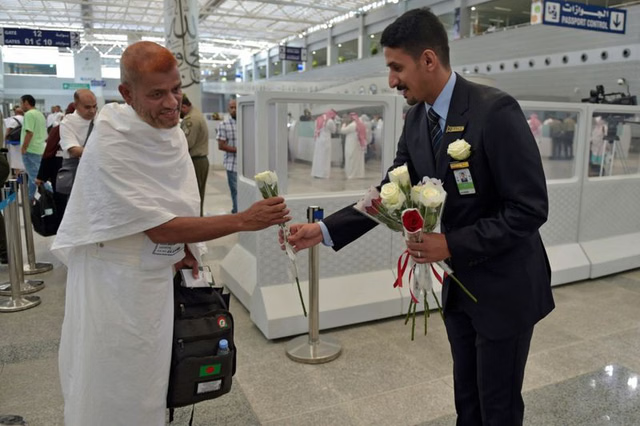
Saudi Arabia’s national digital platform Tawakkalna is providing Hajj-related government services in 19 languages for pilgrims and workers during the 1447H Hajj season, as part of wider efforts to improve the pilgrimage experience through advanced digital solutions.
The initiative comes within the efforts of the Saudi Data and Artificial Intelligence Authority to strengthen integration between government service entities during Hajj and support pilgrims throughout their journey, from arrival in the Kingdom and entry into Mecca and the holy sites to visits to the Prophet’s Mosque in Madinah and departure back to their home countries.
The app supports Arabic, English, Indonesian, Hindi, Urdu, Turkish, French, Bengali, Persian, Malay, Russian, Chinese, Filipino, German, Dutch, Japanese, Italian, Spanish and Portuguese.
Pilgrims can access a range of services through the platform, including Hajj permits linked to the unified digital Hajj permit platform “Tasreeh”, as well as permits related to entering Mecca, work authorisations, volunteer permits and vehicle permits issued by various government entities.
According to officials, Tawakkalna is designed to serve as a trusted digital companion for pilgrims by supporting daily movement and offering a smoother and safer digital experience during Hajj and visits to Madinah after the pilgrimage.
The app also allows users to book visits to Al Rawdah Al Sharifah through the Nusuk gateway service integrated into the platform.
Additional services available during Hajj include multilingual access to the Arafah sermon, an emergency assistance service called “Assefni”, live weather updates for the holy sites, Qibla direction, prayer times and digital Quran services.
Saudi authorities said the services are part of broader efforts aligned with the Pilgrim Experience Programme under Saudi Vision 2030, which prioritises improving services for pilgrims and Umrah performers through smart technology solutions.
The Tawakkalna platform currently offers more than 1,300 services in cooperation with over 350 government entities across sectors including health, education, justice, tourism and professional services, with more than 35 million users registered on the app.
GN


Emirates Specialty Hospital Expands Cancer Care Services in Dubai with Opening of Dedicated Chemotherapy Unit

When Rheumatoid Arthritis Threatened Her Independence: How the Right Diagnosis Helped Her Get Her Life Back

Saudi German Hospital Dubai Launches Mental Health and Wellness Center for Children and Adolescents

Araghchi, Oman Sultan discuss transit, stability in Muscat

UAE’s café culture keeps growing despite price pressure

Netflix to Livestream BTS Comeback Concert
-
 politics6 months ago
Araghchi, Oman Sultan discuss transit, stability in Muscat
-
 UAE10 months ago
UAE’s café culture keeps growing despite price pressure
-
 Entertainment9 months ago
Netflix to Livestream BTS Comeback Concert
-
 Discover9 months ago
Is February 2026 really a once-in -283-years MiracleIn?
-

 Football10 months ago
Algeria, Burkina Faso, Côte d’Ivoire win AFCON 2025 openers
-
 Health10 months ago
NMC Royal Hospital, Khalifa City, performs rare wrist salvage, restoring function for young patient
-
 Health10 months ago
Bascom Palmer Eye Institute Abu Dhabi and Emirates Society of Ophthalmology Sign Strategic Partnership Agreement
-

 Health11 months ago
Emirates Society of Colorectal Surgery Concludes the 3rd International Congress Under the Leadership of Dr. Sara Al Bastaki