
Space
Artemis II crew splashes down after record-breaking moon flyby

The Artemis II, and the four astronauts aboard the Orion space capsule, splashed down into the Pacific Ocean off the coast of San Diego on Friday night, with all four astronauts in good health.
“53 years ago, humanity left the moon. This time we return to stay. Let us finish what they started. Let us focus on what was left undone. Let us not go to plant flags and leave, but to stay with firmness in our purpose, with gratitude for the hands who built the machines and with love for the ones that we carry with us,” Nasa’s associate administrator Amit Kshatriya said at the late-night press conference after the astronauts landed.
The spacecraft touched down at 5.07pm (1.07am BST) making the journey around the moon and back officially 9 days 1hr and 32min. The Orion spacecraft traveled 694,481 miles (1,117,659km), Nasa said. Despite barely passing a ninth day, it will be recorded officially as a 10-day mission because blast-off day was treated as “flight day one”.
Commander Reid Wiseman, pilot Victor Glover, and mission specialist Christina Koch of Nasa, and the Canadian Space Agency’s Jeremy Hansen, have just become the first humans to travel to the moon, and return to Earth safely, since the crew of Apollo 17 in December 1972.
They join an exclusive club of just 24 other humans who have travelled to the moon and returned safely to Earth.
As the Orion capsule descended below 17,000 miles from the planet’s surface, Wiseman gave a description of the Earth as it came into view. “There’s a great blue hue to it. It’s beautiful,” he said.
Sean Quinn, Nasa’s exploration ground systems manager, said he had taken a phone call from Wiseman as he awaited the start of Friday night’s briefing: “It was so great to hear his voice and tell us that all the crew is OK, and we could say that we did our mission. We accomplished what we set out to do.”
After landing in the Pacific Ocean, a recovery crew from the USS John P Murtha stood ready to retrieve the Artemis crew, pulling up in boats to an inflatable “porch” attached to Orion’s hatch. Crew members were then assessed by navy personnel and transferred to the navy ship by helicopter.
Nasa administrator Jared Isaacman, speaking from the deck of the USS John P Murtha while waiting for the astronauts to arrive, said of the team: “Our crew members that we’ve all had an opportunity to observe over the last 10 days, they’re absolutely professional astronauts, wonderful communicators, almost poets. These were the ambassadors from humanity to the stars that we sent out there right now.
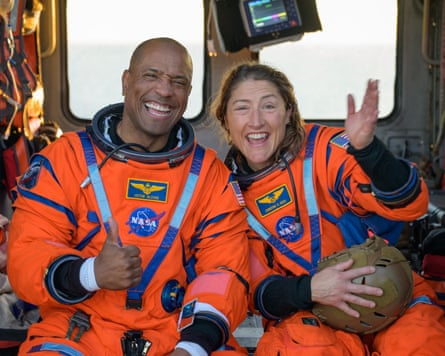
Victor Glover (L), Artemis II pilot, and NASA astronaut Christina Koch, Artemis II mission specialist. Photograph: Bill Ingalls/NASA/AFP/Getty Images
“This is not a once in a lifetime, which you hear sometimes around here. No, it’s not. This is just the beginning. We are going to get back into doing this with frequency, sending missions to the moon until we land on it in 2028 and start building our base.
There is a lot to celebrate right now on the mission well accomplished for Artemis II, and at the same time we’ve got to start getting ready for Artemis III.”
Nasa has proven it can once again send humans safely to and from cislunar space, the void between Earth and its nearest celestial body, and will build on the knowledge gained to further propel the Artemis program towards a scheduled crewed moon landing in 2028, 56 years after the last.
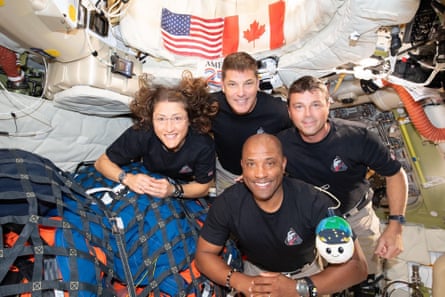
Mission specialist Christina Koch, mission specialist Jeremy Hansen, commander Reid Wiseman, and pilot Victor Glover pause for a group photo with their zero gravity indicator ‘Rise’ inside the Orion spacecraft on their way home. Photograph: Nasa/UPI/Shutterstock
The rest of humanity, meanwhile, appeared to come together for a rare moment of unity to enjoy stunning video footage and high-resolution images of the lunar surface – and Earth from afar – as well as some profound and heartfelt words from usually unsentimental astronauts as they described what they were seeing.
“I just had an overwhelming sense of being moved by looking at the moon,” the Nasa astronaut Christina Koch said of her first impressions of Orion’s closest approach on Monday, 4,067 miles (6,545km) above the lunar surface.
“It lasted just a second or two and I actually couldn’t even make it happen again, but something just threw me in suddenly to the lunar landscape and it became real.
“The moon really is its own unique body in the universe. When we have that perspective and we compare it to our home of the Earth, it just reminds us how much we have in common. Everything we need, the Earth provides, and that, in and of itself, is somewhat of a miracle.”
Koch became the only woman to have travelled to the moon and back during a mission of firsts. Jeremy Hansen of the Canadian Space Agency became the first non-American. Victor Glover, the Artemis II pilot, became the first person of color to do so.
Collectively, with the mission commander, Wiseman, the four travelled farther from Earth than any human before them, reaching 252,756 miles, more than 4,000 beyond the previous record set by the Apollo 13 crew in April 1970.
It was not all plain sailing during their 695,000-mile voyage. Orion’s glitchy toilet in a capsule the size of a small camper van malfunctioned more than once, necessitating the temporary deployment of urine collection bags and inflight repairs from Koch in her alternative role of plumber.
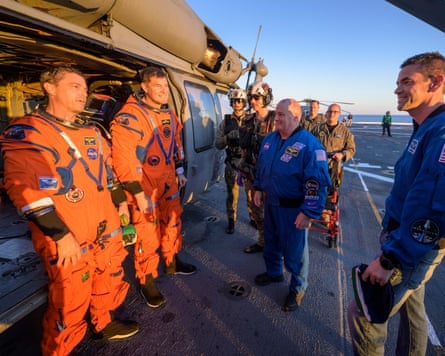
Victor Glover, Artemis II pilot, left, and CSA (Canadian Space Agency) astronaut Jeremy Hansen, Artemis II mission specialist, talk with NASA Administrator Jared Isaacman. Photograph: Bill Ingalls/NASA/Bill Ingalls – NASA/CNP/Shutterstock
There were moments of fun. The crew enjoyed an egg hunt of sorts on Easter Sunday, trying to find packets of dehydrated scrambled eggs hidden around the spacecraft. A plushie named Rise – the mission’s official mascot designed by eight-year-old California second-grader Lucas Ye, appeared regularly on camera during crew press conferences.
Probably the most emotional episode came on Monday, when the crew proposed dedicating a previously unnamed moon crater to Carroll Taylor Wiseman, wife of the Artemis II commander and mother of their daughters, Katey and Ellie, who died of cancer in 2020. Hansen struggled to get the words out, prompting tears and hugs among the four.
During the “business” side of the mission, the astronauts evaluated Orion’s life support systems, radiation detectors, next-generation spacesuits and tested other operations that will be crucial to future deep-space missions and Nasa’s longer-term plans for the Artemis program, including an ambitious $20bn moon base to be built within a decade.
The agency sees the first splashdown of a returning moon crew in more than five decades as an important next step. Although not as visually mesmerizing as the fiery 1 April launch from Florida’s Kennedy Space Center that sent Artemis II into the heavens, the landing still required a similar level of intricate planning, precision and execution.
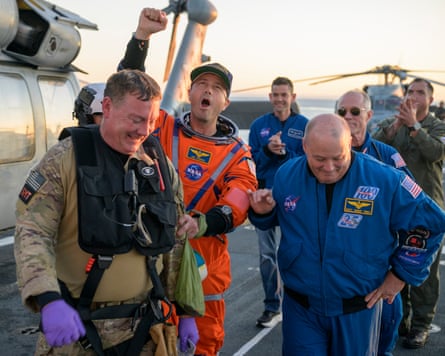
NASA astronaut Reid Wiseman. Photograph: Bill Ingalls/NASA/EPA
Changes to the heat shield after anomalies arose on the uncrewed Artemis I mission of November 2022 gave Nasa confidence that Orion would withstand temperatures up to 5,000F (2,760C) at its 25,000mph re-entry to Earth’s atmosphere; and mission managers selected a steeper, direct path of re-entry to reduce heat stress.
A succession of deployments of Orion’s 11 parachutes at various altitudes was designed to slow the spacecraft to 325mph, then 130mph, before the three main chutes, their canopies stretching a combined 80 yards (73 meters), release for a further deceleration to a 17mph splashdown.
A young boy wearing an astronaut costume cheers during a watch party for the crew’s splash down in the Pacific Ocean. Photograph: Apu Gomes/AFP/Getty Images
Coast Guard and Nasa recovery crews were positioned to cover a landing zone about 550 miles in diameter. After medical checks following hatch opening and a brief stopover at a San Diego military base, the crew’s next destination is Houston’s Johnson Space Center, which they last saw on 27 March, and a reunion with their families.
Nicky Fox, associate administrator of Nasa’s science mission directorate, summed up the importance and impact of the mission in a briefing with reporters this week.
“Our four Artemis II astronauts, Reid, Victor, Christina and Jeremy, took humanity on an incredible journey around the moon and brought back images so exquisite and brimming with science, they will inspire generations to come,” she said.
The Guardian
Space
SpaceX Plans Pipeline to Fuel Starship

SpaceX (SPCX.O), opens new tab plans to begin next month building an eight‑mile (13-km) natural gas pipeline called “Starpipe” to its Texas launch facilities, according to county filings, as Elon Musk’s company seeks to ramp up launches of its next‑generation Starship rocket.
Starpipe, which will end at SpaceX’s Texas company town of Starbase, is expected to be in service by January 26, according to a document filed last month with the Texas Railroad Commission by SpaceX affiliate Lone Star Mineral Development and reviewed by Reuters.
The pipeline plan, previously reported by Rio Grande Valley Business Journal, signals Musk’s intent to accelerate Starship’s development and lay the groundwork for a faster flight rate. The 40‑story rocket is central to SpaceX’s push to expand its Starlink broadband network, deploy orbital AI data center satellites, and eventually carry astronauts to the moon and Mars.
Designed to be fully reusable, Starship uses about 630,000 gallons (2.4 million liters) of liquid methane per launch, currently delivered by hundreds of tanker trucks in an hours-long process incompatible with Musk’s expansion plans. Starship has completed 12 test launches since 2023, but Musk aims to ramp up to dozens, hundreds and eventually thousands of launches a year.
SpaceX did not respond to a request for comment.
SPACEX’S BIG GAS PLANS
Though it is unusual for a space company to build its own natural gas pipeline for launchpad fuel, Starpipe might only be an initial step in a longer-term plan for SpaceX, which has spent years exploring its own drilling operations near Starbase and throughout Texas, according to a Reuters review of Cameron County land records.
SpaceX President Gwynne Shotwell told CNBC on June 12, when the company went public, that the company planned to build pipelines and process its own propellant, and was looking into drilling its own natural gas.
Extracting natural gas would be a challenging pursuit for a company with no oil and gas experience, said Stan Lindsey, an oil and gas consultant in Texas.
“I’m not saying it’s beyond the realm of possibility … it’s possible they got a really nice prospect,” Lindsey said. But if those drilling plans fall short, he added, “they’ve got a fallback position” with Starpipe.
SpaceX has signed over 100 paid-up oil and gas leases with Texas property owners since 2023, the land records show.
Starpipe would begin on an 83-acre (34-hectare) piece of land at the Port of Brownsville that SpaceX is in talks to lease from the city for 50 years, a port official told Reuters, speaking on condition of anonymity because the negotiations are private.
Engineering plans SpaceX filed with the U.S. Army Corps of Engineers, included in a public notice issued last August, show SpaceX wants to build a liquefaction facility at Starbase to process the piped-in natural gas into liquid methane.
“Certainly that would make the most efficient sense,” said William Farrar, a longtime oil and gas lawyer in Texas and geoscientist.
The company could tap into Enbridge’s Valley Crossing Pipeline expansion project that would run close to Starpipe’s start point, Lindsey said.
Enbridge did not immediately respond to a request for comment.
SPACEX WANTS TO OWN SUPPLY CHAIN
SpaceX’s move into gas infrastructure, typically the domain of energy and pipeline firms, underscores its longstanding strategy of controlling as much of its supply chain as possible, a capital‑intensive approach that has helped the company outpace rivals in rocket and spacecraft development.
The effort positions SpaceX to manage an unusually broad chain of resources, stretching from natural gas deep beneath Earth’s surface to the moon, where Musk wants to use lunar material for AI‑focused satellite production, an ambitious and untested goal.
The pipeline’s 16‑inch (406-mm) diameter suggests fuel demand exceeding what Starship would require for 25 launches, the annual cadence currently approved by the Federal Aviation Administration.
SpaceX ultimately aims to deploy thousands of solar‑powered, AI‑focused satellites whose combined energy output could approach one-fifth of the U.S. power grid, according to its initial public offering prospectus.
Reuters
Space
Scientists say we need to send clocks to the Moon soon
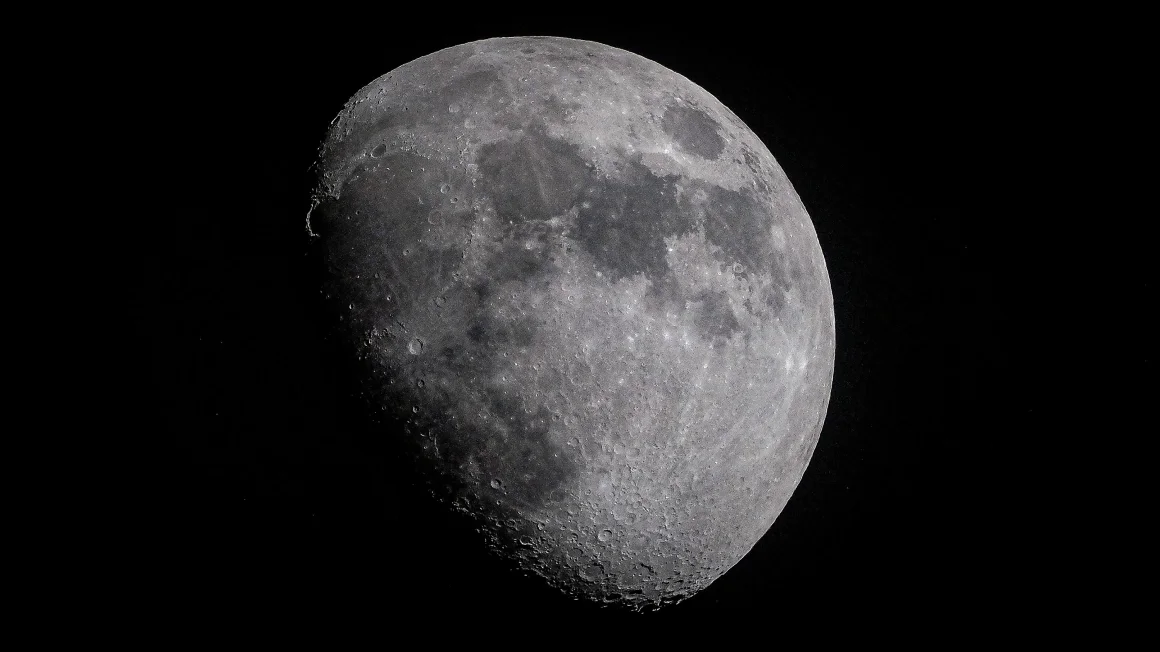
Perhaps the greatest, mind-bending quirk of our universe is the inherent trouble with timekeeping: Seconds tick by ever so slightly faster atop a mountain than they do in the valleys of Earth.
For practical purposes, most people don’t have to worry about those differences.
But a renewed space race has the United States and its allies, as well as China, dashing to create permanent settlements on the moon, and that has brought the idiosyncrasies of time, once again, to the forefront.
On the lunar surface, a single Earth day would be roughly 56 microseconds shorter than on our home planet — a tiny number that can lead to significant inconsistencies over time.
NASA and its international partners are currently grappling with this conundrum.
Scientists aren’t just looking to create a new “time zone” on the moon, as some headlines have suggested, said Cheryl Gramling, the lunar position, navigation, and timing and standards lead at NASA’s Goddard Space Flight Center in Maryland. Rather, the space agency and its partners are looking to create an entirely new “time scale,” or system of measurement that accounts for that fact that seconds tick by faster on the moon,Gramling noted.
The agency’s goal is to work with international partners to set up a new method of tracking time, specifically for the moon, that space-faring nations agree to observe.
A recent memo from the White House also directed NASA to map out its plans for this new time scale by December 31, calling it “foundational” to renewed US efforts to explore the lunar surface. The memo also asks that NASA implement such a system by the end of 2026, the same year the space agency is aiming to return astronauts to the moon for the first time in five decades.
For the world’s timekeepers, the coming months could be crucial for figuring out how to accurately keep lunar time — and reach agreements on how, when and where to put clocks on the moon.
Such a framework will be crucial for humans visiting our closest celestial neighbor, Gramling told CNN.
Astronauts on the moon, for example, are going to leave their habitats to explore the surface and carry out science investigations, she said. They’re also going to be communicating with one another or driving their moon buggies while on the lunar surface.
“When they’re navigating relative to the moon,” Gramling said, “time needs to be relative to the moon.”
A brief history of Earth time
Simple sundials or stone formations, which track shadows as the sun passes overhead, mark a day’s progression just as the shifting phases of the moon can log the passing of a month on Earth. Those natural timekeepers have kept humans on schedule for millennia.
But perhaps since mechanical clocks gained traction in the early 14th century, clockmakers have grown ever more persnickety about precision.
Exacting the measurement of seconds also grew more complicated in the early 1900s, thanks to Albert Einstein, the German-born physicist who rocked the scientific community with his theories of special and general relativity.
“Darn that Einstein guy — he came up with general relativity, and many strange things come out of it,” said Dr. Bruce Betts, chief scientist at The Planetary Society, a nonprofit space interest group. “One of them is that gravity slows time down.”
General relativity is complicated, but in broad terms, it’s a framework that explains how gravity affects space and time.
Imagine that our solar system is a piece of fabric suspended in the air. That fabric is space and time itself, which — under Einstein’s theories — are inextricably linked. And every celestial body within the solar system, from the sun to the planets, is like a heavy ball sitting atop the fabric. The heavier the ball, the deeper the divot it creates, warping space and time.
Even the idea of an earthly “second” is a humanmade concept that’s tricky to measure. And it was Einstein’s theory of general relativity that explained why time passes slightly more slowly at lower elevations — because gravity has a stronger effect closer to a massive object (such as our home planet).
Scientists have found a modern solution to all the complications of relativity for timekeeping on Earth: To account for imperceptible differences, they have set up a few hundred atomic clocks at various locations across the globe. Atomic clocks are ultra-precise instruments that use the vibration of atoms to measure the passage of time, and those clocks — in line with Einstein’s theories — tick slower the closer to Earth’s surface they sit.
The readings from atomic clocks around the world can be averaged for a broad but accurate as possible sense of time for planet Earth as a whole, giving us Coordinated Universal Time, or UTC. Still, occasionally “leap seconds” are factored in to keep UTC in line with slight changes in Earth’s speed of rotation.
This methodical keeping of time helps make the modern world go round — metaphorically speaking, said Kevin Coggins, deputy associate administrator and program manager for NASA’s Space Communications and Navigation Program.
“If you’ve researched time on the Earth, you realize it is the critical enabler for everything: the economy, food security, trading, the financial community, even oil exploration. They use precise clocks,” Coggins said. “It’s in everything that matters in modern society.”
Space, time: The continual question
If time moves differently on the peaks of mountains than the shores of the ocean, you can imagine that things get even more bizarre the farther away from Earth you travel.
To add more complication: Time also passes slower the faster a person or spacecraft is moving, according to Einstein’s theory of special relativity.
Astronauts on the International Space Station, for example, are lucky, said Dr. Bijunath Patla, a theoretical physicist with the US National Institute of Standards and Technology, in a phone interview. Though the space station orbits about 200 miles (322 kilometers) above Earth’s surface, it also travels at high speeds — looping the planet 16 times per day — so the effects of relativity somewhat cancel each other out, Patla said. For that reason, astronauts on the orbiting laboratory can easily use Earth time to stay on schedule.
For other missions — it’s not so simple.
Fortunately, scientists already have decades of experience contending with the complexities.
Spacecraft, for example, are equipped with their own clocks called oscillators, Gramling said.
“They maintain their own time,” Gramling said. “And most of our operations for spacecraft — even spacecraft that are all the way out at Pluto, or the Kuiper Belt, like New Horizons — (rely on) ground stations that are back on Earth. So everything they’re doing has to correlate with UTC.”
But those spacecraft also rely on their own kept time, Gramling said. Vehicles exploring deep into the solar system, for example, have to know — based on their own time scale — when they are approaching a planet in case the spacecraft needs to use that planetary body for navigational purposes, she added.
For 50 years, scientists have also been able to observe atomic clocks that are tucked aboard GPS satellites, which orbit Earth about 12,550 miles (20,200 kilometers) away — or about one-nineteenth the distance between our planet and the moon.
Studying those clocks has given scientists a great starting point to begin extrapolating further as they set out to establish a new time scale for the moon, Patla said.
“We can easily compare (GPS) clocks to clocks on the ground,” Patla said, adding that scientists have found a way to gently slow GPS clocks down, making them tick more in-line with Earth-bound clocks. “Obviously, it’s not as easy as it sounds, but it’s easier than making a mess.”
For the moon, however, scientists likely won’t seek to slow clocks down. They hope to accurately measure lunar time as it is — while also ensuring it can be related back to Earth time, according to Patla, who recently co-authored a paper detailing a framework for lunar time.
The study, for the record, also attempted to pinpoint exactly how far apart moon and Earth time are, as estimates have wavered between 56 and 59 microseconds per day.
Clocks on the moon’s equator would tick 56.02 microseconds faster per day than clocks at the Earth’s equator, according to the paper.
Lunar clockwork
What scientists know for certain is that they need to get precision timekeeping instruments to the moon.
Exactly who pays for lunar clocks, which type of clocks will go, and where they’ll be positioned are all questions that remain up in the air, Gramling said.
“We have to work all of this out,” she said. “I don’t think we know yet. I think it will be an amalgamation of several different things.”
Atomic clocks, Gramling noted, are great for long-term stability, and crystal oscillators have an advantage for short-term stability.
“You never trust one clock,” Gramling added. “And you never trust two clocks.”
Clocks of various types could be placed inside satellites that orbit the moon or perhaps at the precise locations on the lunar surface that astronauts will one day visit.
As for price, an atomic clock worthy of space travel could cost around a few million dollars, according Gramling, with crystal oscillators coming in substantially cheaper.
But, Patla said, you get what you pay for.
“The very cheap oscillators may be off by milliseconds or even 10s of milliseconds,” he added. “And that is important because for navigation purposes — we need to have the clocks synchronized to 10s of nanoseconds.”
A network of clocks on the moon could work in concert to inform the new lunar time scale, just as atomic clocks do for UTC on Earth.
(There will not, Gramling added, be different time zones on the moon. “There have been conversations about creating different zones, with the answer: ‘No,’” she said. “But that could change in the future.”)
The new time scale would underpin an entire lunar network, which NASA and its allies have dubbed LunaNet.
“You can think of LunaNet like the internet — or the internet and a global navigation satellite system all combined,” Gramling said. It’s “a framework of standards that contributors to LunaNet (such as NASA or the European Space Agency) would follow.”
“And you can think of the contributors maybe as your internet service provider,” Gramling added.
Creating such a framework means bringing a lot of people across the world to the table. So far, Gramling said, conversations with US partners have been “very, very positive.”
It’s not clear whether NASA and its partners on this effort, which include the European Space Agency, will get a buy-in from nations that aren’t among US allies, such as China. Gramling noted those conversations would be held through international standard-setting bodies, such as the International Astronomical Union.
‘A whole different mindset’
Accurate clockwork is one matter. But how future astronauts living and working on the lunar surface will experience time is a different question entirely.
On Earth, our sense of one day is governed by the fact that the planet completes one rotation every 24 hours, giving most locations a consistent cycle of daylight and darkened nights. On the moon, however, the equator receives roughly 14 days of sunlight followed by 14 days of darkness.
“It’s just a very, very different concept” on the moon, Betts said. “And (NASA is) talking about landing astronauts in the very interesting south polar region (of the moon), where you have permanently lit and permanently shadowed areas. So, that’s a whole other set of confusion.”
“It’ll be challenging” for those astronauts, Betts added. “It’s so different than Earth, and it’s just a whole different mindset.”
That will be true no matter what time is displayed on the astronauts’ watches.
Still, precision timekeeping matters — not just for the sake of scientifically understanding the passage of time on the moon but also for setting up all the infrastructure necessary to carry out missions.
The beauty of creating a time scale from scratch, Gramling said, is that scientists can take everything they have learned about timekeeping on Earth and apply it to a new system on the moon.
And if scientists can get it right on the moon, she added, they can get it right later down the road if NASA fulfills its goal of sending astronauts deeper into the solar system.
“We are very much looking at executing this on the moon, learning what we can learn,” Gramling said, “so that we are prepared to do the same thing on Mars or other future bodies.”
CNN
Space
How China is challenging the U.S. to become the next great space power
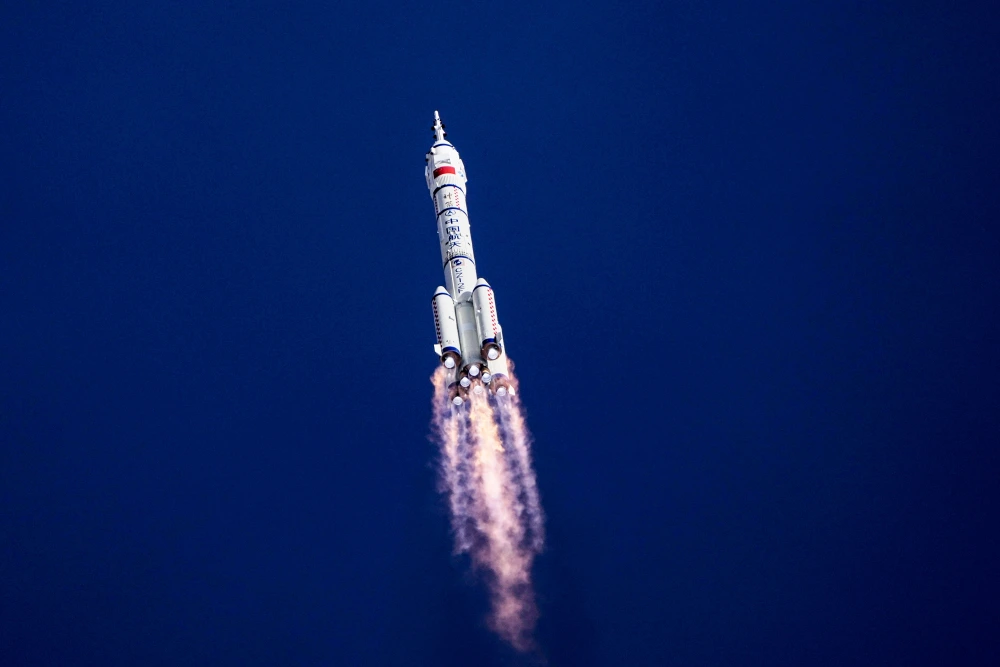
China’s space program has hit a number of milestones lately.
In 2025, China executed over 90 orbital launches, setting a new national record for orbital launches in a single year. In the last five years, China returned the first samples from the far side of the Moon, completed its own low-earth orbit space station and landed a rover on the surface of Mars.
“We’ve seen multiple statements from President Xi [Jinping] and what he calls China’s space dream,” said Dave Cavossa, president of the Commercial Space Federation, a trade association that represents the commercial space industry. “They see space and AI as two of those, sort of, industries that are going to help lead and catapult China to become a global leader.”
The Commercial Space Federation recently published a report alongside Arizona State University’s NewSpace initiative warning that the U.S. could soon lose its dominance in space to China.
“The United States today is still by far the global leader when it comes to space,” Cavossa told CNBC. “You know, we still have the strongest commercial space industry. We still have the strongest launch capability on the planet. But what we see is China is moving very quickly to catch up. And if we do nothing, we see them surpassing us here in the next five years.”
Chinese investment in its commercial space sector, including from private and government sources, increased from $340 million in 2015 to about $3.81 billion in 2025 according to data from space research firm Orbital Gateway Consulting.
Over the last decade, China has spent over $104 billion on civil, military and commercial space efforts, according to Jonathan Roll, a research analyst at ASU’s NewSpace initiative and co-author of the China space report.
“The immediate question you’ll probably ask me is what did the U.S. spend in the equivalent amount of time? The estimates that we had was over five times more.” Roll said. “But the real narrative is that China keeps increasing its expenditures. So they’re they’re progressing towards their goal of being a leader, if not the leader in space science.”
In China, the space sector is supported by a combination of local government, universities, state-owned enterprises and private companies. The result is a robust network of space activity hubs dispersed throughout the country.
These hubs house rocket and satellite manufacturing facilities, as well as launch sites and universities.
“The real, real uptick — that hockey stick moment — has been since 2014. In 2014, one of the regulatory entities in China put out a document which is colloquially known as ’Document 60.′ And what that essentially does is it opens the space domain and ecosystem to private investment, but then also private ownership,” Roll said.
China has doubled down on building rockets.
The country has more than a dozen private rocket manufacturers, some of which are working on reusable rockets like those made by Elon Musk’s SpaceX.
The country is also making great strides in building out its satellite infrastructure.
In 2020, China launched the last satellite needed to complete its own global satellite navigation system called BeiDou, which directly competes with the U.S. GPS constellation. Also in the works are thousands of internet satellites, though the majority have yet to be launched, that will directly compete with SpaceX’s Starlink constellation.
Space also has become a major part of the country’s Belt and Road initiative.
Launched in 2013 by Xi, the Belt and Road Initiative is a massive international infrastructure and economic development program meant to expand Chinese influence and economic reach.
“They’ve long built satellites for other countries and launched them, but now they’ve started building out ground stations and even in some countries like Egypt and Pakistan, they’ve built out whole facilities,” Roll said. “But then they’ve also sort of enveloped countries into the sinocentric world through standards, technology, services that they’re getting from BeiDou …. So it’s soft power. It’s gray power, as you could say in diplomacy.”
Still, experts say that there are a number of things the U.S. can do to maintain its leadership in space.
These include investing in space ports, streamlining commercial launch licensing and allocating sufficient spectrum for satellite operations.
“This current space race is not about flags and footprints,” Casossa said. “This space race is going to be the country that builds the strongest commercial space industrial base.“
CNBC


Emirates Specialty Hospital Expands Cancer Care Services in Dubai with Opening of Dedicated Chemotherapy Unit

When Rheumatoid Arthritis Threatened Her Independence: How the Right Diagnosis Helped Her Get Her Life Back

Saudi German Hospital Dubai Launches Mental Health and Wellness Center for Children and Adolescents

Araghchi, Oman Sultan discuss transit, stability in Muscat

UAE’s café culture keeps growing despite price pressure

Netflix to Livestream BTS Comeback Concert
-
 politics6 months ago
Araghchi, Oman Sultan discuss transit, stability in Muscat
-
 UAE10 months ago
UAE’s café culture keeps growing despite price pressure
-
 Entertainment9 months ago
Netflix to Livestream BTS Comeback Concert
-
 Discover9 months ago
Is February 2026 really a once-in -283-years MiracleIn?
-

 Football10 months ago
Algeria, Burkina Faso, Côte d’Ivoire win AFCON 2025 openers
-

 Health10 months ago
NMC Royal Hospital, Khalifa City, performs rare wrist salvage, restoring function for young patient
-

 Health10 months ago
Bascom Palmer Eye Institute Abu Dhabi and Emirates Society of Ophthalmology Sign Strategic Partnership Agreement
-

 Health11 months ago
Emirates Society of Colorectal Surgery Concludes the 3rd International Congress Under the Leadership of Dr. Sara Al Bastaki