
world
Tanker crew trapped as Iran war escalates
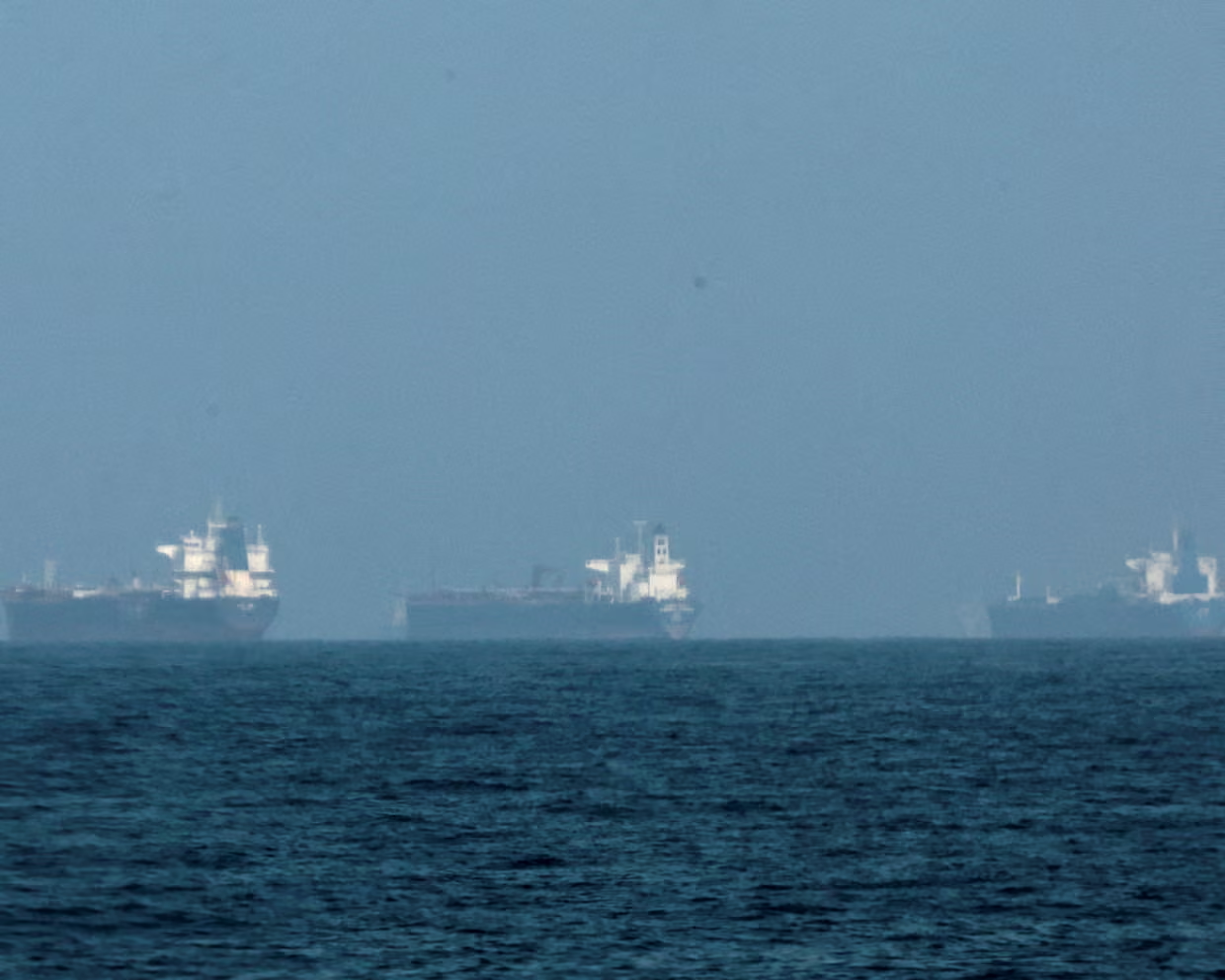
Thousands of seafarers are trapped on tankers in the Gulf after the strait of Hormuz was effectively closed to shipping by the escalating war on Iran.
The Guardian spoke to a crew member on one of the stranded tankers that typically ferries vast quantities of oil from the Middle East to ports around the world.
“When [Donald] Trump said Iran had 10 days to agree to his deal or bad things would happen, I did the math and thought we might get stuck here. And we did,” said the seafarer.
From a cabin below deck, they explained how the crew watched explosions light up the sky as they loaded the vessel with crude oil at an industrial complex in the Gulf.
Initially the crew were told to stop loading the oil, but hours later they were told to return and continue filling the tanker.
“At the time we had no GPS, no communications, and we were sitting on more than a million barrels of floating oil,” said the crew member.
“Now we’re at anchor off the coast of Dubai and it looks like we’re stuck here indefinitely. We’re powerless; just waiting and hoping that nothing hits us.”
After war broke out on Saturday, Iran’s Revolutionary Guards said it would “set ablaze” any western tanker attempting to transit the strait, a body of water through which about a fifth of the world’s oil and liquefied natural gas passes on tankers.
Typically, about 100 tankers pass through the trade artery each day but marine traffic has evaporated as military aggression has increased and insurance costs have soared or cover has been withdrawn. About 200 tankers, which are not under sanctions are stranded in the strait, according to the maritime data firm Lloyd’s List, as well as on hundreds of other vessels, leaving thousands of crew effectively trapped in a war zone.
The seafarer has been on the tanker for three months, and was due to head home to Europe once the vessel was loaded with crude and ready to depart for east Asia. In total there are more than seafarers on board, including nationals from the Philippines and India.
“We send messages every few hours to the tanker owner to report that we are OK. In response we have received generic messages about a mental health hotline. But that’s about that,” they said.
“If they wanted to do more they could start by providing more internet. We get a data allowance for free, and then we need to pay. I’m mostly scrolling news reports or texting friends and family but the internet isn’t always available because the GPS signal here gets jammed by the Iranians or the Americans. My mother is freaking out,” the seafarer added.
The effective blockade has caused oil and gas prices to surge, and threatens to upend the global economy by stoking inflation. The longer the strait is shut off to transit, the greater the risk to the global economy – and the thousands of seafarers held hostage by circumstance.
At least six vessels have been attacked and two seafarers killed. On Wednesday a large explosion was reported on an oil tanker near the coast of Kuwait.
“People are trying to get on with their work, but it does take a toll,” the seafarer said. “And as the days pass, it feels more and more unreal that we are just working normally in the middle of all this. We can hear the military planes, we can see explosions in the sky sometimes, it’s the strangest situation.
“People might go to the gym, or watch movies in the cabins in their downtime. Some guys go fishing in the evening, but for obvious reasons we need to keep lights to a minimum so as not to attract attention.”
Stephen Cotton, the general secretary of the International Transport Workers’ Federation (ITF), a trade union representing 1.2 million seafarers, has been inundated by requests for information from its members.
“Seafarers are sometimes invisible,” he said. “They are always on the frontline and our economies can’t survive [without them]. But let’s be clear: seafarers are innocent civilians. They happen to be on a ship in a region that is incredibly explosive at the moment.”
The union is fielding desperate queries over whether it is possible to repatriate seafarers who want to leave their vessel – and the region.
“You can’t just get off a ship,” Cotton said. “The feedback from most of the ship owners is that it’s a no-go zone. What we are exploring is what we can do.”
The crew member said their tanker has enough food for about 60 days and was fitted with desalination equipment to produce water on board, although rationing may be necessary eventually.
David Appleton, a senior leader at the trade union Nautilus International, said: “I don’t think keeping the ships supplied is the issue. When it all starts dragging on and people are supposed to be relieved and they can’t be, psychological stress becomes the main thing. Many seafarers will remember the pandemic when they were trapped on board for months and months at the time, unable to leave the ship.”
He added: “It’s all obviously up in the air, because we have no idea how long this is going to go on. Our position ultimately is that seafarers shouldn’t be considered expendable. It’s a civilian career.”
No shipowner can force a seafarer to take up a position in a high-risk area, raising the question of who would replace those stuck on board even if a relief mission was logistically possible.
“Who would be willing to take my place? You’d need to be really desperate for work” said the seafarer. “Honestly, when I do get home I want a very large, strong drink as soon as I arrive. But mostly I’m eager to see my pets, my family and my friends. There are hundreds of others in our position and I’m really concerned that we will not be heard, when there are so many more horrible things happening.
“The sad truth is that crew members have already died trying to cross Hormuz, or by just being in the wrong place at the wrong time.”
The Guardian
world
Qatar vessel incident: One killed, one injured

The Ministry of Interior of Qatar has confirmed that maritime search operations were carried out after a vessel carrying two individuals failed to return at its scheduled time, prompting an immediate response from the General Directorate of Coasts and Borders Security.
According to an official statement, routine monitoring and verification procedures first flagged the delay, following which maritime patrols launched a search operation on the evening of Saturday, June 27, 2026
The Maritime Search and Rescue Team located the vessel in the early hours of Sunday, June 28, the ministry said.
One killed, one injured in incident
The ministry confirmed that a Qatari citizen was killed after sustaining injuries from shrapnel linked to military activity in the area.
An Arab resident on board was also injured and has been hospitalised in stable condition.
Condolences and ongoing investigation
The Ministry of Interior extended its condolences to the family of the deceased, praying for mercy upon him, and wished a swift recovery for the injured individual.
It added that investigations are ongoing in accordance with established legal procedures.
GN
world
Philippines Leads Global Solar Boom
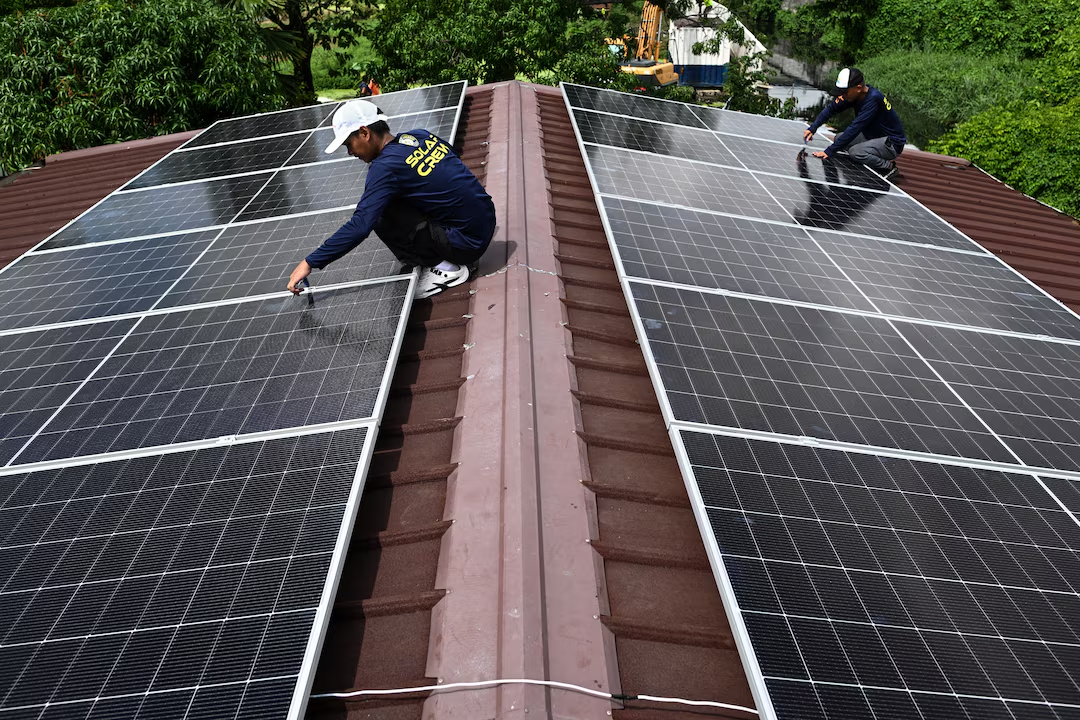
People in the Philippines are flocking to install solar power on rooftops and escape the burden of soaring electricity prices, making it the world’s biggest spender on solar panels since the war in Iran started.
Top power distributor Meralco has raised prices by 10% since the Middle East conflict began in late February. Now, a median household spends around 12% of monthly income on electricity, assuming it consumes 200 kilowatt-hours — approximately the monthly average for three people.
The Philippines is one of the few countries in Southeast Asia with barely any power subsidies, and its residential power prices are the highest in the region. Only Singapore comes close, but its citizens’ average purchasing power is nearly 13 times higher.
Adrian Sabatera, a 39-year-old software engineer, thought about getting solar for years but found it too costly. That changed as costs came down and electricity prices kept rising.
“I wouldn’t be shocked if a third of the middle-class population eventually finds their way to this setup,” Sabatera said after recently pulling the trigger on a 570,000 peso ($9,300) installation at the Manila house he shares with three others.
The rooftop solar rush has resulted in $407 million in panel imports in the three months through May, a 145% increase from a year earlier, according to trade data from China, which accounts for most global supply.
Even when Chinese panel shipments fell 13% in May after a tax rebate removal, exports to the Philippines rose by almost a third.
On paper, the Netherlands remains a larger market for panels, but experts say that’s because it is a transshipment hub.
SURGE IN INQUIRIES
Philergy German Solar, a Manila-based installer, received more than 2-1/2 times the number of customer enquiries in the first five months of this year compared to last year. At one point it fielded 3,000 inquiries a day, according to managing partner Jochen Staudter.
Customers are deciding to buy “much faster than before,” Staudter said. “Demand will continue to be driven by high electricity prices.”
In two years, distributed solar capacity could nearly triple to 3,500 megawatts (MW), matching the current size of the Philippines’ utility-scale solar fleet, as loan payback times shrink to 3.1 years from 4 years, said Alnie Demoral, analyst at energy think tank Ember.
Solar accounts for under 4% of national power consumption, government data shows.
SUPPLY CHALLENGES
A weakening currency has compounded the increase in power prices because the Philippines relies on imported coal and gas to generate power. That has pushed inflation to multi-year highs and slowed growth.
Manila entrepreneur Jason Porciuncula installed a 12-kilowatt system with battery storage in January. As prices hit record highs in May, his monthly bill dropped to a fifth of last summer’s 21,000 pesos.
But it’s not all smooth sailing. Installations are lagging behind demand due to component hoarding, volatile equipment costs and inadequate quality checks, said Brenda Valerio, Philippines director at New Energy Nexus.
The government provides loans for solar of up to 500,000 pesos at 5% interest, below market rates. But it excludes private-sector workers.
Another deterrent: high upfront costs, usually above average annual household incomes of 353,200 pesos.
“The opportunity is real, but the upfront cost is often too high for a household or business, no matter how quick the payback time is,” Ember’s Demoral said.
($1 = 61.2870 Philippine pesos)
Reuters
world
4-Year Stay Limit: What It Means for International Students

A sweeping change to US immigration rules could soon reshape how international students plan their education in the country, with a proposed policy introducing a fixed four-year limit on student stays.
The White House has cleared a Department of Homeland Security (DHS) regulation that would replace the long-standing “Duration of Status” (D/S) system with a time-bound admission model for foreign students and exchange visitors.
According to Bloomberg reports, under the proposed changes, most international students would be permitted to stay in the US for up to four years. After this period, those continuing their studies would be required to obtain formal approval to extend their stay.
Currently, students can stay for the full length of their academic programme as long as they maintain valid status, without a fixed expiry date.
If implemented, the change could affect F-1 student visa holders, J-1 exchange visitors and other categories, requiring more frequent interaction with US immigration authorities.
The rule has cleared review by the White House Office of Management and Budget and is expected to move toward publication in the Federal Register, with implementation likely within 30 to 60 days of final notification.
What is the proposed change?
Under current plans reported by Bloomberg, international student stays could be capped at around four years, regardless of how long their academic programme runs.
The rule would apply to multiple visa categories, including:
- F-1 student visas
- J-1 exchange visitor visas
- Other related study-based visa categories
If implemented, students whose programmes extend beyond the limit would need to apply for formal extensions through US immigration authorities.
The regulation has already cleared review by the White House Office of Management and Budget (OMB) and is expected to be published in the Federal Register, with an implementation window of 30 to 60 days after publication.
How the current ‘Duration of Status’ system works
At present, international students in the US are admitted under the Duration of Status (D/S) framework.
This allows students to stay in the country for as long as they:
- Remain enrolled full-time
- Maintain valid student status
- Comply with visa conditions
There is no fixed end date attached to their stay.
This system allows flexibility to:
- Extend academic programmes
- Switch universities or courses
- Progress from undergraduate to postgraduate studies
- Complete Optional Practical Training (OPT) and STEM OPT
What would change under the new rule?
The proposed system would replace this flexible model with a fixed admission period, likely around four years for most students.
Key implications include:
- Students would no longer have automatic stay based on enrolment
- Extensions would require approval from USCIS
- Additional documentation and biometric checks may be required
- Processing delays could affect academic timelines
- Overstaying without approval could lead to legal consequences
In effect, continued study in the US would depend on periodic immigration approvals rather than academic enrolment alone.
Why the US government is proposing the change
The Department of Homeland Security argues that the current system makes it harder to track compliance and identify visa overstays.
A fixed end-date model, officials say, would:
- Improve monitoring of foreign students
- Strengthen immigration enforcement
- Standardise visa oversight across categories
Why Indian students could be most affected
India is the largest source of international students in the United States.
According to the Open Doors 2024 report, more than 331,000 Indian students were enrolled in US institutions in the 2023–24 academic year — nearly 30% of all international students.
Many of these students are in programmes that exceed four years, including:
- PhD and doctoral research programmes
- Long-duration master’s degrees
- Technical and professional courses
Under the proposed system, these students may face:
- More extension applications
- Increased immigration scrutiny
- Greater uncertainty around long-term academic planning
Key concerns raised by experts and institutions
Organisations such as the Association of American Universities (AAU), American Council on Education (ACE) and NAFSA have warned that fixed stay limits could:
- Increase administrative burden
- Create uncertainty for research-based programmes
- Make it harder to maintain legal status in longer academic tracks
They also caution that changes could affect transitions into work pathways such as OPT.
What happens if a visa stay expires?
A major concern under the proposed framework is enforcement.
If a student’s authorised stay expires:
- They may begin accruing unlawful presence immediately
- Delays in extension processing could create legal risks
- Immigration penalties could affect future US travel eligibility
According to immigration firm Fragomen, this could significantly raise the stakes for administrative delays or paperwork errors.
Impact on OPT and post-study work pathways
The effect on Optional Practical Training (OPT) is still unclear.
However, experts warn that moving away from the D/S system could:
- Complicate transitions from study to employment
- Add procedural steps before work authorisation
- Increase pressure on visa timelines for STEM OPT participants
OPT remains a key pathway for international graduates seeking US work experience.
What about the grace period?
Earlier versions of the proposal suggested reducing the post-study grace period for F-1 students from 60 days to 30 days.
This period is currently used to:
- Apply for OPT
- Transfer universities
- Change visa status
- Prepare for departure
Any reduction would tighten post-graduation timelines significantly.
When could the rule take effect?
The rule is not yet in force.
- OMB review has been completed
- Final publication in the Federal Register is pending
- Implementation could begin 30–60 days after publication
Experts suggest rollout may occur later in 2026, though timelines remain uncertain.
What should students do now?
There is no immediate change for current or prospective students.
At this stage, students should:
- Continue under existing visa rules
- Monitor updates from DHS and USCIS
- Stay in touch with university international offices
What happens next
The regulation is not yet in force. It still requires formal publication before becoming law.
Once published, the government is expected to announce an implementation timeline, which experts say could begin later in 2026.
Until then, the current Duration of Status system remains unchanged, allowing students to stay in the US for the full length of their academic programme as long as they comply with visa conditions.
Agencies


Emirates Specialty Hospital Expands Cancer Care Services in Dubai with Opening of Dedicated Chemotherapy Unit

When Rheumatoid Arthritis Threatened Her Independence: How the Right Diagnosis Helped Her Get Her Life Back

Saudi German Hospital Dubai Launches Mental Health and Wellness Center for Children and Adolescents

Araghchi, Oman Sultan discuss transit, stability in Muscat

UAE’s café culture keeps growing despite price pressure

Netflix to Livestream BTS Comeback Concert
-
 politics6 months ago
Araghchi, Oman Sultan discuss transit, stability in Muscat
-
 UAE10 months ago
UAE’s café culture keeps growing despite price pressure
-
 Entertainment9 months ago
Netflix to Livestream BTS Comeback Concert
-
 Discover9 months ago
Is February 2026 really a once-in -283-years MiracleIn?
-

 Football10 months ago
Algeria, Burkina Faso, Côte d’Ivoire win AFCON 2025 openers
-

 Health10 months ago
NMC Royal Hospital, Khalifa City, performs rare wrist salvage, restoring function for young patient
-

 Health10 months ago
Bascom Palmer Eye Institute Abu Dhabi and Emirates Society of Ophthalmology Sign Strategic Partnership Agreement
-

 Health11 months ago
Emirates Society of Colorectal Surgery Concludes the 3rd International Congress Under the Leadership of Dr. Sara Al Bastaki