world
Tanker crew trapped as Iran war escalates
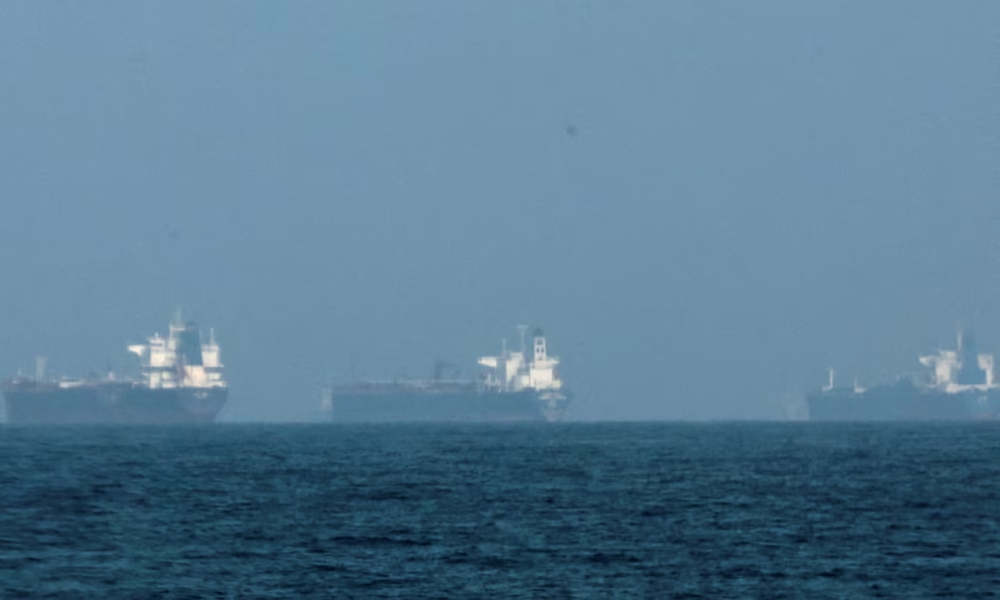
Thousands of seafarers are trapped on tankers in the Gulf after the strait of Hormuz was effectively closed to shipping by the escalating war on Iran.
The Guardian spoke to a crew member on one of the stranded tankers that typically ferries vast quantities of oil from the Middle East to ports around the world.
“When [Donald] Trump said Iran had 10 days to agree to his deal or bad things would happen, I did the math and thought we might get stuck here. And we did,” said the seafarer.
From a cabin below deck, they explained how the crew watched explosions light up the sky as they loaded the vessel with crude oil at an industrial complex in the Gulf.
Initially the crew were told to stop loading the oil, but hours later they were told to return and continue filling the tanker.
“At the time we had no GPS, no communications, and we were sitting on more than a million barrels of floating oil,” said the crew member.
“Now we’re at anchor off the coast of Dubai and it looks like we’re stuck here indefinitely. We’re powerless; just waiting and hoping that nothing hits us.”
After war broke out on Saturday, Iran’s Revolutionary Guards said it would “set ablaze” any western tanker attempting to transit the strait, a body of water through which about a fifth of the world’s oil and liquefied natural gas passes on tankers.
Typically, about 100 tankers pass through the trade artery each day but marine traffic has evaporated as military aggression has increased and insurance costs have soared or cover has been withdrawn. About 200 tankers, which are not under sanctions are stranded in the strait, according to the maritime data firm Lloyd’s List, as well as on hundreds of other vessels, leaving thousands of crew effectively trapped in a war zone.
The seafarer has been on the tanker for three months, and was due to head home to Europe once the vessel was loaded with crude and ready to depart for east Asia. In total there are more than seafarers on board, including nationals from the Philippines and India.
“We send messages every few hours to the tanker owner to report that we are OK. In response we have received generic messages about a mental health hotline. But that’s about that,” they said.
“If they wanted to do more they could start by providing more internet. We get a data allowance for free, and then we need to pay. I’m mostly scrolling news reports or texting friends and family but the internet isn’t always available because the GPS signal here gets jammed by the Iranians or the Americans. My mother is freaking out,” the seafarer added.
The effective blockade has caused oil and gas prices to surge, and threatens to upend the global economy by stoking inflation. The longer the strait is shut off to transit, the greater the risk to the global economy – and the thousands of seafarers held hostage by circumstance.
At least six vessels have been attacked and two seafarers killed. On Wednesday a large explosion was reported on an oil tanker near the coast of Kuwait.
“People are trying to get on with their work, but it does take a toll,” the seafarer said. “And as the days pass, it feels more and more unreal that we are just working normally in the middle of all this. We can hear the military planes, we can see explosions in the sky sometimes, it’s the strangest situation.
“People might go to the gym, or watch movies in the cabins in their downtime. Some guys go fishing in the evening, but for obvious reasons we need to keep lights to a minimum so as not to attract attention.”
Stephen Cotton, the general secretary of the International Transport Workers’ Federation (ITF), a trade union representing 1.2 million seafarers, has been inundated by requests for information from its members.
“Seafarers are sometimes invisible,” he said. “They are always on the frontline and our economies can’t survive [without them]. But let’s be clear: seafarers are innocent civilians. They happen to be on a ship in a region that is incredibly explosive at the moment.”
The union is fielding desperate queries over whether it is possible to repatriate seafarers who want to leave their vessel – and the region.
“You can’t just get off a ship,” Cotton said. “The feedback from most of the ship owners is that it’s a no-go zone. What we are exploring is what we can do.”
The crew member said their tanker has enough food for about 60 days and was fitted with desalination equipment to produce water on board, although rationing may be necessary eventually.
David Appleton, a senior leader at the trade union Nautilus International, said: “I don’t think keeping the ships supplied is the issue. When it all starts dragging on and people are supposed to be relieved and they can’t be, psychological stress becomes the main thing. Many seafarers will remember the pandemic when they were trapped on board for months and months at the time, unable to leave the ship.”
He added: “It’s all obviously up in the air, because we have no idea how long this is going to go on. Our position ultimately is that seafarers shouldn’t be considered expendable. It’s a civilian career.”
No shipowner can force a seafarer to take up a position in a high-risk area, raising the question of who would replace those stuck on board even if a relief mission was logistically possible.
“Who would be willing to take my place? You’d need to be really desperate for work” said the seafarer. “Honestly, when I do get home I want a very large, strong drink as soon as I arrive. But mostly I’m eager to see my pets, my family and my friends. There are hundreds of others in our position and I’m really concerned that we will not be heard, when there are so many more horrible things happening.
“The sad truth is that crew members have already died trying to cross Hormuz, or by just being in the wrong place at the wrong time.”
The Guardian