Environment
Saudi Woman Turns Date Pits into Natural Soap in Al-Ahsa

The activities of Palm Village in Al-Ahsa have provided a competitive and creative platform to showcase innovative agro-processing products derived from palm trees and dates. Participating families working in cottage industry have distinguished themselves by presenting high-quality natural products free from additives, attracting strong visitor interest and generating robust sales.
Among the standout local brands is Afra7 Care, founded by Afrah Al-Harbi, who developed a distinctive “date soap” shaped like a braided Sukkari date. The product is made from Sukkari date pits and palm oil, offering a fully natural formulation without chemical additives. This makes it particularly suitable for children and individuals with sensitive skin who are affected by commercially manufactured soaps.
Al-Harbi explained that the idea of producing soap from date pits began 13 years ago when she sought a natural alternative for her children, who were suffering from severe eczema. Over time, the concept evolved into a refined product that is now showcased at the event.
She added that her participation in Palm Village was supported by the National Center for Palms and Dates, which provided her with the opportunity to present and market her products to visitors and consumers, as well as participate in various exhibitions. She noted that the palm tree has opened broad horizons for success and distinction, transforming her aspirations into tangible achievements. She emphasized that the path to success lies in nurturing and developing creative ideas to compete at the highest levels.
The Palm Village activities in Al-Ahsa, organized by the National Center for Palms and Dates, continue to attract large numbers of families and visitors from across the Kingdom, providing farmers and local producers with valuable opportunities to market their dates and value-added products.
— SPA

Environment
Saudi Arabia builds major waste processing city
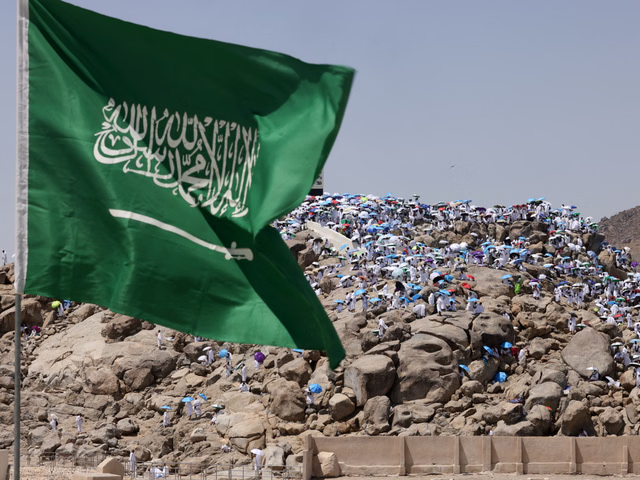
Saudi Arabia is building a large scale waste processing city south of Mecca as part of efforts to strengthen environmental services and support the growing needs of the holy city and surrounding pilgrimage sites.
The project, known as the Waste Processing City, is being developed on an area of 8.5 million square metres and is expected to be completed by the end of 2027.
Authorities said the facility is designed to meet Mecca’s waste management requirements for up to 60 years, supporting the city’s long-term urban growth and the millions of pilgrims who visit annually for Hajj and Umrah.
The project comes as Saudi Arabia continues to expand municipal and environmental infrastructure at the holy sites.
More than 13,000 sanitation workers are currently deployed across Mecca and the holy sites, supported by 3,000 vehicles and pieces of equipment. Authorities have also distributed around 88,000 waste containers across targeted locations to maintain cleanliness during peak pilgrimage seasons.
GN
Environment
How plastic bottle caps became a symbol of EU regulation
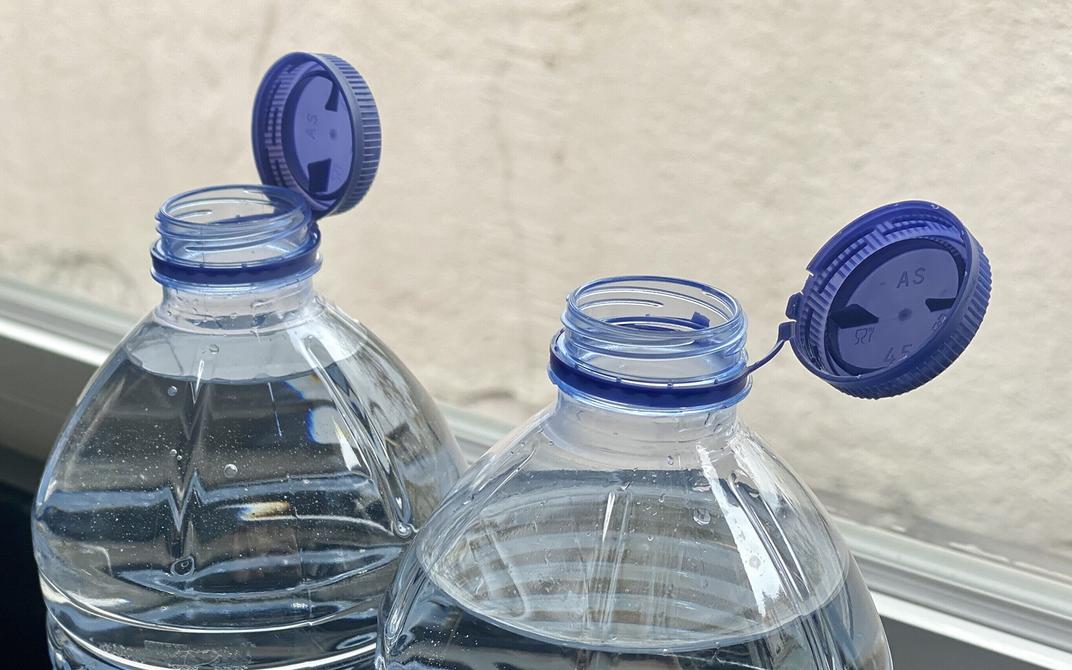
In July 2024, a European Union law came into force requiring plastic bottle caps to remain attached to their bottles. The regulation was widely mocked by social-media jokesters and Silicon Valley billionaires alike. This, people said, was Brussels at its worst: bureaucrats micromanaging, treating citizens like children who couldn’t be trusted to recycle a cap.
What went almost entirely unreported was the evidence behind it. Plastic bottle caps have been identified, across decades of coastal cleanup data, as among the top items found littering European beaches. Small, light and made from a different plastic than the bottle itself, the caps float independently once separated, travelling far longer distances than the bottles they came from. They are far more likely to be swallowed by seabirds, fish and marine turtles who mistake them for food.
Now consider what happened next. After lobbying against the rule, some of the world’s largest beverage companies redesigned their caps and adapted. But companies such as Coca-Cola also did something revealing: while they trumpeted the design of the new caps as a sign of their unwavering commitment to sustainability, they maintained the detachable ones virtually everywhere else. Not because the physics of plastic pollution differ across continents, but because no other country, be it the US or in Asia, has passed a national law requiring the change.
The bottle cap story is a parable for a larger fight playing out at the highest levels of European politics. One side claims that EU rules are the problem: a self-imposed burden of standards on business that slow Europe down while the US and China race ahead. The other says those rules are not a handicap but a source of power, the only instrument a continent without a single government possesses to shape its own economic future while protecting its people and the planet.
At present, the first camp is winning. The political coalition behind it is broad, stretching from Brussels to Berlin, Warsaw and Rome. The argument sounds on the surface entirely reasonable. From that diagnosis follows a programme of “simplification” championed by the European Commission led by Ursula von der Leyen: cuts to environmental protections, digital rules, consumer and food safety requirements. Standards that Europe spent two decades building are being rolled back, all in the name of competitiveness.
There is one problem at the foundation of all this. The diagnosis is at best questionable and at worst wrong.
The red tape explosion that would allegedly account for the widening growth gap with the US is a fiction. The OECD’s latest data shows that the regulatory burden on European business has arguably risen only modestly over the past 15 years.
Even the landmark 2024 report by Mario Draghi, the former chief of the European Central Bank commissioned by the EU to diagnose Europe’s economic weaknesses, cannot substantiate the claim.
The report’s most-cited figure, that more than 60% of EU companies saw regulation as an obstacle to investment in 2023, turns out on inspection to mean that only about 25% identified it as a major obstacle. This share has since risen but a larger proportion of European businesses remain concerned by other obstacles, such as energy costs. More importantly, Draghi’s central demand was not for a less regulated Europe, but a more coordinated, better-funded and strategically capable one.
And even if you accept the diagnosis, the proposed cure – deregulation – barely makes a difference. The European Commission’s own estimate of the annual savings from its entire simplification programme – the legislative packages at the centre of this agenda – is €12bn, or roughly 0.07% of EU GDP.
Europe’s productivity problem is real. But the caricature of a continent collapsing under regulation is not. Much of the apparent US-European growth gap reflects population growth, purchasing power, working hours and the very different social bargain Europe has chosen to preserve. This suggests that Europe does not need to become the US to become more competitive.
Dismantling Europe’s regulatory framework does not merely fail to deliver growth. It surrenders something that Europe has spent decades building. Consider what the targeted rules actually do. When the EU forced Apple to open its App Store to rival app developers and payment routes, Apple complied – at least in Europe. This reveals how EU digital market rules are not costly tick-box exercises, but the actual reason European consumers now have choices – in apps, in payment and platforms – that consumers in the US still lack. The wider European rulebook is also why Google, Meta and Amazon face limits on how they combine, harvest and monetise Europeans’ data. Weaken them, and US platforms – and their tech billionaires – gain even greater control over Europe’s markets and people.
The timing of this push for deregulation is not a coincidence. The Trump administration formally designated Europe’s digital rules as trade barriers, threatened punitive tariffs if Brussels refused to weaken them and demanded their rollback as a condition for any deal on steel and aluminium. The deregulation agenda playing out in Brussels is precisely what Washington has been demanding through every available lever: weaker European rule-making, greater access for American firms and a continent less able to offer an economic or even ideological alternative to the US model.
Europe’s rules are not necessarily constraints, but at their best, they are instruments of power. They shift the burden of collective choices away from individuals and on to the companies best placed to bear them. That is why those companies so often oppose them and why, once the rules exist, they usually comply.
The bottle cap is still attached to the bottle in Europe. The question is whether Europe retains the will to be itself – a political project that uses rules to protect its people and shape global markets – or whether, in the name of competitiveness, it surrenders that power to exactly the interests that want that power gone.
THE GUARDIAN
Environment
Can anime treat depression?

As a teenager struggling to fit into life in rural Sicily, psychiatrist Francesco Panto found refuge in anime, where he discovered characters that resembled the kind of man he wanted to be.
Now living in Japan, Panto thinks anime can benefit others and is trialling whether it could be used as a method of therapy, particularly for people who would otherwise struggle to ask for help.
“The use of manga and anime supported me so much… they were very important emotional support kind of tools,” Panto told AFP.
“Being raised in Italy, in Sicily, there were very strong stereotypes around gender or self-expression. But when I was 12 or 13 years old I started to play this game called ‘Final Fantasy’… and the male protagonists resonated with me.
“They were so masculine and cool, but in their own way.”
Panto’s six-month pilot study into “character-based counselling” at Yokohama City University ended in March.
As part of the trial, he and his team recruited 20 people aged 18-29 who had symptoms of depression and gave them online counselling delivered by a psychologist who appeared on the screen as an anime avatar with a digitally altered voice.
He believes that the “filter of fantasy” can help put people at ease and aid recognition of their problems – and he’s hoping that the trial results will confirm this theory.
From a steady and trustworthy “maternal energy” figure who brandishes an assault rifle, to an emotionally perceptive “prince-like” male who wears a cape, six different characters were created specifically for the study.
Each is based on a particular archetype in Japanese manga, with trial participants given freedom to choose among them.
“I tried to infuse each character with a specific mental struggle. One character is called Kuroto Nagi. She’s affected by bipolar personality traits,” Panto said.
Others struggle with post-traumatic stress disorder or anxiety disorders, or experience problems related to alcohol use.
But the idea is for the avatars to be “fun”, Panto explained, and although the psychologist tells the story of their character at the start of the session, they were instructed not to make mental health issues too obvious.
One 24-year-old trial participant explained how they had been drawn to the study by a description of one of the characters, who was said to be “searching for true strength”.
That “made me feel like it might help me get closer to the answer to my own problems,” said the participant, an anime fan and game developer who could not be identified by name under the rules of the trial. Will to live
The phase-one trial – which tracked participants’ heart rates and sleep – is primarily to test whether anime therapy is feasible and if this kind of treatment can reduce symptoms of depression.
Panto is also considering whether the therapy could be delivered using artificial intelligence, without the medium of a real psychologist.
The research project is one of many trying to find solutions to mental health challenges in Japan including “ikizurasa”, a term for people who find it “difficult to live, difficult to survive in society”, said Mio Ishii, an assistant professor helping lead the project.
“There are many young people who cannot go to school or continue working. So, our scope is to give them… new choices to recover from their difficulties,” she said, adding that there was still huge stigma in Japan attached to seeking help.
As of 2022, only six percent of people in Japan had used psychological counselling for mental health problems, according to data cited on the World Economic Forum website. The rate was much higher in Europe and the United States.
“It can facilitate the expression of emotions… (and) identification and communication between the patient and the therapist,” he said.
Under the rules of the study, the 24-year-old trial participant – whose current favourite anime series include “The End of Evangelion” and “Girls Band Cry” – could not comment on the trial itself.
But they said anime had given them the “will to live, seeing characters who are full of life as they work hard toward their dreams”.
Ishii hopes the therapy could help people of all ages across the world.
“Because usually people have stigmas and psychological barriers to ask for help about their mental health,” she said. “But anime or technology can decrease them.”
GN


UAE Cycling Federation and AB Investment Sign Partnership to Support National Teams and Emerging Talent

Emirati Women’s Day: Hamda Al Mansoori takes UAE-grown ventures from AI and manufacturing to cross-border partnerships

Beyond Uniforms and Lunchboxes: Is Your Child Healthy and Ready for School?

Araghchi, Oman Sultan discuss transit, stability in Muscat

UAE’s café culture keeps growing despite price pressure

Netflix to Livestream BTS Comeback Concert
-
 politics5 months ago
Araghchi, Oman Sultan discuss transit, stability in Muscat
-
 UAE9 months ago
UAE’s café culture keeps growing despite price pressure
-
 Entertainment8 months ago
Netflix to Livestream BTS Comeback Concert
-
 Discover8 months ago
Is February 2026 really a once-in -283-years MiracleIn?
-

 Football9 months ago
Algeria, Burkina Faso, Côte d’Ivoire win AFCON 2025 openers
-

 Health9 months ago
NMC Royal Hospital, Khalifa City, performs rare wrist salvage, restoring function for young patient
-

 Health9 months ago
Bascom Palmer Eye Institute Abu Dhabi and Emirates Society of Ophthalmology Sign Strategic Partnership Agreement
-
 travel9 months ago
Rail routes connecting Saudi Arabia, UAE, Oman, Qatar, Kuwait and Bahrain