
Analytics
Why Iran’s Kharg Oil Hub Is Untouched

Kharg Island – through which 90% of Iran’s oil exports flow – is arguably the country’s most sensitive economic target but the export terminal has so far remained untouched throughout the US-Israel bombing campaign.
Experts say bombing or capturing the site with US forces would be likely to cause a sustained increase to already surging oil prices, as it would amount to taking the entirety of Iran’s daily crude exports offline.
“We may see the $120 a barrel price we saw on Monday heading to the $150 if Kharg were attacked,” said Neil Quilliam, with the Chatham House thinktank. “It’s too vital for global energy markets”.
Although the US has struck 5,000 targets in and around Iran, it has so far refrained from bombing the country’s oil infrastructure – though oil prices remain nearly $20 per barrel higher because the fear of Iranian retaliation has in effect closed the strait of Hormuz to tanker traffic.
Israel’s air force did strike two oil refineries and two depots on Saturday, plunging Tehran into what some residents described as an “apocalyptic” darkness as thick black smoke descended over the capital. But there have been no attacks since.
Kharg, a five-mile-long coral island in the Persian Gulf 27 miles from the mainland, is where pipelines from Iran’s oilfields in the centre and the west of the country terminate. Established by a US oil conglomerate, Amoco, it was seized by Iran during the 1979 revolution.
While most of Iran’s coastline is silty and too shallow for very large crude tankers used by the oil industry, Kharg is sufficiently close to deep waters. Satellite imagery reveals vast loading jetties emerging from its eastern shore.
Typically, between 1.3m and 1.6m barrels of oil a day pass through Kharg, though Iran increased volumes to 3m a day in mid-February, according to the investment bank JP Morgan, in anticipation of a US-led attack. A further 18m barrels are stored on Kharg as a backup, the bank added.
Media reports have hinted at White House interest, including a brief reference in an Axios report on Saturday that officials had considered “seizing Kharg”. The US defence secretary, Pete Hegseth, has not ruled out attacking Iran with ground forces, although there are not large numbers of US troops in the region.
Michael Rubin, a senior Pentagon adviser on Iran and Iraq in the George W Bush administration, said last week he had discussed the idea with White House officials, arguing it could be a way to cripple the Iranian regime economically. “If they can’t sell their own oil, they can’t make payroll,” he said.
Before the latest US-Israel offensive, most of Iran’s crude oil from Kharg was exported to China. But the interconnected nature of the market means a permanent loss in export supply would affect prices globally, at a time when a further 3.5m barrels a day, mostly from Iraq, are also offline because of the closure of Hormuz.
Destroying Kharg or damaging the export site “runs the risk of causing an economy-shaping increase in oil price that would not drop rapidly”, argues Lynette Nusbacher, a former British army intelligence officer. Israel did not attack it in last summer’s 12-day war, and its complex infrastructure could take years to repair.
There is also a longer-term political argument. “Kharg Island is sufficiently important to the Iranian economy that destroying its facilities would abandon any pretence of fighting a war to create a brighter future for Iran,” Nusbacher argues, because it would deny a successor regime vital oil income.
An effort to seize the island, given its size, would be likely to require a sizeable and sustained operation, greater than a typical special forces incursion. Though a US seizure would in theory give the White House leverage over Tehran, Quilliam argued it was very likely that such an effort would be self-defeating.
“If the US were to seize it, then you are separating the Iranian oil industry. Iran would have production but couldn’t export, while the US wouldn’t be able to produce. That would set markets in a tailspin; that’s a real standoff,” the analyst said.
The Guardian
Analytics
How China can survive without the Strait of Hormuz
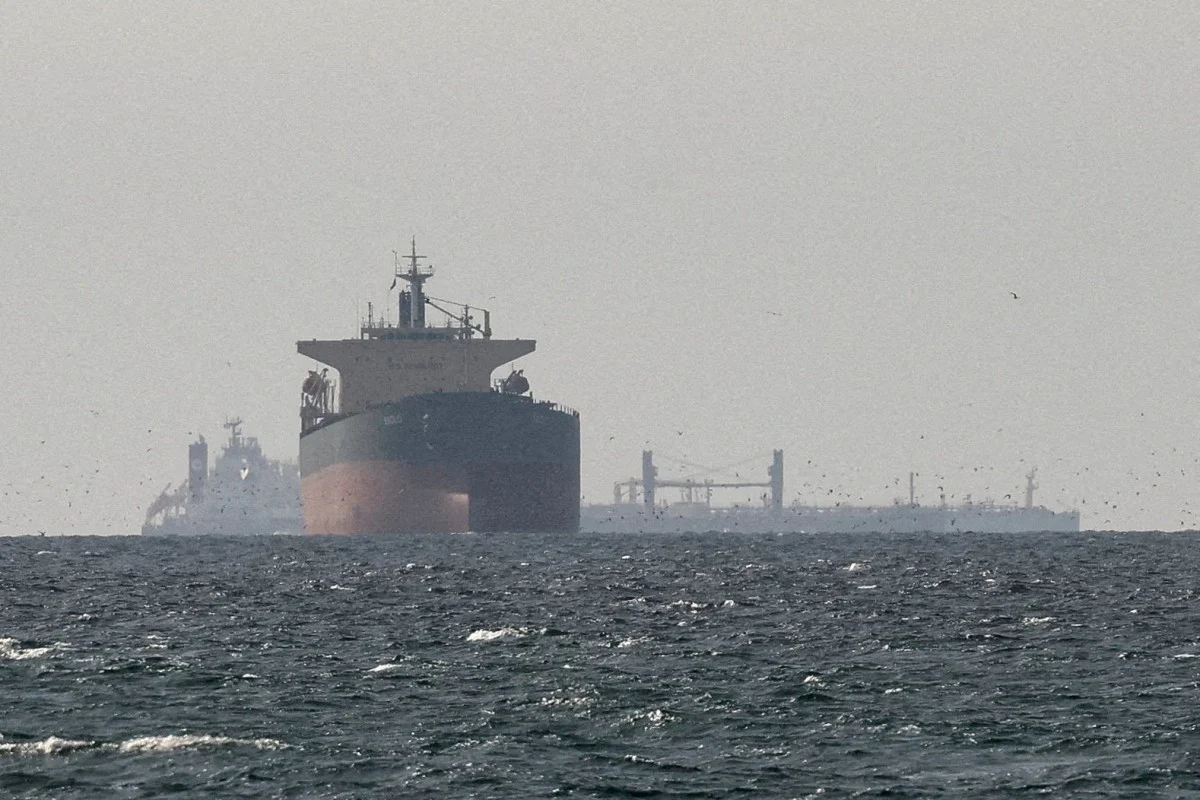
The world’s largest importer of oil through the Strait of Hormuz is, paradoxically, also one of the best placed to weather the waterway’s closure.
China consumes oceans of oil from the Gulf and imports roughly as much from the region as India, Japan and South Korea combined. In response to the closure of the Strait, officials across Asia are asking citizens to take shorter showers or work from home to save energy. In China, the ruling Communist Party’s flagship newspaper is instead telling readers the country holds its own “energy rice bowl.”
While the editorial does not mention that Beijing has unofficially banned fuel exports to conserve supplies, the country is nonetheless more insulated than many of its neighbours thanks to years of policy measures that have reduced its vulnerability to energy shocks.
China boasts an electric vehicle fleet about as large as the rest of the world’s combined, vast and growing oil stockpiles, diversified supplies of oil, and gas and an electricity grid that is almost insulated from imports thanks to domestic coal and renewables.
“The current situation is really close to what Chinese planners have had in mind for decades,” said Lauri Myllyvirta, co-founder of the Centre for Research on Energy and Clean Air in Finland.
“It validates the drive to reduce reliance on seaborne fossil fuels.”
The unexpected EV boom
In late 2020, Beijing issued a goal for electric vehicle purchases to hit 20% of new sales in 2025. By last year, sales hit half of all new vehicles.
That unexpected boom in EVs means China’s fuel consumption has topped out after decades of breakneck growth. The country is burning and importing less oil than it was expected to just a few years ago.
Oil displaced by EVs last year was roughly equal to what China imported from Saudi Arabia, according to estimates from the Centre for Research on Energy and Clean Air.
The EV boom means China imports much less oil
Annual oil consumption displaced by electric vehicles in China
An insulated electricity grid
China’s electricity grid is powered almost entirely by coal and rapidly growing renewable energy. The boom in clean energy, which has exceeded Beijing’s own targets, is such that almost all the extra power the economy requires each year is met with new solar or wind. That means fewer coal imports and less liquefied natural gas (LNG) imported into the handful of coastal provinces where it is part of the electricity mix.
Lots of oil, but many suppliers
China imports lots of oil, but in contrast to other major Asian importers, it is careful to stay independent of any one supplier.
Take Japan: Tokyo normally buys nearly 80% of its oil from Saudi Arabia and the United Arab Emirates. China bought the same share of oil from eight countries, including large amounts of discounted oil from Russia, Venezuela and Iran, which U.S. sanctions place off limits for most buyers.
China keeps its oil imports diversified
Crude oil import volumes by origin for major importers. Less than 20% of China’s oil imports are from any one source.
China also funnels a share of those imports into the storage tanks of its secretive strategic petroleum reserve. No one knows exactly how big the reserves are, but combined with stocks held by commercial refiners, China has enough oil in storage to replace imports via the Strait of Hormuz for perhaps seven months by some estimates.
China has enough oil stored to cover seven months of imports via Hormuz
Domestic production is growing
China produced 4.3 million barrels per day of oil last year, a new record that was equal to about 40% of all oil imports. However, oil reserves are drying up and China is unlikely to replicate the U.S. shale oil boom.
Gas, however, is another story. Domestic production is growing fast enough that, combined with gas imported via pipeline, China is actually importing less LNG than it did in 2020.
China’s pipeline network allows it to diversify away from seaborne imports and source oil and gas from Russia, central Asia and Myanmar. Ambitious plans have been proposed for another Russian-China pipeline, the Power of Siberia 2, however it remains years from completion.
China’s pipeline gas imports have steadily risen since the Power of Siberia
Island neighbors such as Japan or Korea do not share the same geographic advantage
A more secure future
For decades China’s growth has been fueled by fossil fuels imported from overseas, in particular crude oil. But thanks to the EV boom, China is unhitching its growth engine from foreign oil.
“China’s oil demand is likely to peak this year and decline thereafter,” said Chen Lin, vice president of oil and gas research at Rystad Energy. “So although the import share will remain high, the situation is unlikely to worsen.”
Reuters
Analytics
Saudi Arabia to burn more oil for power this summer
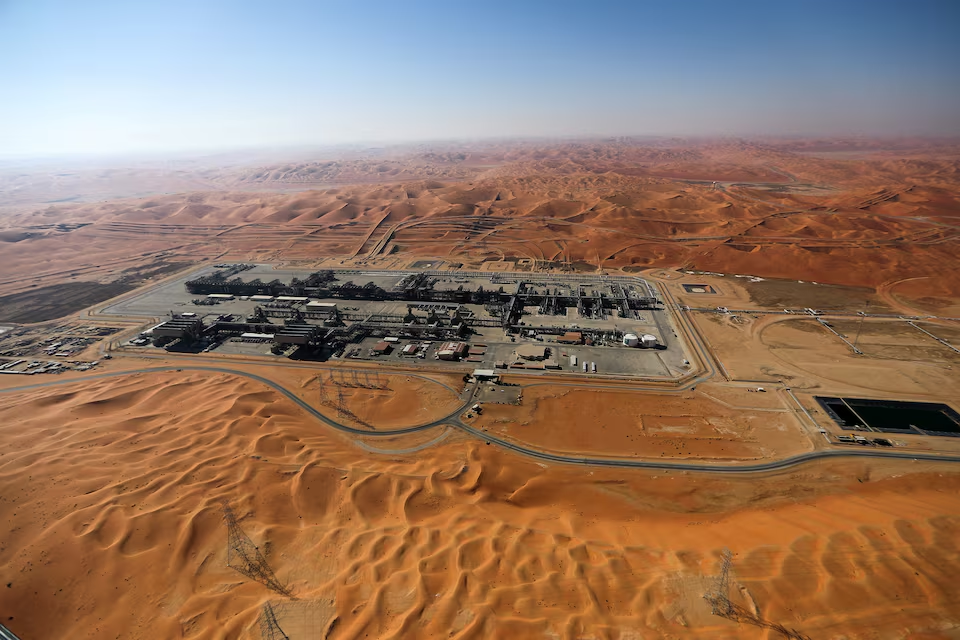
Saudi Arabia is expected to burn more imported fuel oil for power generation this summer following a loss of natural gas supply from oilfields that have been shut after the Iran war curbed its oil exports, analysts said.
The rise in fuel oil use at power plants just as electricity demand jumps for cooling in the summer marks a setback for the kingdom’s push to switch to cleaner fuels.
The world’s top oil exporter has been forced to shut more than 3 million barrels per day of oil production after an Iranian blockade on the Strait of Hormuz halted crude exports from Ras Tanura, which in turn has reduced output of gas released with oil production.
Gas output slipped to 10.5 billion cubic feet per day (bcfd) in the first quarter, from 10.7 bcfd in the fourth quarter of 2025, despite the start-up of the Jafurah gas field in December, Saudi Aramco (2222.SE), opens new tab said in its latest quarterly earnings report.
To replace gas at power plants, Aramco ramped up fuel oil imports to about 1.7 million tons (360,000 bpd) in April, up 86% on-year, Vortexa data showed, with most of these imports discharged at terminals linked to power and desalination plants including Jeddah South and Shuqaiq Steam.
“The sharp increase in fuel oil imports is a leading indicator that oil burn will rise above year-ago levels,” Rahul Choudhary, vice president, oil & gas research at consultancy Rystad Energy, said.
The kingdom’s power demand typically rises from April and peaks in August, boosting crude, high-sulphur fuel oil (HSFO) and gas use at power plants.
The burning of crude and fuel oil for power could breach 1 million barrels per day this summer, countering efforts to switch to more gas and renewables and undoing the 991,000 bpd low seen in 2025, Choudhary said.
Saudi Aramco declined to comment. The Saudi government communications office did not respond to a request for comment.
ARAMCO PRIORITISES CRUDE FOR EXPORTS
Saudi Aramco is expected to burn less crude for power this summer as it prioritises crude, mostly Arab Light, for export via the East-West pipeline to the Red Sea port of Yanbu and as HSFO is cheaper than Saudi crude, analysts said.
Last year, Saudi Arabia’s direct crude burn averaged 593,500 barrels per day (bpd) between June and September, data from the Joint Organisations Data Initiative (JODI) showed.
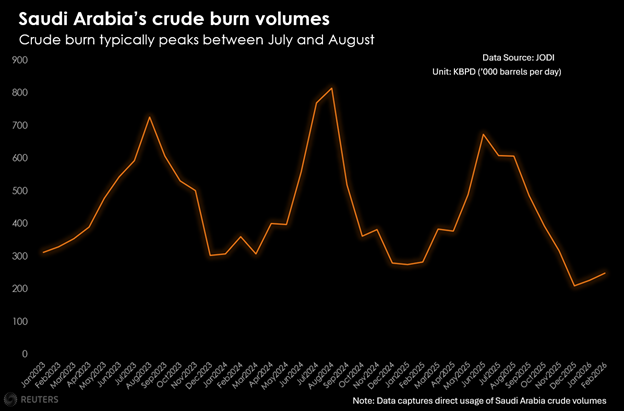
Crude burn typically peaks between July and August
Analysts’ views vary on how much crude Saudi Arabia will burn for power generation this summer.
Wood Mackenzie expects a 5,000 to 15,000 bpd drop in crude burn from an average of 629,000 bpd in June to August 2025.
“Every barrel of Arab Light crude burned domestically represents a significant loss in windfall export revenue,” said Jayadev D, oil research analyst at WoodMac.
Rystad Energy expects crude consumption for power to average about 540,000 to 550,000 bpd this summer.
“However, if the Hormuz disruption deepens or extends well into Q3, Aramco may pivot from substitution to direct crude burn as a contingency,” Choudhary said.
Koen Wessels, head of demand at Energy Aspects, expects Saudi Arabia to burn more crude this summer than in 2025 as it is constrained by how much crude supply it can divert to Red Sea ports.
Energy Aspects expects Hormuz transits to remain disrupted through the end of May, with a 50% recovery on pre-war tonnage in June, 60% in July and 70% in August, Wessels said.
Thomson Reuters
Analytics
How Much People Save Around the World
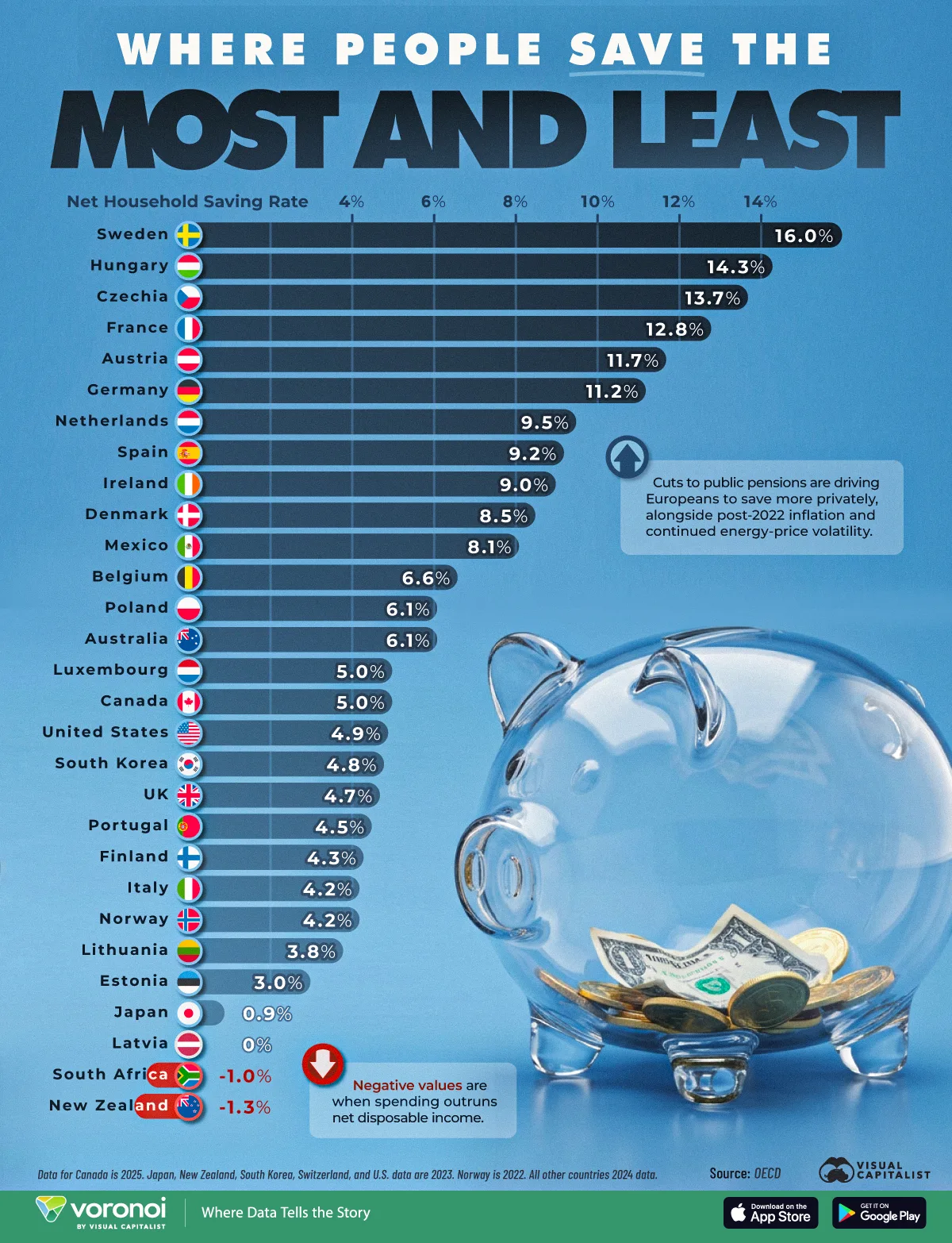
This chart ranks household savings rates across major economies using the latest OECD data. It reveals a wide gap between top savers and those struggling to set money aside. In countries like Sweden and Hungary, households save more than 10% of their income. In the U.S., that figure is just 4.9%.
In some cases, the gap is even more striking. Americans save roughly half as much as households in Mexico, highlighting how cost pressures and consumption patterns differ across economies.
How Much People Save by Country
Sweden ranks as the most disciplined saver, with net household savings rates rising nearly eightfold from 2.3% to 16% over the past two decades.
Many European countries also rank at the top of the list. Households continue to set aside a relatively large share of their income, including Hungary (14.3%) and France (12.8%). These elevated rates are often linked to structural factors such as pension systems and aging
he table below shows savings rates by country in 2024, or the latest available data:
| Country | Net Saving Rate (% of net disposable income) |
| 🇸🇪 Sweden | 16.0% |
| 🇭🇺 Hungary | 14.3% |
| 🇨🇿 Czechia | 13.7% |
| 🇫🇷 France | 12.8% |
| 🇦🇹 Austria | 11.7% |
| 🇩🇪 Germany | 11.2% |
| 🇳🇱 Netherlands | 9.5% |
| 🇪🇸 Spain | 9.2% |
| 🇮🇪 Ireland | 9.0% |
| 🇩🇰 Denmark | 8.5% |
| 🇲🇽 Mexico | 8.1% |
| 🇧🇪 Belgium | 6.6% |
| 🇵🇱 Poland | 6.1% |
| 🇦🇺 Australia | 6.1% |
| 🇱🇺 Luxembourg | 5.0% |
| 🇨🇦 Canada | 5.0% |
| 🇺🇸 United States | 4.9% |
| 🇰🇷 South Korea | 4.8% |
| 🇬🇧 United Kingdom | 4.7% |
| 🇵🇹 Portugal | 4.5% |
| 🇫🇮 Finland | 4.3% |
| 🇮🇹 Italy | 4.2% |
| 🇳🇴 Norway | 4.2% |
| 🇱🇹 Lithuania | 3.8% |
| 🇪🇪 Estonia | 3.0% |
| 🇯🇵 Japan | 0.9% |
| 🇱🇻 Latvia | 0.0% |
| 🇿🇦 South Africa | -1.0% |
| 🇳🇿 New Zealand | -1.3% |
In the middle of the pack, savings rates drop off quickly. The U.S., Canada, and the UK all cluster around 5% or lower, far behind top European savers. The gap is particularly striking when compared globally. U.S. households save about half as much as those in Mexico, and less than one-third of what households in Sweden set aside each year.
At the bottom of the ranking, the picture flips entirely. In countries like New Zealand and South Africa, households are not saving at all. Instead, they are spending more than they earn.
Negative savings rates typically mean people are dipping into past savings or taking on debt to cover everyday expenses, a sign of financial strain rather than choice.
What It Means Going Forward
Savings rates are a key signal of financial resilience.
Countries where households consistently save more tend to have a stronger buffer against inflation, job losses, or economic shocks. Higher savings can also support long-term investment and stability.
On the other hand, persistently low or negative savings rates can point to underlying pressure. When households have little margin to save, economies may become more vulnerable to downturns, rising debt levels, and weaker consumer spending over time.
Visual Capitalist


Emirates Specialty Hospital Expands Cancer Care Services in Dubai with Opening of Dedicated Chemotherapy Unit

When Rheumatoid Arthritis Threatened Her Independence: How the Right Diagnosis Helped Her Get Her Life Back

Saudi German Hospital Dubai Launches Mental Health and Wellness Center for Children and Adolescents

Araghchi, Oman Sultan discuss transit, stability in Muscat

UAE’s café culture keeps growing despite price pressure

Netflix to Livestream BTS Comeback Concert
-
 politics6 months ago
Araghchi, Oman Sultan discuss transit, stability in Muscat
-
 UAE10 months ago
UAE’s café culture keeps growing despite price pressure
-
 Entertainment9 months ago
Netflix to Livestream BTS Comeback Concert
-
 Discover9 months ago
Is February 2026 really a once-in -283-years MiracleIn?
-

 Football10 months ago
Algeria, Burkina Faso, Côte d’Ivoire win AFCON 2025 openers
-

 Health10 months ago
NMC Royal Hospital, Khalifa City, performs rare wrist salvage, restoring function for young patient
-

 Health10 months ago
Bascom Palmer Eye Institute Abu Dhabi and Emirates Society of Ophthalmology Sign Strategic Partnership Agreement
-

 Health11 months ago
Emirates Society of Colorectal Surgery Concludes the 3rd International Congress Under the Leadership of Dr. Sara Al Bastaki