
COMMUNITY
Homebuyers flock to Saudi city as demand rises
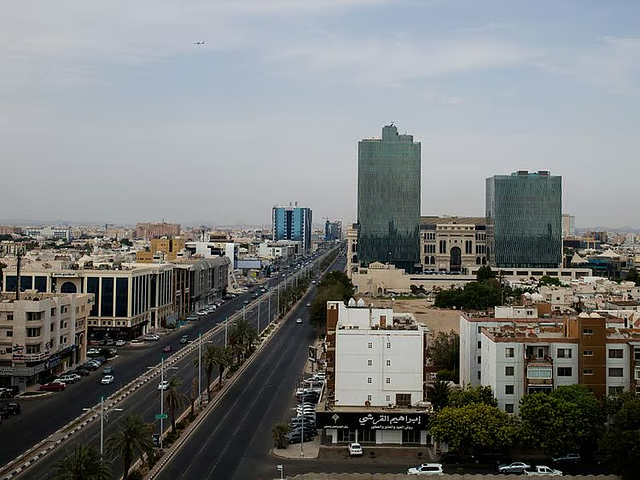
Saudi Arabia’s housing market is beginning to diverge across cities, with Jeddah recording its strongest year in recent memory while Riyadh shows signs of strain and Dammam gains ground on pricing appeal.
According to Cavendish Maxwell’s 2025 KSA Residential Real Estate performance report, Jeddah saw 30,500 residential transactions in 2025, with total sales reaching SAR36.6 billion. The average deal size stood at SAR1.2 million, reflecting steady end-user demand even as market conditions shifted.
That contrasts with Riyadh, where activity slowed despite larger ticket sizes, suggesting a shift in how buyers approach the market.
Dammam draws buyers on pricing
Dammam is emerging as a preferred market for buyers seeking relative value.
Sales values climbed close to 30% to SAR10.7 billion, with transaction volumes also rising, supported by more accessible pricing and steady economic activity in the Eastern Province.
“KSA’s three major residential markets – Riyadh, Jeddah and Dammam – delivered contrasting performances in 2025. Jeddah showed resilience with its highest sales volumes for several years and is expected to maintain stable growth in the future. Dammam, where property is more affordable compared to other cities, was the standout performer and is poised for sustained growth supported by competitive pricing and robust economic activity in the region,” said Siraj Ahmed, Director, Head of Strategy and Consulting at Cavendish Maxwell.
Riyadh demand adjusts to higher costs
Riyadh remains the largest market by value, with SAR96.2 billion in residential sales across 56,600 transactions. Yet volumes fell 31% year-on-year, indicating pressure on buyer activity.
Higher property prices and financing costs have reduced purchasing power, even as average transaction values reached SAR1.7 million.
“In Riyadh, affordability constraints and elevated financing costs led to a decline in purchasing power and buyer activity. Although transactions were down year-on-year, population growth, urbanisation and housing initiatives should support long-term market demand,” Ahmed said.
Policy shifts begin to take effect
Recent policy changes are expected to influence pricing and supply over the coming quarters.
A five-year rent freeze introduced last year and adjustments to the White Land Tax are aimed at encouraging development and improving affordability, particularly in Riyadh.
“We expect a recalibration of the market as new supply, the 5-year rent freeze and White Land Tax reforms make property more competitively priced and lead to a recovery in market activity,” Ahmed said.
Supply builds, but delivery remains uneven
New supply continues to enter the market, though completion timelines remain fluid.
Riyadh added 13,000 units last year, taking total inventory to 1.93 million, with tens of thousands more planned through 2027. Jeddah’s pipeline is also expanding, while Dammam is set to add new stock over the same period, giving buyers more options and greater negotiating power.
“The expansion in supply is further supported by the recent rise in White Land Tax, which encourages landowners to develop empty plots of land and accelerate delivery timelines. The full impact of this reform will likely materialise through this year and beyond, with the gap between demand and supply gradually narrowing, in turn easing price pressure and enhancing affordability,” Ahmed said.
Foreign ownership widens the base
A new foreign ownership law introduced earlier this year is expected to draw a broader investor base into the market.
The framework allows non-Saudi buyers to acquire property in designated zones, marking a shift from earlier restrictions and opening the sector to additional capital.
Demand remains supported despite risks
Oil price swings and geopolitical developments remain key variables, though underlying demand drivers continue to hold.
“External factors including oil market volatility and geopolitical tensions of course warrant close monitoring, but Saudi’s residential market remains well positioned, supported by strong demographic drivers, ongoing infrastructure investment and a continued commitment to Vision 2030,” Ahmed said.
GN
COMMUNITY
Hajj 2026 begins in Saudi Arabia
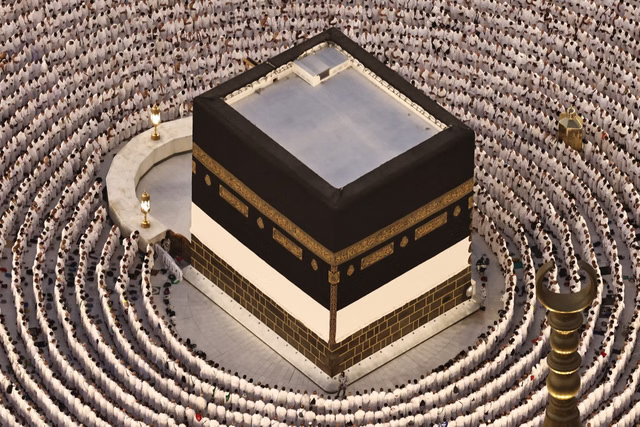
The annual Hajj pilgrimage, one of the Five Pillars of Islam, officially began on Monday, with more than 1.5 million pilgrims arriving in Saudi Arabia from abroad.
Saudi officials said the influx comes as the region remains on edge due to a fragile ceasefire linked to the Iran war and wider geopolitical uncertainty.
Saleh bin Saad Al Murabba, commander of the Hajj passport forces, said the foreign pilgrim arrivals had surpassed 1.5 million. Many worshippers described a mix of gratitude and relief at being able to undertake the journey.
Egyptian pilgrim Samya Abdul Moneim said she felt blessed to have reached Mecca. “I am in a state of blessing and happiness,” she said. “It’s an indescribable feeling, truly. Thank God, I am in a blessing.”
Pilgrims endure sweltering conditions
As temperatures soar, pilgrims have been performing rituals in intense heat, circling the Kaaba in Mecca’s Grand Mosque while using umbrellas, fans and water sprays to cope.
Large crowds typically move to a vast tent city in nearby Mina at the start of the pilgrimage. Volunteers have been distributing water, while cooling systems and misting fans are being used to reduce heat stress.
The Hajj, performed over several days, is a deeply spiritual journey for Muslims, offering a chance for repentance, prayer and renewal.
Faith and global uncertainty shape journey
Many pilgrims said they undertook the journey amid regional instability and global tensions, relying on faith and preparation.
The pilgrimage is unfolding against the backdrop of ongoing Middle East tensions, including the Iran conflict and uncertainty over a ceasefire.
A potential reopening of the Strait of Hormuz has been linked to broader efforts to ease global energy pressures following disruptions caused by earlier attacks in the region. Oil and gas prices have remained volatile amid the instability.
The United States has maintained pressure on Iran through a blockade of its ports, while diplomatic discussions on a possible agreement continue.
Key Hajj rituals ahead
Pilgrims will soon travel to Mina to continue rituals in the tent city before gathering at Mount Arafat on Tuesday — the most significant day of Hajj. There, worshippers stand in prayer, seek forgiveness and offer supplications in one of the most spiritually important moments of the pilgrimage.
Many pilgrims carry written prayers from loved ones and spend the day in intense devotion and reflection.
Gulf news
COMMUNITY
Saudi Arabia unveils plan to ensure pilgrim safety during 2026 Hajj season
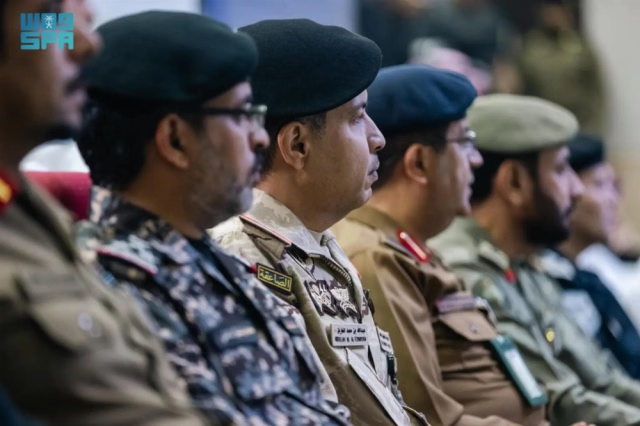
Saudi Arabia’s Ministry of Defence has completed preparations for the 2026 Hajj season under a comprehensive operational plan involving military, civilian, medical and technical personnel deployed across Mecca, Medina and the holy sites.
The ministry said the plan was designed to support security and government agencies in ensuring the safety of pilgrims and facilitating their movement during the annual pilgrimage.
Land forces will assist with crowd management and the detection of hazardous materials, while the Royal Saudi Air Force will monitor airspace, manage air traffic and carry out emergency surveillance operations, the ministry said.
Naval forces will support security operations at seaports and the holy sites through explosive detection teams, drone operations and search-and-rescue units.
The ministry added that its medical services division had deployed healthcare missions across 41 locations, including hospitals and clinics equipped with more than 1,100 beds and staffed by over 2,160 medical personnel.
Air medical evacuation services using four fully equipped aircraft will operate around the clock during the pilgrimage season, officials said.
The ministry also said it would provide religious guidance programmes and host foreign military attachés, in addition to accommodating families of martyrs and injured personnel involved in coalition operations.
GN
COMMUNITY
Hajj 2026: What every pilgrim should know
Imagine saving up for years, perhaps decades, for a single journey. You pack your bags, say goodbye to your loved ones, and travel thousands of miles to a place you have only ever seen in pictures or dreamed about at night.
That is what Hajj means to a Muslim. It is not a holiday or a tourist trip. It is a calling from God. Of the five core pillars that hold up the religion of Islam, Hajj is the fifth.
It is the pilgrimage to Mecca, and for anyone who is able, it is expected to be done at least once in a lifetime. But why is it so special?
Because Muslims believe that Hajj brings along a rare and beautiful chance to wipe the slate completely clean, to ask for forgiveness, and to return home as if they were just born, free of sin.
The Prophet Muhammad, peace be upon him, once said that whoever performs Hajj sincerely, without any bad behaviour, will come back as pure as the day their mother brought them into this world. That is a promise that fills hearts with hope. We are less than two weeks away
Right now, we are less than two weeks away from one of the most sacred times of the year. Hajj 2026 is expected to begin on Monday, May 25, and will continue until Saturday, May 30.
The most important day of all, the Day of Arafah, will likely fall on Tuesday, May 26, and then Eid Al Adha will follow on Wednesday, May 27.
If you know someone travelling for Hajj this year or are preparing for the journey yourself the coming days are likely already filled with prayer, preparation and emotional readiness for one of Islam’s most sacred experiences.
Who actually has to go? And who does not?
Hajj is a duty, but God is kind and does not ask for what is impossible. So who is expected to go?
Only those who are Muslim, grown up, of sound mind, physically strong enough to handle the journey, and able to afford it without begging or going into debt.
That sounds like a lot, but it is really just common sense. If you have a long term illness that leaves you bedridden, if you are elderly and frail, if you have a mental or physical disability that stops you from completing the rites, or if you simply do not have the money after paying for food, rent, and looking after your children, then you are not required to go.
Children are also exempt, although some families take them along for the blessing. And here is the beautiful part: there is no guilt, no shame, and no sin in staying home if you genuinely cannot go.
God sees your heart and your situation. Even the Prophet’s own wife, Aisha, narrated that the Prophet said there is no greater reward than for someone who intends to do good but is prevented by a genuine excuse.
What to keep in mind as the days tick down
If you are preparing to leave in less than two weeks, there are a few things that deserve your attention more than anything else. First, your body needs to be ready. Hajj is not easy.
You will walk between five and fifteen kilometres every single day, often under the hot sun, moving between Mecca, Mina, Arafat, and Muzdalifah with millions of other people.
So start walking now. Go for gentle walks around your neighbourhood, drink plenty of water, eat properly, and if you take any medication, see your doctor for a final check up. This is not about being an athlete. It is about being kind to your own body so that you can focus on your soul.
Second, there is a state called Ihram. It is not just clothing. It is a mood, a mindset, a promise you make to yourself and to God. When you enter Ihram, you are saying: I will not argue. I will not shout. I will not fight. I will not cut my hair or my nails. I will not wear perfume.
For men, Ihram means two simple white sheets without any seams. For women, it means modest clothing that leaves the face and hands uncovered. That is it. No designer labels, no jewellery, no signs of wealth or status.
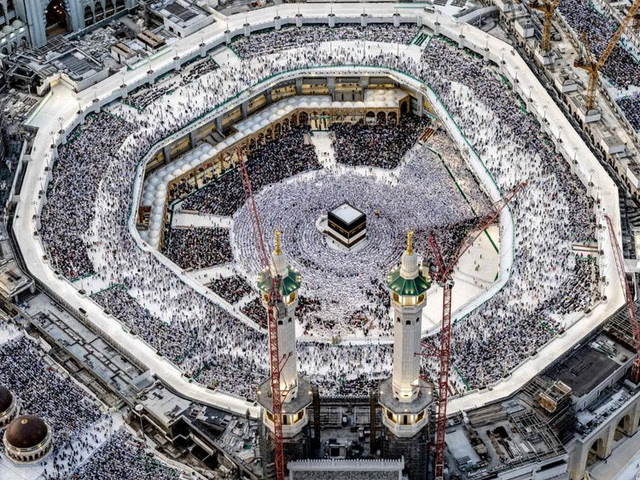
A million people dressed in white, standing together, rich and poor, king and worker, all looking exactly the same. That image alone is enough to bring tears to your eyes because it shows what really matters.
Third, please think about safety. The biggest dangers during Hajj are not spiritual but practical. Crowds can be overwhelming. People can get lost, separated, or hurt. So make a plan with your group.
Carry identification. Keep your phone charged. Agree on a meeting point before you go anywhere. Listen to the Saudi authorities and your group leader because they are there to protect you.
And do not forget simple health basics like wearing a mask in crowded areas, washing your hands often, and carrying your medicines with you wherever you go.
Finally, and perhaps most importantly, check your intention deep inside your heart. Are you going for show? For pictures on social media? To tell everyone back home that you made it?
Or are you going for God alone? Hajj is a private conversation between you and your Creator. No one else needs to know how much you cried or how long you prayed. Do it for Him, and you will find peace.
What actually happens during hajj? A gentle walk through
You might be wondering what a pilgrim actually does day by day. Let us walk you through it like a story. It all begins with the intention and entering Ihram.
Then you arrive in Mecca and stand before the Kaaba, that beautiful cube shaped building that Muslims around the world turn toward when they pray. You circle it seven times, slowly, counter clockwise, and it is called Tawaf.
After that, you run seven times between two small hills, Safa and Marwah, remembering a desperate mother named Hajar who ran back and forth looking for water for her baby in the burning desert.
Then you head to Mina, a tent city where you spend a night praying and resting. The next morning, you go to the plain of Arafat, and this is the heart of Hajj. You stand there from noon until sunset, just standing, praying, crying, asking, hoping.
The Prophet said that Hajj is Arafat, meaning if you miss this day, you miss Hajj entirely. After sunset, you move to Muzdalifah, where you sleep under the open sky with nothing but a small mattress or the ground itself.
You collect tiny pebbles because tomorrow you will throw them at pillars that represent the devil. You throw seven pebbles on the first day, then more on the following days, to remember Prophet Ibrahim who threw stones at the devil when he tried to stop him from obeying God.
Then comes the sacrifice of an animal, which we call Qurbani, to honour Ibrahim’s willingness to sacrifice his own son before God provided a ram instead. You shave your head if you are a man, or you clip a small bit of hair if you are a woman, as a sign of renewal.
Then you go back to Mecca for another Tawaf, and finally, before leaving the holy city, you say goodbye with a Farewell Tawaf, circling the Kaaba one last time with a heavy heart.
Hajj and Umrah are not the same thing
Some people confuse Hajj with Umrah, so let me clear that up quickly. Umrah is a shorter, simpler pilgrimage that you can do any day of the year. It is not required, but it is beautiful and rewarding.
Hajj is the one that is required, but only once in your life, and only during these specific five or six days of Dhul Hijjah. Think of Umrah as a short visit and Hajj as the full, once in a lifetime journey.
A final advice
If you are leaving in less than two weeks, pack lightly but wisely. Take your Ihram, comfortable sandals that you have worn before, any medicines you need, unscented soap, a sleeping bag or blanket for the cold night at Muzdalifah, and a small backpack.
Learn the Talbiyah, that beautiful prayer that pilgrims repeat over and over: “Here I am, O God, here I am.”
And when you stand on Arafat, do not forget your loved ones. Do not forget your parents, your children, your neighbours, and every Muslim everywhere who cannot be there with you.
The Day of Arafah is the best day in the entire year for prayer, and your du’a on that day is never rejected. So pray for peace, for healing, for forgiveness, and for unity.
GN


Emirates Specialty Hospital Expands Cancer Care Services in Dubai with Opening of Dedicated Chemotherapy Unit

When Rheumatoid Arthritis Threatened Her Independence: How the Right Diagnosis Helped Her Get Her Life Back

Saudi German Hospital Dubai Launches Mental Health and Wellness Center for Children and Adolescents

Araghchi, Oman Sultan discuss transit, stability in Muscat

UAE’s café culture keeps growing despite price pressure

Netflix to Livestream BTS Comeback Concert
-
 politics6 months ago
Araghchi, Oman Sultan discuss transit, stability in Muscat
-
 UAE10 months ago
UAE’s café culture keeps growing despite price pressure
-
 Entertainment9 months ago
Netflix to Livestream BTS Comeback Concert
-
 Discover9 months ago
Is February 2026 really a once-in -283-years MiracleIn?
-
 Football10 months ago
Algeria, Burkina Faso, Côte d’Ivoire win AFCON 2025 openers
-
 Health10 months ago
NMC Royal Hospital, Khalifa City, performs rare wrist salvage, restoring function for young patient
-
 Health10 months ago
Bascom Palmer Eye Institute Abu Dhabi and Emirates Society of Ophthalmology Sign Strategic Partnership Agreement
-

 Health11 months ago
Emirates Society of Colorectal Surgery Concludes the 3rd International Congress Under the Leadership of Dr. Sara Al Bastaki