
Discover
GLP-1 diabetes drugs could stop anxiety and depression
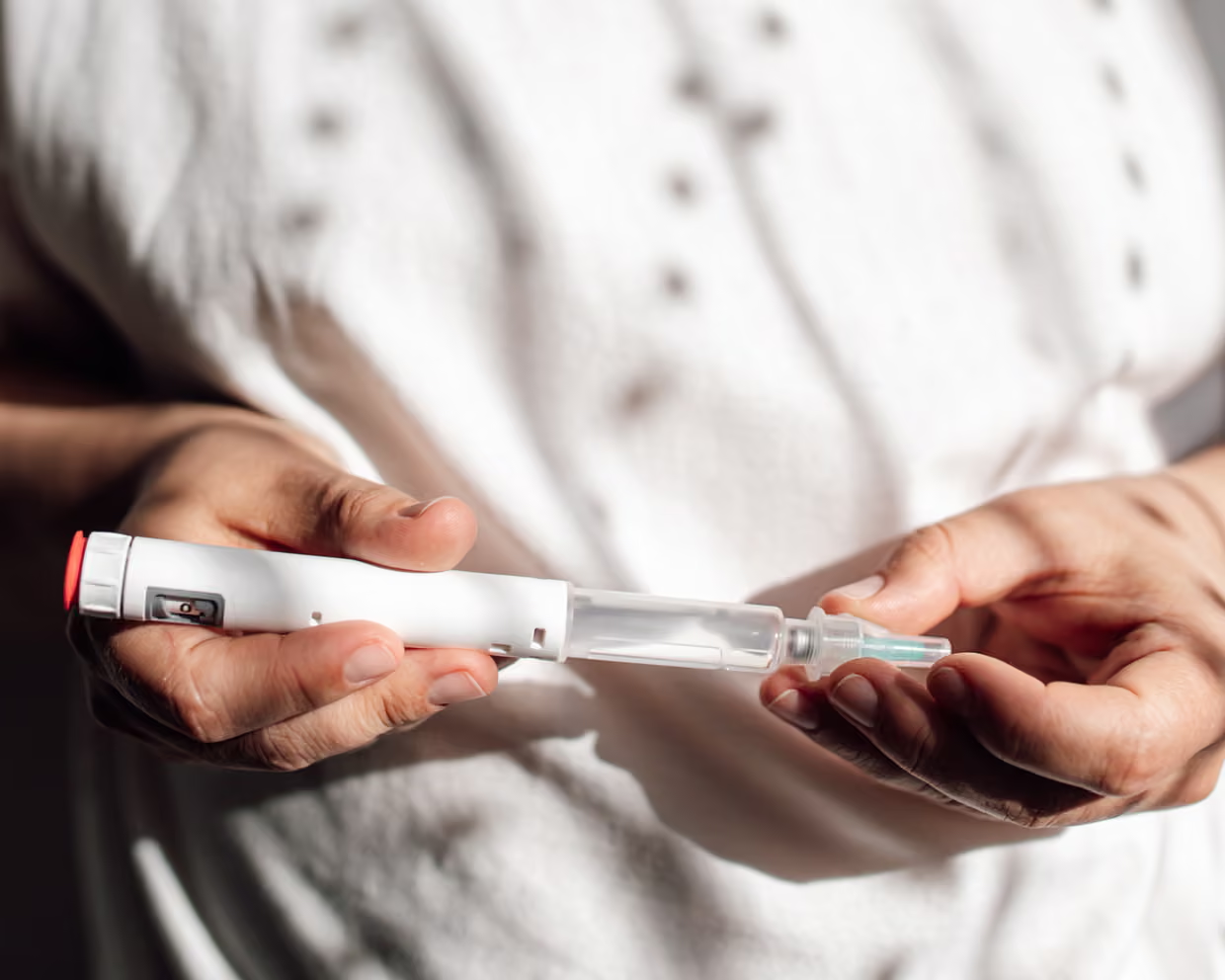
Diabetes drugs could prevent anxiety and depression from worsening, according to research.
Type 2 diabetes affects more than 800 million people globally and research shows that those with the condition are about twice as likely to have depression as the wider population.
GLP-1 receptor agonists such as semaglutide are commonly prescribed for diabetes and obesity. While studies have found other health benefits beyond weight loss and better blood sugar levels, the medications’ effects on mental health have been unclear.
International researchers examined Swedish health records of almost 95,000 people with a diagnosis of depression or anxiety who were also taking various diabetes medications between 2009 and 2022.
The study compared periods when patients were taking GLP1s, or other second-line diabetes medications, with when they were not taking them. Worsening mental health was assessed through data on psychiatric hospital admissions, sick leave from work due to mental health reasons, hospitalisation owing to self-harm and death by suicide. Published in the Lancet Psychiatry, the research also examined data on new diagnoses of anxiety and depression.
The authors found that semaglutide, the active ingredient in the drugs Ozempic for diabetes and Wegovy for weight loss, as well as liraglutide (Saxenda) were associated with a lower risk of worsening mental illness in those with anxiety and depression.
Semaglutide had a 42% lower risk of worsening mental health, while liraglutide was linked to an 18% lower risk. Other GLP-1 drugs, including exenatide and dulaglutide, did not show the same benefit.
Semaglutide was associated with a 44% lower risk of worsening depression, a 38% lower risk of worsening anxiety and a 47% lower risk of worsening substance use disorder.
“For anxiety and depression that co-occur with diabetes and obesity, semaglutide and, to a lesser extent, liraglutide might be useful dually effective therapeutic options,” the authors concluded.
Dr Markku Lähteenvuo, a research director at the University of Eastern Finland, said: “It is possible that, in addition to factors such as reduced alcohol consumption, weight loss-related improvements in body image, or relief associated with better glycaemic control in diabetes, there may also be direct neurobiological mechanisms involved, for example, through changes in the functioning of the brain’s reward system.”
Responding to the findings, experts urged caution, including Prof David Nutt, who is the head of the neuropsychopharmacology unit at Imperial College London and chair of the independent scientific committee Drug Science.
He said: “It is well established that better mental health tends to follow from better physical health and since the 1880s we have known that diabetes is associated with depression, although I think it’s unlikely that using GLP-1R agonists alone as treatments for depression or anxiety will work.”
Prof Eduard Vieta, a professor of psychiatry at the University of Barcelona and editor in chief of the European College of Neuropsychopharmacology journal, said: “From a clinical perspective, these findings are reassuring regarding the psychiatric safety of GLP-1 receptor agonists and suggest a potential role not only in preventing worsening but also, possibly, in improving mental health outcomes.
“However, they should not yet be interpreted as evidence of a direct therapeutic effect on depression or anxiety.”
The research came as a separate study found that women taking semaglutide for diabetes before they knew they were pregnant had a 84% higher relative risk of preterm birth, compared with those who did not take GLP-1 medication, while the risk was 70% higher with liraglutide.
Academics looked at Danish health registries for nearly 500,000 women, of whom 529 had been taking liraglutide or semaglutide when they became pregnant.
The study found that inadvertent exposure to GLP-1s in early pregnancy was associated with a higher risk of the baby being born before 37 weeks when the drugs were used for diabetes treatment, but not among those taking them for weight loss.
Taking semaglutide was associated with approximately a 11% higher absolute risk of preterm birth. Liraglutide showed a 9% increased risk.
The Guardian
Discover
Does Pulling Grey Hair Multiply It?

Iwish that by plucking a single hair you would get more to grow back,” says Desmond Tobin, professor of dermatological science at University College Dublin. “It would be a great solution for people who are thinning and unhappy about it.”
Unfortunately, it’s a myth. Our scalp is covered in follicles – essentially tiny hair factories – and each one produces just a single hair shaft. Plucking a hair won’t cause multiple hairs to grow from the same follicle.
In fact, repeatedly pulling hairs out can have the opposite effect. Over time, the damage may mean the hair never grows back at all. Tobin points to the ultra-thin eyebrow trend of the 1990s and early 2000s, when many people overplucked and found their follicles simply stopped producing hair. “They weren’t getting two for every one,” he says. “They were actually getting none.”
Damage is the key issue. “You may fracture the hair as you pluck it, or pull it out by the root,” Tobin explains. “Sometimes when you see tiny blood droplets on the skin, you know you’ve removed the entire follicle and it will not recover.”
Is there anything you can do to discourage grey hairs from appearing? It is largely genetic, says Tobin. Looking at close relatives can give you a sense of what to expect. That said, chronic stress, poor sleep and nutritional deficiencies may accelerate aspects of biological ageing, including changes in the hair.
Still, grey hair isn’t necessarily a negative development. It often grows just as well as – and sometimes better than – pigmented hair. Men with salt-and-pepper beards, for example, frequently notice that white hairs grow longer between shaves. “There seems to be a preferential growth-rate advantage to white and grey hair,” says Tobin.
The Guardian
Discover
Humans may have 33 senses, not 5
For decades, humans know about the five traditional senses famously described by Aristotle. However, a new research study has challenged the long-held notion, claiming that humans could have 22-33 senses.
According to the study, humans experience multisensory input even during the daily routines, thereby revealing a much more complex and interconnected sensory world.
As per researchers’ observations, senses do not work separately, in fact they blend into a unified perception of the world.
How senses interact
Senses are known to influence one other, like what humans see, feel, hear, and smell changes overall perception. For instance, through smell and texture, humans can imagine or perceive different characteristics of products.
Senses beyond traditional five
According to professor Charles Spence from the Crossmodal Laboratory in Oxford, other senses include proprioception, interoception, vestibular system, and agency & ownership.
Proprioception: It gives the awareness of body position
Interoception: Sensing internal bodily changes, such as hunger or heart rate.
Vestibular system: The sense of balance, managed by the ear canals. It can affect visual perception, such as how airplane cabins appear during takeoff.
Agency & Ownership: The feeling that your body parts belong to you and that you are the one moving them.
The study also states that flavor comes from taste, touch, and smell, not taste alone. Similarly, gustation detects basic tastes, including sweet, salty, umami, bitter and sour. Smell contributes the largest share of flavor perception, especially through odors traveling from mouth to nose during eating.
Sound, such as aircraft noise, can change taste perception, thereby making umami-rich foods like tomato juice taste better on planes.
The News Digital
Discover
Vital Water Sources in Arid Environments

At the edges of the valley rocks and mountain folds in Tabuk, a natural phenomenon known locally as “alqultat” stands out—rock cavities formed by erosion that collect and trap water, creating natural reservoirs during rainy seasons.
Scattered across rocky areas, alqultat vary in size and depth based on the region’s geology, serving as vital water sources in dry and semi-arid environments.
These formations have ecological and historical significance. Throughout history, they’ve provided water for human seasonal movements, migrating birds, and local wildlife, especially during dry periods. Alqultat are a testament to how the rocky environment in Tabuk adapts to the climate, with the rock’s composition reducing evaporation and keeping water longer than open streams.
Today, alqultat remain an important natural resource, reflecting the region’s rich landscape and the need to preserve it for future generations.
— SPA


Shiloh Jolie, 19, looks strikingly like mom Angelina

US–Iran war Day 36: Crew search, 48-hour ultimatum

Buffett may halt Gates donations over Epstein ties

Is February 2026 really a once-in -283-years MiracleIn?

Algeria, Burkina Faso, Côte d’Ivoire win AFCON 2025 openers

NMC Royal Hospital, Khalifa City, performs rare wrist salvage, restoring function for young patient
-
Discover2 months ago
Is February 2026 really a once-in -283-years MiracleIn?
-
 Football3 months ago
Algeria, Burkina Faso, Côte d’Ivoire win AFCON 2025 openers
-
 Health3 months ago
NMC Royal Hospital, Khalifa City, performs rare wrist salvage, restoring function for young patient
-

 Health4 months ago
Bascom Palmer Eye Institute Abu Dhabi and Emirates Society of Ophthalmology Sign Strategic Partnership Agreement
-

 Health5 months ago
Emirates Society of Colorectal Surgery Concludes the 3rd International Congress Under the Leadership of Dr. Sara Al Bastaki
-

 Health5 months ago
Born Too Soon: Understanding Premature Birth and the Power of Modern NICU Care
-

 Lifestyle5 months ago
Saudi Arabia Lifestyle Trends 2025: What You Need to Know About Fitness, Wellness, Healthy Eating & Self-Care Growth
-

 Football4 months ago
Globe Soccer Awards 2025 nominees announced as voting opens in Dubai