
Culture
EPAA Sharjah announces discovery of new, rare ant species in Wadi Shees
The Environment and Protected Areas Authority in Sharjah (EPAA), through the Al Dhaid Wildlife Center, has recorded a new scientific achievement that adds to Sharjah’s growing contributions in research and biodiversity conservation.
A new and rare ant species has been discovered in Wadi Shees and officially documented under the scientific name Carebara Sharjahensis- Sharjah Ant. This discovery marks a significant addition to EPAA’s ongoing efforts to monitor local wildlife and study endemic species within the Hajar Mountains, one of the richest ecological regions in the UAE.
The discovery was made by Professor Dr. Mustafa Sharaf from EPAA’s Al Dhaid Wildlife Center, following extensive and meticulous field surveys in Wadi Shees. Only a single specimen of the new species, classified as a “soldier” ant, was found, despite repeated visits to the site. This rarity suggests that the species inhabits highly specialised microhabitats and likely follows a subterranean lifestyle, making it extremely difficult to detect.
This discovery also represents the first documented record of the Carebara genus in the UAE and only the third known species of this genus in the Arabian Peninsula.
This achievement reflects Sharjah’s vision of placing science and knowledge at the core of biodiversity conservation and advancing specialised research efforts.
EPAA affirmed that the discovery of the Carebara Sharjahensis “Sharjah Ant” marks an important step forward in Sharjah’s efforts to support scientific research and document the unique environmental assets of the Hajar Mountains. This discovery once again reinforces that Sharjah’s natural environment is home to rich, rare, and endemic species that must be protected and preserved.
EPAA expressed its appreciation for the extensive scientific efforts undertaken by the team at the Al Dhaid Wildlife Center, whose work strengthens Sharjah’s position as a leading hub for biodiversity research in the region. EPAA continues to support environmental studies and field surveys, while ensuring the highest levels of protection for the mountainous areas to safeguard the species they host.
EPAA added that this rare scientific discovery is clear evidence of the success of Sharjah’s environmental monitoring system and the expertise of its specialists and researchers, who work diligently to protect and document the richness of the local environment. The achievement also reflects Sharjah’s vision of embedding science and knowledge as fundamental pillars for biodiversity conservation, ensuring the continuation of advanced research that highlights endemic species in the Hajar Mountains and enhances Sharjah’s presence on the regional and global map of scientific discoveries.
The scientific study revealed that Carebara Sharjahensis bears partial resemblance to a species recorded in Zimbabwe, yet it displays distinct anatomical features, most notably the presence of well-developed lateral horns on both sides of the head, accompanied by fine sensory hairs. The ant also possesses a uniform yellow coloration and several precise structural traits in the head and thorax.
These characteristics confirm that the newly discovered species exhibits clear uniqueness, making it an important addition to the region’s biological richness. Researchers continue their efforts to locate other members of the colony, including the queen, males, and workers, as initial findings suggest the species follows a concealed lifestyle, dwelling beneath the soil and among decomposing organic materials.
WAM
Culture
Understanding My Autistic Son Through Doctor Who

The film Elf is a no-go in our house. My son interprets it as the psychological horror story of a man who is telling the truth but is constantly disbelieved. He loves The Traitors and rewatches entire series of it – knowing who the traitors are gives him an autonomy and comfort watching the game. Any other kind of conflict on screen and he’ll leave the room or wind it forward. I tried to explain that there are no stories without conflict. It made no difference.
My son is autistic and has ADHD – what’s sometimes referred to as AuDHD. We’ve always called him “fizzy”. He’s often the noisiest person in a room but hates too much noise. He’s incredibly sociable and wants so desperately to be part of the fun but finds the fun stressful. I had never seen anyone like him represented on screen.
And then I put on Doctor Who. It was a punt – my son was eight and he liked science. We went in at the David Tennant era – beginning with the episode The Christmas Invasion, where the Doctor doesn’t wake up till a third of the way through the episode. Suddenly there, standing in his pyjamas with a big boyish grin, was Tennant, describing a frightening alien with a weapon as a “big fella”. My son grinned back at the screen. When Tennant’s Doctor arrives properly, he barely stops talking or moving. He’s sword-fighting, then joking, then forgiving – and then he kills the baddy with a satsuma. All while repeating certain phrases to himself. My son laughed in recognition (he often repeats phrases to himself). He turned to me, eyes wide.
“He’s like me!” he said.
“You mean funny? Yes, you are very funny, luv.”
“No,” he insisted. “He’s fizzy. Like me.”
Watching Tennant’s Doctor was like watching an adult version of my son: the infectious joy, the righteous anger, veering so suddenly from one emotion to the other. A fierceness to it all – a fizz. I don’t think David Tennant purposely played the Doctor as AuDHD, or that Russell T Davies wrote him that way. But when we watched those episodes together, that’s what we saw. That’s who we saw. And my son saw himself.
He found comfort in the structure of it. Every episode there’d be a new problem and the Doctor would use his fizzy brain to solve it. It helped him understand that stories need conflict, and then resolution. That real life has conflict and resolution, too. It helped me find parallels between what happened in the episodes and what was happening in his life. “The Doctor really likes hanging out with humans even though he finds them a bit stressful, doesn’t he?” I’d say. “Do you think that’s a bit like you and your friends sometimes?”
One Friday afternoon, my son exploded about something I can’t even remember now. It was the week at school pouring out of him in a screaming, kicking tangle of limbs. In the remorse that followed, I said something I’d said many times before: “Your feelings and emotions are just so big for such a little person.”
But then I had a sudden realisation, from all the Doctor Who we’d been watching. I squeezed his hands in mine. “You’re like a Tardis. You’re just so much bigger on the inside than you are on the outside, my love.”
He nodded back. “I am like a Tardis.”
The Guardian
Culture
What is Hag Al Laila?
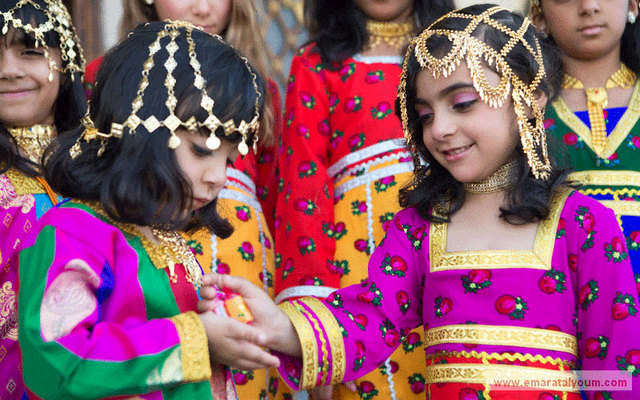
Fifteen days before Ramadan every year, children wear traditional clothes and carry colourful woven bags as they go door-to-door, singing in return for nuts and sweets. Hag Al Laila, which means “for this night”, usually begins after maghreb prayers and is a joyful way to remind communities that the holy month is just around the corner.
While popularly known as Hag Al Laila in countries including the UAE, the tradition is known by different names across the region. In Iraq, Kuwait, Qatar, Bahrain and some cities in Saudi Arabia, it is called gerga’aan and is celebrated on the 15th day of Ramadan instead. It is celebrated on the same day in Oman too, but is called qaranqasho.
Origins
While its actual origins are known, some trace the tradition to one of the earliest Ramadans, when Fatima, the daughter of the Prophet Mohammed, distributed sweets to people two weeks into the holy month. Others, however, suggest it predates Islam and could even be the basis for Halloween’s trick-or-treat tradition.
When is Hag Al Laila this year?
While the exact start of Ramadan will be dictated by the sighting of the new crescent moon, Ibrahim Al Jarwan, chairman of the board of directors of the Emirates Astronomy Society, told The National earlier that Ramadan was expected to begin on February 18.
This means Hag Al Laila would take place on February 3. However, some celebrations have already begun across the UAE. In Dubai, for example, bridges and lampposts have been decorated to mark the occasion. Malls in Abu Dhabi and Dubai have also launched a series of children’s activities, from traditional music performances to games and giveaways.
THE NATIONAL
Culture
Three Eid holidays in one year?
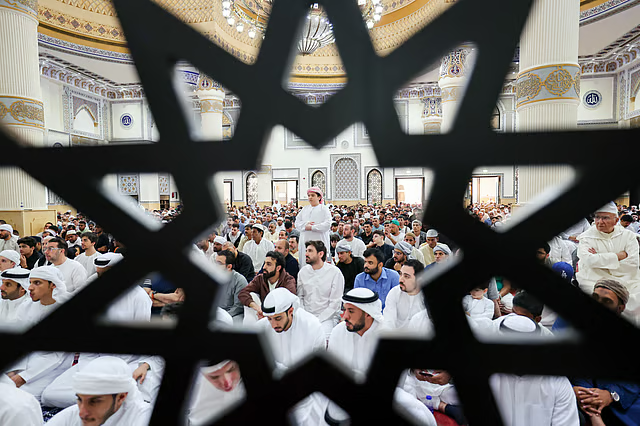
Residents in the UAE and the wider Muslim world are set to experience a rare astronomical alignment in 2039, with three Eid festivals falling within a single Gregorian calendar year.
According to renowned climate and astronomical expert Dr. Abdullah Al Misnad from Saudi Arabia, the unusual alignment stems from the way the Islamic lunar calendar gradually shifts against the solar Gregorian calendar, advancing by roughly 11 days each year.
Double Hajj and the Day of Arafat
The drift will lead to a remarkable convergence in 2039. The year will begin with the first Eid Al Adha falling on January 6, 2039, corresponding to 10 Dhul Hijjah 1460, the traditional culmination of Hajj and the major festival of sacrifice. But that won’t be the only one.
Nearly 12 months later, the lunar calendar will complete its full cycle again, and a second Hajj season will begin, culminating in another Eid Al Adha on December 26, corresponding to the 10th of Dhul Hijjah in the year 1461.
This means that two separate pilgrimages to Mecca will be performed within a single solar year, an exceedingly rare feat.
Even more unusual: both occasions will come with their own Day of Arafat, the spiritually charged day preceding the Eid, when pilgrims gather at Mount Arafat to pray.
Sandwiched between these two events will be Eid Al Fitr, expected to fall on October 19, 2039. Three Eids in a single year, two sacrificial and one celebratory, amount to an unparalleled spiritual cycle of fasting, pilgrimage, prayer, and festivity.
The lunar calendar’s shift is not limited to the Hajj season. Ramadan, the holiest month of fasting and spiritual reflection, will also experience a similar occurrence in the near future.
Two Ramadans in 2030
In 2030, Muslims will observe two Ramadans within the same Gregorian year, one beginning in January and another starting in December. This event will be the first double Ramadan in 33 years, following the last occurrence in 1997.
The Islamic Hijri calendar is based on the phases of the moon and consists of 354 or 355 days. The Gregorian calendar, which follows the solar cycle, consists of 365 or 366 days. This mismatch causes Islamic dates to shift earlier each year by approximately 10 to 11 days.
Gulf News


UAE Cycling Federation and AB Investment Sign Partnership to Support National Teams and Emerging Talent

Emirati Women’s Day: Hamda Al Mansoori takes UAE-grown ventures from AI and manufacturing to cross-border partnerships

Beyond Uniforms and Lunchboxes: Is Your Child Healthy and Ready for School?

UAE’s café culture keeps growing despite price pressure

Araghchi, Oman Sultan discuss transit, stability in Muscat

Is February 2026 really a once-in -283-years MiracleIn?
-
 UAE9 months ago
UAE’s café culture keeps growing despite price pressure
-
 politics4 months ago
Araghchi, Oman Sultan discuss transit, stability in Muscat
-
Discover8 months ago
Is February 2026 really a once-in -283-years MiracleIn?
-

 Entertainment7 months ago
Netflix to Livestream BTS Comeback Concert
-

 Football9 months ago
Algeria, Burkina Faso, Côte d’Ivoire win AFCON 2025 openers
-

 Health8 months ago
NMC Royal Hospital, Khalifa City, performs rare wrist salvage, restoring function for young patient
-
 Health9 months ago
Bascom Palmer Eye Institute Abu Dhabi and Emirates Society of Ophthalmology Sign Strategic Partnership Agreement
-
 travel9 months ago
Rail routes connecting Saudi Arabia, UAE, Oman, Qatar, Kuwait and Bahrain