
UAE
How AI Is Reshaping Jobs in the UAE, Pressuring Businesses and Workers

AI is no longer a future promise in the UAE. It is already shaping how people work, how companies invest, and how residents think about their careers.
Two recent reports — from enterprise technology firm Kyndryl and consulting giant PwC — suggest the country has reached a turning point. Businesses are starting to see returns from artificial intelligence, while employees across the region are using AI tools in their daily jobs. At the same time, cracks are emerging around skills, infrastructure and long-term readiness.
“The UAE has set out one of the most ambitious AI agendas in the world, from its drive to build an AI-powered government to the transformation of key industries and the development of an AI-ready workforce,” said Raoul Van Engelshoven, Managing Director of Kyndryl UAE.
AI gains, scaling pains
According to Kyndryl’s UAE Readiness Report, 93% of business leaders expect AI to transform jobs in their organisations within the next year. Many companies have moved beyond experimentation, yet the pressure to prove results is rising fast.
About 70% of UAE organisations say they feel increased pressure to show a clear return on AI investments. Even so, two-thirds admit their AI projects often stall after early pilots. Foundational technology issues remain a major hurdle, with many firms saying their systems are not yet built to scale innovation.
Bosses remain confident, but the pace of change is stretching teams. More than 90% say they struggle to keep up with rapid technological advances, while others point to complex IT environments and weak coordination between business and tech teams.
For UAE residents, the impact of AI is becoming tangible. While companies expect roles to change quickly, many are unsure how ready their people are.
Kyndryl found that nearly one in three organisations worry about how to reskill employees whose roles may be affected by AI. Gaps in technical capabilities and problem-solving skills are already emerging, raising concerns about whether the workforce can keep pace with automation.
Workers embrace AI
PwC’s Middle East Workforce Hopes and Fears Survey shows employees are not waiting for change — they are already using AI. Three in four workers across the region have used AI tools in the past year, with daily use of generative AI higher than global averages.
Most employees see AI as a positive force. Many say it has improved productivity, work quality and creativity. Younger workers, especially millennials and Gen Z, are driving adoption and often lead experimentation inside organisations.
“As employees confidently embrace change and build new capabilities with AI, they also want to feel secure and supported,” said Randa Bahsoun, Partner at PwC Middle East.
Yet optimism is paired with caution. Job security has become the top priority for workers, outweighing pay rises. Fewer employees plan to ask for higher salaries next year, reflecting a more careful outlook.
Cloud and cyber risks
As AI use grows, infrastructure decisions are becoming more sensitive. Kyndryl found widespread concern about data sovereignty and geopolitical risk, pushing many UAE organisations to rethink cloud strategies and keep more data closer to home.
Cybersecurity is another weak spot. Most firms experienced a cyber-related outage in the past year, yet many admit their defences are still catching up.
“Organisations that provide clarity on how roles will evolve and expand access to learning will be the ones that retain talent in a fast-changing labour market,” Bahsoun added.
What comes next
Together, the findings point to a workforce that is engaged, adaptable and ready to learn — but increasingly focused on stability. AI is moving fast in the UAE. Whether businesses can modernise systems, build skills and protect wellbeing at the same pace may define the next chapter of work in the country.
Story by Gulf News
UAE
Emirati Women’s Day: Hamda Al Mansoori takes UAE-grown ventures from AI and manufacturing to cross-border partnerships
From AI agents and smart manufacturing to investment opportunities in Syria and partnerships with Chinese companies, the Emirati entrepreneur is building businesses designed to scale beyond the UAE.
As the UAE marks Emirati Women’s Day, a new generation of Emirati women is emerging not only as leaders within established industries, but as founders, investors and technology builders creating businesses with ambitions far beyond the country’s borders.
Among them is Hamda Al Mansoori, an Emirati entrepreneur whose business interests span a notably diverse range of sectors — from manufacturing and jewellery to artificial intelligence, digital transformation, investment, consulting and business development.
Through ventures including The Black Box Group, Z2A Group Holding and Outworks, Al Mansoori is building an ecosystem that brings together industry, technology and investment, with the UAE serving as its base for regional and international expansion.
Where manufacturing meets technology
Through The Black Box Group, Al Mansoori has pursued a business model that increasingly blurs the line between traditional industries and emerging technologies.
The group’s activities span manufacturing and jewellery as well as business development, branding, digital solutions, enterprise resource planning systems, AI-powered business automation, logistics and expansion strategies.
Technology has also made its way onto the manufacturing floor.
Artificial intelligence is being incorporated into jewellery production processes to help monitor different stages of manufacturing, analyse operations, identify potential issues and track material loss — with the broader objective of improving efficiency and product quality.
The scale of the ambition became more visible during the group’s participation in Make it in the Emirates 2026, where it announced a pipeline of projects and opportunities worth more than $10 million.
The figure points to a broader strategy: building UAE-based businesses that can develop locally while being structured for expansion into international markets.
Betting on the next generation of AI
Alongside manufacturing, Al Mansoori has moved into one of the fastest-evolving areas of the global technology industry: AI agents.
Through Outworks, the focus is on enterprise artificial intelligence and developing solutions that can take AI beyond answering questions or assisting employees.
AI agents are designed to carry out defined tasks and workflows within organisations, interact with systems and enterprise knowledge, and support operations under established permissions and controls.
For governments, financial institutions and large corporations, however, the race to adopt AI is increasingly about more than capability.
Data sovereignty, cybersecurity, governance and human oversight are becoming central to how organisations decide where and how artificial intelligence can be deployed.
It is an area in which UAE technology companies have an opportunity to compete: not simply by adopting global AI products, but by developing enterprise solutions from the Emirates that address the specific requirements of governments and businesses in the region and potentially beyond.
Looking beyond the UAE
Al Mansoori’s interests extend beyond technology.
Through Z2A Group Holding, her activities include investment strategy, business development and exploring opportunities in regional and international markets.
One of the markets under consideration is Syria, where the group participated as part of a UAE delegation visiting Damascus for economic meetings and discussions around potential investment opportunities.
Areas being explored include industry, tourism and economic development, with an emphasis on identifying opportunities for longer-term projects and partnerships.
The approach reflects a wider investment philosophy that looks beyond capital alone, combining investment, technology, business expertise, project development and knowledge transfer.
For UAE companies looking outward, such markets can represent an opportunity not merely to invest, but to participate in developing businesses and sectors at an earlier stage of growth.
Building bridges with China
At the same time, Al Mansoori’s businesses are expanding their international network through cooperation and partnerships with companies outside the region, including Chinese firms across areas related to technology, manufacturing and business development.
China’s position in advanced manufacturing, technology and global supply chains makes such relationships increasingly relevant for UAE businesses seeking international expertise and scalable industrial capabilities.
The opportunity lies in connecting those capabilities with the UAE’s strengths as a business, investment and technology hub — potentially creating projects that combine international technology and expertise with businesses developed and managed from the Emirates.
It is a model that reflects the increasingly international character of UAE entrepreneurship: build from the UAE, partner globally and expand into new markets.
The UAE remains the launchpad
Despite the diversity of sectors and geographies, the UAE remains at the centre of Al Mansoori’s business strategy.
The country’s investments in artificial intelligence, advanced manufacturing and the digital economy, coupled with its push to attract global businesses and capital, have created an environment in which local entrepreneurs can think beyond the domestic market from the outset.
Al Mansoori’s portfolio reflects that shift.
Rather than building her career around a single industry, her ventures bring together manufacturing, AI, technology, investment, consulting and international partnerships.
The common thread is the attempt to create businesses that can originate in the UAE while competing and expanding internationally.
Emirati Women’s Day: From empowerment to creating opportunities
Al Mansoori’s story takes on particular relevance as the country celebrates Emirati Women’s Day.
The conversation around women’s empowerment in the UAE is increasingly moving beyond representation and leadership positions.
Emirati women are today founding companies, developing technology, directing investment, entering new markets and negotiating international partnerships.
From manufacturing operations incorporating artificial intelligence to enterprise AI agents, and from exploring investment opportunities in Syria to developing relationships with Chinese and international businesses, Al Mansoori’s journey reflects the increasingly global outlook of a new generation of Emirati entrepreneurs.
And perhaps that is one of the more significant stories to emerge this Emirati Women’s Day: Emirati women are no longer only taking their place in the industries of the future — they are increasingly helping to build them, from the UAE to the world.
Business
Dubai Gold Falls Again: Time to Buy?

Gold prices in Dubai fell further on Wednesday morning, giving jewellery buyers a good price break after rates pulled back from the highs seen earlier this month.
At 8.50 am, 24-karat gold stood at Dh491.50 per gram, compared with Dh498.75 on Tuesday, while 22-karat gold was at Dh455.25, down from Dh461.75. The latest decline gives UAE shoppers a lower entry point, although traders say buyers should still expect quick price swings because global bullion remains sensitive to the dollar, US interest-rate expectations and equity market volatility.
The fall marks a retreat from the start of June, when 24-karat gold was trading above Dh539 per gram and later touched Dh542.50 on June 2. Prices remained elevated in the first week, with 24-karat gold at Dh538.50 on June 4 before easing to Dh522.50 on June 5 and holding near Dh521 levels over the following days.
Prices pull back from June highs
The most notable move came around June 10, when 24-karat gold dropped to Dh492.50 and 22-karat fell to Dh456, before prices recovered again in the middle of the month. By June 15 and 16, 24-karat gold had climbed back above Dh521, while 22-karat returned to the Dh482 to Dh483 range.
That recovery did not last. Prices eased again from June 18, when 24-karat gold stood at Dh509.25 and 22-karat at Dh471.50. By June 22, 24-karat had slipped to Dh506, followed by Dh498.75 on June 23 and a further decline on Wednesday morning. The latest price leaves 24-karat gold more than Dh50 below its June 2 level, giving buyers a much lower rate than they would have paid earlier this month.
Should shoppers buy now?
The latest drop improves affordability, especially for those purchasing wedding jewellery, gifts or larger pieces where a Dh40 to Dh50 move per gram can make a visible difference to the final bill. Buyers who have been waiting through June’s price swings may see current levels as more attractive, particularly after the metal’s pullback from record highs.
Still, analysts say the decision depends on whether shoppers are buying for immediate use or trying to time the market. Those purchasing for near-term needs may benefit from the current correction, while buyers with flexibility may prefer staggered purchases because the market remains exposed to sudden moves.
Dollar strength weighs on bullion
Globally, gold fell for a second day as a stronger US dollar and a tech-led selloff in equities prompted some investors to cut bullion holdings and raise cash to cover losses elsewhere.
Spot gold dropped as much as 1.2% to below $4,070 an ounce, after falling 1.7% in the previous session to record its lowest close in two weeks. US Treasuries rallied on Tuesday, while a gauge of the dollar gained 0.6% so far this week, making dollar-priced bullion more expensive for buyers using other currencies.
Gold is usually seen as a haven during periods of uncertainty, but it can also fall during broad market selloffs because investors use it as a source of liquidity. Tuesday’s Wall Street decline was driven by concerns that the AI-led equity rally had moved too far, although Asian markets later showed a cautious recovery.
Rate outlook remains a risk
Gold is also facing pressure from persistent inflation risks and expectations that central banks may keep interest rates steady for longer or move towards further hikes. Higher borrowing costs tend to weigh on gold because the metal does not offer interest income.
The hawkish tone from Federal Reserve Chair Kevin Warsh has added to investor caution and partly offset the supportive impact from last week’s interim US-Iran peace deal. Until there is greater clarity on inflation, interest rates and the dollar, Dubai gold prices are likely to remain volatile, even if current levels look more appealing for shoppers than the highs seen earlier this month.
GN
UAE
Barakah attack condemned, global nuclear safety
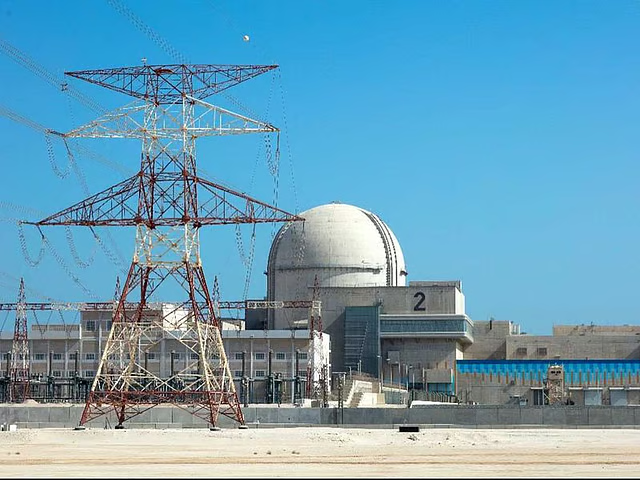
A wide international coalition, including the UAE, EU and dozens of countries such as the US, UK, France, Saudi Arabia and Japan, has issued a joint statement condemning a drone attack near the Barakah Nuclear Energy Plant in the UAE.
The May 17, 2026 strike, attributed to armed factions in Iraq, targeted electrical infrastructure outside the plant’s inner perimeter and was described as a “flagrant violation of international law”. The signatories warned of serious safety, environmental and humanitarian risks, urged an immediate halt to attacks on the UAE, and reaffirmed support for the peaceful operation and security of nuclear facilities under IAEA oversight.
A joint statement on the attack on the Barakah Nuclear Plant has been issued by the United Arab Emirates, Argentina, Armenia, Australia, Austria, Bahrain, Belgium, Bulgaria, Canada, Chile, Colombia, Comoros, Costa Rica, Côte d’Ivoire, Croatia, Cyprus, Czechia, Denmark, Egypt, Ecuador, Estonia, EU, Finland, France, Georgia, Germany, Greece, Guatemala, Honduras, Hungary, Ireland, Italy, Japan, Jordan, Kazakhstan, Kuwait, Latvia, Lebanon, Libya, Liechtenstein, Lithuania, Luxembourg, Malta, Marshall Islands, Mauritius, Moldova, Morocco, Netherlands, New Zealand, Norway, Pakistan, Palau, Paraguay, Peru, Philippines, Poland, Portugal, Qatar, Republic of Korea, Romania, Saint Vincent and the Grenadines, San Marino, Saudi Arabia, Serbia, Seychelles, Singapore, Slovakia, Slovenia, Spain, Sweden, Switzerland, Syria, Tonga, Türkiye, Ukraine, United Kingdom, United States, Uruguay, Vietnam, and Yemen. Following is the statement:
“We condemn in the strongest terms the drone attack of 17 May 2026 launched by armed factions in Iraq on electrical infrastructure outside the inner perimeter of the Barakah Nuclear Energy Plant in the United Arab Emirates.
This attack constitutes a flagrant violation of international law, including the Charter of the United Nations, and threatens regional and international peace and security. The attack posed significant risks for civilian lives and objects and of potential severe transboundary radiological, environmental, and human health consequences.
We express our deep concern over this dangerous escalation and demand the immediate and permanent cessation of all attacks against the United Arab Emirates, including attacks against nuclear facilities devoted exclusively to peaceful purposes. We call on States to refrain from acts of aggression and to respect their obligation, under international law, to ensure that their territory is not used by non-state actors to launch attacks against other States.
We strongly support the territorial integrity and sovereignty of the United Arab Emirates, in line with the principles of the Charter of the United Nations.
We commend the prompt and transparent information provided to the International Atomic Energy Agency (IAEA) by the United Arab Emirates through its competent authorities about the consequences of this attack, successful mitigation actions and radiation levels around the Barakah Nuclear Energy Plant which remained normal.
We appreciate the continued efforts of the United Arab Emirates authorities to ensure the safe, secure and peaceful operation of the Barakah Nuclear Energy Plant under Agency safeguards and in accordance with the highest international standards, and welcome the ongoing coordination between the IAEA and the relevant United Arab Emirates authorities.
We reaffirm that the Barakah Nuclear Energy Plant was designed, constructed, and is operated in accordance with the highest international standards and under the oversight of the United Arab Emirates’ Federal Authority for Nuclear Regulation (FANR), and in line with the safety standards of the IAEA.
We support the continued efforts of the IAEA and the Director General in monitoring developments relevant to nuclear safety, nuclear security and safeguards in member States.
We call on States to refrain from any action that may endanger the safety and security of nuclear power plants devoted exclusively to peaceful purposes.
This drone attack affecting infrastructure in proximity to the Barakah Nuclear Energy Plant facility underscores the urgent importance of protecting nuclear infrastructure devoted exclusively to peaceful purposes from threats and hostile acts.
We call for strengthened international cooperation aimed at protecting nuclear power plants devoted exclusively to peaceful purposes and related sites and infrastructure, including through enhanced physical protection, emergency preparedness, and resilience measures.”
GN


UAE Cycling Federation and AB Investment Sign Partnership to Support National Teams and Emerging Talent

Emirati Women’s Day: Hamda Al Mansoori takes UAE-grown ventures from AI and manufacturing to cross-border partnerships

Beyond Uniforms and Lunchboxes: Is Your Child Healthy and Ready for School?

Araghchi, Oman Sultan discuss transit, stability in Muscat

UAE’s café culture keeps growing despite price pressure

Netflix to Livestream BTS Comeback Concert
-
 politics5 months ago
Araghchi, Oman Sultan discuss transit, stability in Muscat
-
 UAE9 months ago
UAE’s café culture keeps growing despite price pressure
-
 Entertainment8 months ago
Netflix to Livestream BTS Comeback Concert
-
 Discover8 months ago
Is February 2026 really a once-in -283-years MiracleIn?
-

 Football9 months ago
Algeria, Burkina Faso, Côte d’Ivoire win AFCON 2025 openers
-
 Health9 months ago
NMC Royal Hospital, Khalifa City, performs rare wrist salvage, restoring function for young patient
-
 Health9 months ago
Bascom Palmer Eye Institute Abu Dhabi and Emirates Society of Ophthalmology Sign Strategic Partnership Agreement
-
 travel10 months ago
Rail routes connecting Saudi Arabia, UAE, Oman, Qatar, Kuwait and Bahrain