
travel
UAE travellers rush to sign up for travel insurance
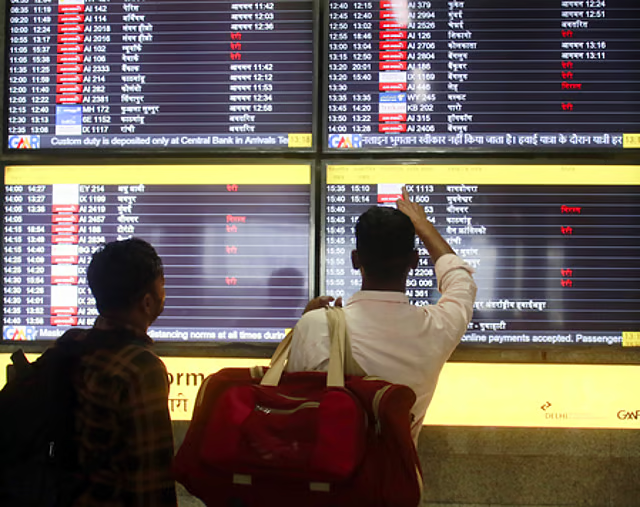
Dubai: Travel disruptions hit hard this week after the Ethiopia volcano sent ash sweeping into major air corridors between the Gulf and India. Airlines cancelled and rerouted flights without warning, leaving many travellers scrambling for new plans and covering unexpected costs along the way.
Moments like these are pushing more UAE residents to protect their travel plans before stepping on a plane. Policybazaar.ae reports a 45% jump in travel-insurance queries for Q4 2025 compared with last year.
That increase particularly comes at a time when more people travel for National Day, year-end holidays and the December school break — a period when disruptions are more painful and costly.
Lock in insurance early
Travelers are locking in insurance earlier, paying closer attention to cancellation and delay clauses, and choosing coverage that mirrors the rising uncertainty. Inbound travellers are doing the same, with a 48% rise in visitors securing insurance for trips into the UAE.
Toshita Chauhan, Chief Business Officer – General Insurance at Policybazaar.ae, says demand reflects a more aware and proactive traveller: “Travellers today are far more aware of the risks associated with international travel and view insurance as a necessity.
“We are seeing a clear shift toward informed decision-making, with customers actively seeking protection, especially during peak travel periods when volumes are at their highest.”
Why buy insurance now
The strongest interest comes from travellers aged 28–45, a group that often books tightly scheduled itineraries, relies heavily on pre-paid arrangements and values financial protection.
People are also insuring more diverse trips. Nature-driven holidays, hiking, wildlife travel and remote itineraries are trending. Solo travellers — including more women travelling independently — are choosing comprehensive policies that cover medical emergencies, trip interruptions and lost belongings.
Safety net — not gamble
Recent data shows many travellers are acting on that instinct. A 2025 survey found a 32% rise in travel-insurance quote requests between January and April compared with the same period in 2024, according to a Reuters poll.
That jump mirrors the wave of uncertainty passengers have felt during recent disruptions. Insurers say interest consistently spikes after major events — whether an IT outage or a natural incident — with some reporting a noticeable surge in requests for “delay coverage” right after a global disruption.
Market estimates reinforce the shift: the global travel-insurance sector is valued at about $30.77 billion in 2025 and is forecast to grow at roughly 16.8% through 2029. For everyday travellers, it signals something simple — people aren’t willing to fly without financial protection anymore.
What coverage works
Today’s travellers prioritise coverage that shields them from the most expensive risks:
- Trip-cancellation or interruption protection for events like volcanic ash, severe weather, strikes or unexpected crises.
- Flight-delay benefits that cover meals, hotels or alternative transport when delays stretch for hours.
- Medical and emergency assistance for costly treatment or evacuation abroad.
- Cancel-for-Any-Reason (CFAR) policies for added flexibility.
TravelInsurance.com summarises the shift in their 2025 outlook: “Travel insurance today is more important to travelers than ever before. Disruptions persist, from unpredictable weather events to flight disruptions and health issues.
“Trip cancellation coverage protects trip costs, while travel medical and emergency coverage is essential for those venturing abroad.” For travellers, that means fewer surprise expenses and less risk of losing money on non-refundable bookings.
Impact on UAE travellers
Travellers departing from Dubai, Abu Dhabi or Sharjah during winter and year-end holidays face heavy booking volumes — and higher disruption risk. When plans shift unexpectedly, you may end up:
- Paying more for last-minute flights
- Covering hotel nights during extended delays
- Losing non-refundable tours or stays
- Rearranging onward connections at your own expense
The past week showed how fast carefully planned itineraries can collapse. In that environment, travel insurance feels less like an optional extra and more like a financial buffer.
If you’re flying soon, compare policies carefully. Check cancellation and delay protections. Look for coverage that includes natural-event disruptions such as volcanic ash. Review medical limits. Consider CFAR coverage if your plans feel uncertain.
A policy won’t stop disruptions — but it determines who pays for them: you, or your insurer.
Story by GULF NEWS
travel
Emirates extends suspension of Dubai flights amid airspace closures
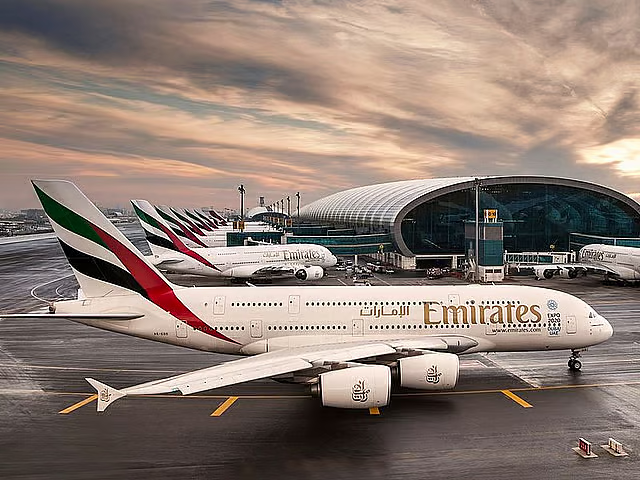
Emirates has temporarily suspended all flights to and from Dubai until 15:00 UAE time on Tuesday, March 3, due to multiple regional airspace closures.
The airline said the situation is dynamic and continuously monitored, urging passengers to check emirates.com
Options for affected passengers
Rebook flights: Passengers can rebook to the same destination on or before 20 March. Those who booked via travel agents should contact them directly; direct bookings can be managed at Emirates Support
Request a refund: Refunds for direct bookings can be requested via Emirates Refund Form
Travel agent bookings should be handled through the agent.
Passengers are advised to ensure contact details are updated via Manage Booking to receive real-time notifications.
All city check-in points across Dubai are temporarily closed until further notice.
Emirates said it is actively monitoring the situation and coordinating with relevant authorities. The airline apologised for the inconvenience and reaffirmed that the safety and security of passengers and crew remain its top priority.
GN
travel
Saudi business visa rejections rise as scrutiny tightens

Riyadh is tightening scrutiny of business visas used mainly by UAE-based professionals travelling into Saudi Arabia, disrupting a decades-long practice that has let companies run projects in the kingdom without staff relocation.
There are no official figures on rejections, but immigration advisers and executives say they have seen more applications returned or refused in recent weeks, particularly for technical specialists and frequent visitors.
The “fly-in fly-out model”, as it is occasionally called, typically involves the misuse of a visa meant as a short-term permit for meetings and relationship-building, not revenue-generating work. Specialists say such misapplication has triggered the clampdown.
Abeer Husseini, a partner at global immigration law practice Fragomen, told AGBI there has been “scaled” misuse of business visas that are not intended for productive work.
“Based on our recent experience, we are seeing a higher possibility for business visa applications to be returned in certain scenarios,” Husseini said.
Abdulrahman Alfahad, a client relationship manager at Sovereign PPG Corporate Services in Saudi Arabia, said companies have relied on repeated business visits for individuals carrying out day-to-day operational roles, “which goes beyond the intended scope of a business visit visa”.
“Authorities are paying closer attention to travel frequency, length of stay and the nature of activities undertaken, particularly where patterns resemble full-time employment,” Alfahad said.
He said the impact is being felt mostly by consulting, professional services and project-based sectors, as well as regional headquarters structures where staff frequently travel in and out of the kingdom.
More than 10 UAE-based professionals at companies across banking, law and management consulting told AGBI their business trips to Saudi Arabia have been cancelled or delayed in recent months, though previously they had been entering and leaving the country nearly every week.
Immigration experts said the stricter outcomes reflect Saudi Arabia’s broader drive to support labour-market policies and a shift toward international standards.
“Saudi is clearly moving towards international best practice by drawing a firmer distinction between permissible business activities and work that requires employment authorisation,” Alfahad said.
Saudi Arabia has been pushing companies to build onshore capacity under Vision 2030 and meet Saudisation requirements – rules that require companies to employ a set proportion of nationals.
In 2024, it required businesses to base their regional headquarters in Saudi Arabia to qualify for government contracts.
Many multinationals that have long run operations out of Dubai have moved to meet Riyadh’s requirements, drawn by the scale of business in Saudi Arabia, which has the Gulf’s largest population.
But an HR executive, who declined to be identified, told AGBI that while companies have set up headquarters in Saudi Arabia, staffing is kept to a minimum – both to limit Saudisation quotas, which increase with each expatriate hire, and because employees are unwilling to relocate.
“Misuse of business visas can distort workforce reporting, and stricter enforcement supports more accurate Saudisation compliance and localisation objectives,” Alfahad said.
Ahmed Hassounah, managing director at Job Borsa, a Saudi recruitment services company that helps businesses comply with localisation requirements, said the goal is enforcement, not disruption for businesses already operating in Saudi Arabia.
“What the government is really focused on is ensuring that citizens and employees are trained and actively participating in the market,” Hassounah said.
AGBI
travel
Riyadh airport starts biggest overhaul in 40 years
King Khalid International Airport in Riyadh has begun implementing its largest operational transformation since opening more than 40 years ago, marking the first comprehensive overhaul of airline operations across its terminals. The phased redistribution came into effect today.
Under the “Terminal Transition” project, managed by Riyadh Airports Company, terminal allocations are being reorganised to enhance operational efficiency and improve passenger flow at the Saudi capital’s main gateway.
From today, Terminals 1 and 2 are designated for international flights operated by Saudi national carriers. From February 24, Terminal 4 will serve domestic flights for national airlines.
Beginning February 25, Terminal 5 will handle international flights operated by foreign carriers. On the same day, operations at Terminal 3 will be merged with Terminal 4 to accommodate domestic services of national carriers.
The move forms part of wider efforts to streamline airport operations and support rising passenger volumes in line with the Kingdom’s aviation growth strategy.
GN


Private Credit Investors Rush to Withdraw

UAE moves spring break for schools and universities

How Etihad Rail ferried 350+ UAE passengers back home with Saudi help

Is February 2026 really a once-in -283-years MiracleIn?

Algeria, Burkina Faso, Côte d’Ivoire win AFCON 2025 openers

Bascom Palmer Eye Institute Abu Dhabi and Emirates Society of Ophthalmology Sign Strategic Partnership Agreement
-
Discover1 month ago
Is February 2026 really a once-in -283-years MiracleIn?
-
 Football2 months ago
Algeria, Burkina Faso, Côte d’Ivoire win AFCON 2025 openers
-
 Health3 months ago
Bascom Palmer Eye Institute Abu Dhabi and Emirates Society of Ophthalmology Sign Strategic Partnership Agreement
-
 Health2 months ago
NMC Royal Hospital, Khalifa City, performs rare wrist salvage, restoring function for young patient
-

 Health4 months ago
Emirates Society of Colorectal Surgery Concludes the 3rd International Congress Under the Leadership of Dr. Sara Al Bastaki
-

 Health4 months ago
Born Too Soon: Understanding Premature Birth and the Power of Modern NICU Care
-

 Football3 months ago
Globe Soccer Awards 2025 nominees announced as voting opens in Dubai
-

 Health2 months ago
Decline in Birth Rate in the UAE