
politics
Khaleda Zia, Bangladesh’s first female PM, dies at 80
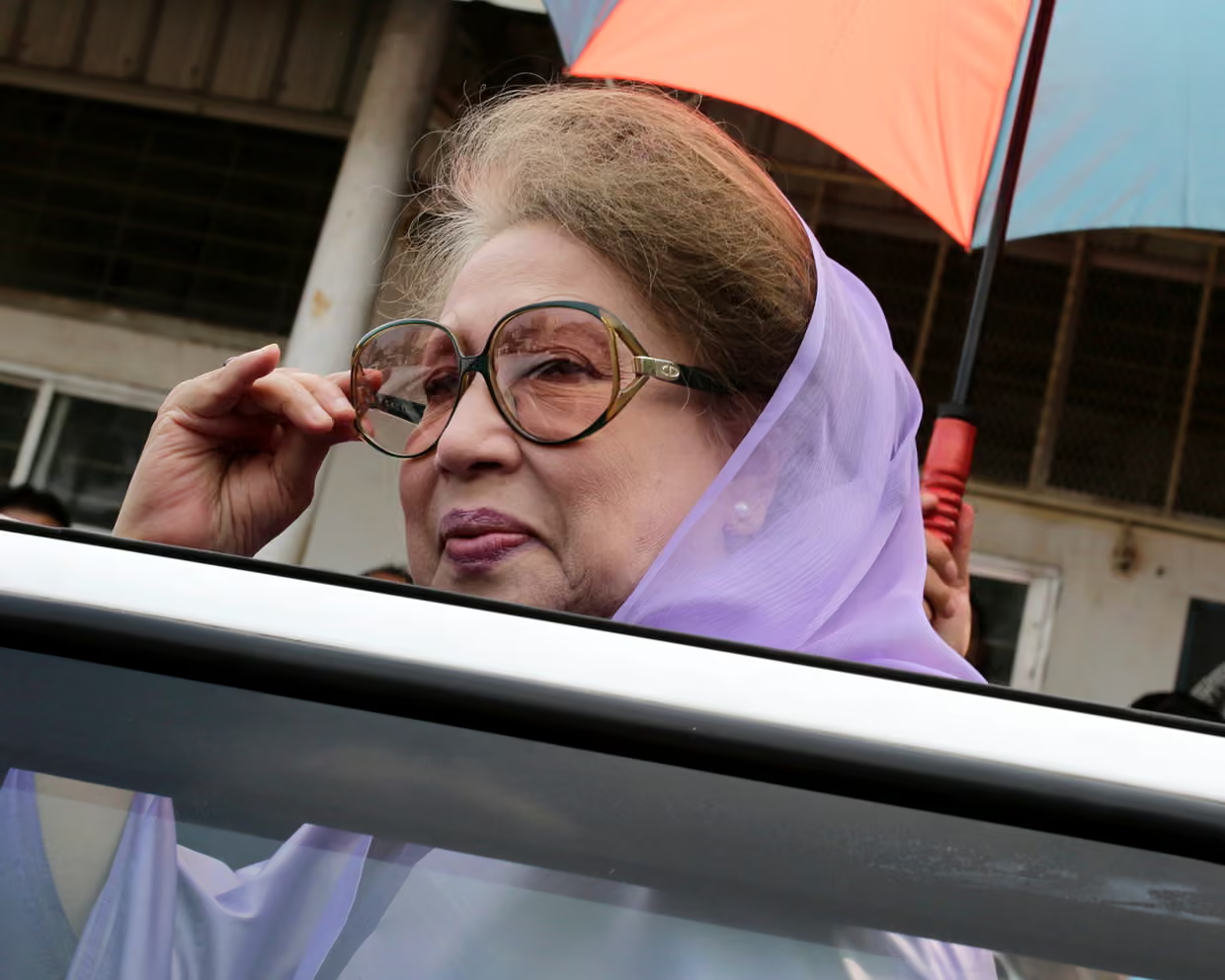
Zia’s archrivalry with Sheikh Hasina defined the country’s politics for a generation
Former Bangladeshi prime minister Khaleda Zia, whose archrivalry with Sheikh Hasina defined the country’s politics for a generation, has died, her political party said on Tuesday. She was 80.
“The BNP chairperson and former prime minister, the national leader Begum Khaleda Zia, passed away today at 6am, just after the Fajr (dawn) prayer,” the Bangladesh Nationalist party (BNP) said in a statement.
“We pray for the forgiveness of her soul and request everyone to offer prayers for her departed soul,” it added.
Zia was the country’s first female prime minister.
She had faced corruption cases she said were politically motivated, but in January 2025 the supreme court acquitted Zia in the last corruption case against her, which would have let her run in February’s election.
She had returned to the country in May after undergoing medical treatment in the UK.
In early January, Bangladesh’s interim government had allowed her to travel abroad after Hasina’s government rejected previous requests at least 18 times.
Despite years of ill health and imprisonment, Zia vowed in November to campaign in elections set for February 2026 – the first vote since a mass uprising toppled her arch-rival Sheikh Hasina last year. Zia’s BNP is widely seen as a frontrunner.
But in late November she was taken to hospital, where, despite the best efforts of medics, her condition declined from a raft of health issues.
During her final days, interim leader Muhammad Yunus called for the nation to pray for Zia, calling her a “source of utmost inspiration for the nation”.
Bangladesh’s early years of independence – gained in a bloody 1971 war against Pakistan – were marked by assassinations, coups and countercoups as military figures and secular and Islamic leaders jockeyed for power.
Zia’s husband, president Ziaur Rahman, had seized power as a military chief in 1977 and a year later formed the BNP. He was credited with opening democracy in the country, but was killed in a 1981 military coup. Zia’s uncompromising stance against the military dictatorship helped build a mass movement against it, culminating with the ousting of dictator and former army chief HM Ershad in 1990.
Khaleda Zia waves at the start of a 400km protest march from Dhaka to the northern village of Dinajpur in 1999. Photograph: Pavel Rahmen/AP
Zia’s opponent when she won her first term in 1991 and in several elections after that was Hasina, the daughter of independence leader Sheikh Mujibur Rahman, who was assassinated in a 1975 coup.
Zia was criticised over an early 1996 election in which her party won 278 of the 300 parliamentary seats during a wide boycott by other leading parties including Hasina’s Awami League, which demanded an election-time caretaker government. Zia’s government lasted only 12 days before a nonpartisan caretaker government was installed and the new election was held that June.
Zia returned to power in 2001 in a government shared with the country’s main Islamist party, Jamaat-e-Islami, which had a dark past involving Bangladesh’s independence war.
Zia’s BNP was previously closely allied with the party, and her government maintained the confidence of the business community by following pro-investment, open market policies. Zia was known to have a soft spot for Pakistan and used to deliver anti-Indian political speeches. India alleged insurgents were allowed to use Bangladesh’s soil to destabilise India’s northeastern states under Zia, especially during her second term from 2001-06.
Zia was sentenced to 17 years in jail in two separate corruption cases for misuse of power in embezzling funds meant for a charity named after her late husband. Her party said the charges were politically motivated to weaken the opposition, but the Hasina government said it did not interfere and the case was a matter for the courts.
Hasina was bitterly criticised by both her opponents and independent critics for sending Zia to jail.
Guardian and agencies
politics
How Etihad Rail ferried 350+ UAE passengers back home with Saudi help

Etihad Rail, in coordination with the Emergencies, Crises and Disasters Management Centre Abu Dhabi (ADCMC), operated three exceptional passenger train services between Al Ghuwaifat Station (Al Dhafra) and Al Faya Station (Abu Dhabi City).
These trips safely transported over 350 passengers ahead of the official launch of the passenger rail service, offering a reliable alternative for residents affected by regional travel disruptions.
Stay updated: Get the latest faster by downloading the Gulf News app – it’s completely free. Click here for Apple or here for Android. You can also find it on the Huawei AppGallery.
3 train services to bring passengers to UAE
- Passengers ferried by train ahead of official launch
- Passengers travelled from Ghuwaifat Station in Al Dhafrah Region to Al Faya Station in Abu Dhabi
Why it matters
- Ensured safe and efficient travel for returning residents.
- Highlighted Abu Dhabi’s operational readiness and flexibility in emergency situations.
- Freight operations continued without disruption, showing the railway network can handle both passenger and cargo transport simultaneously.
What residents should know
- The operation confirms alternative transport options are available during travel disruptions.
- Residents should stay updated via official channels for future passenger services.
- Safety protocols were fully activated, with technical and human resources deployed to ensure smooth operations.
Operational highlights
- The exceptional train service demonstrates the strategic importance, efficiency, and reliability of the UAE’s national railway network.
- Operations were conducted without affecting other logistical or freight services.
- Additional services will continue as required, until air traffic resumes and flights return to normal schedules.
Key takeaway
The operation reflects Abu Dhabi’s proactive response framework, capable of swift activation of alternative transport and maintaining continuity of vital services during regional developments.
Residents can watch the official video update and follow announcements from Etihad Rail and ADCMC for further information.
GM
politics
UAE air defences intercept 3 ballistic missiles, 129 drones
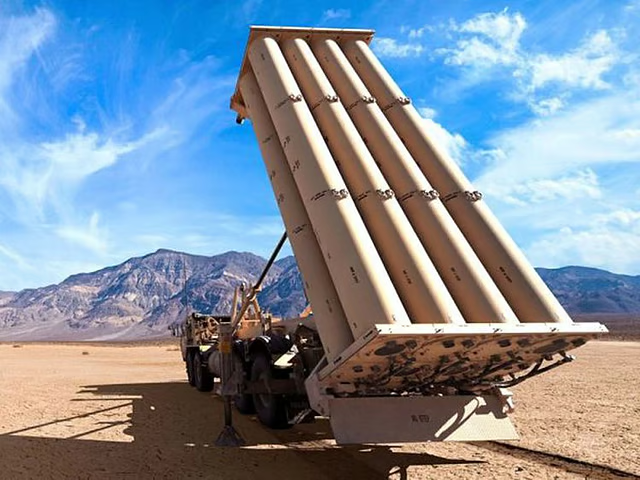
The Ministry of Defence announced that UAE air defence systems successfully intercepted three ballistic missiles today, 4th March 2026, and detected 129 drones, of which 121 were intercepted while eight fell within the territory of the state.
The ministry stated that since the start of the blatant Iranian aggression, 189 ballistic missiles launched towards the UAE have been detected, with 175 missiles destroyed, 13 falling into the sea and one missile landing within the territory of the state. A total of 941 Iranian drones have also been detected, of which 876 were intercepted, while 65 fell within the country. Eight cruise missiles were also detected and destroyed.
The attacks caused some collateral damage and resulted in three fatalities of Pakistani, Nepali and Bangladeshi nationalities, as well as 78 minor injuries among individuals of Emirati, Egyptian, Sudanese, Ethiopian, Filipino, Pakistani, Iranian, Indian, Bangladeshi, Sri Lankan, Azerbaijani, Yemeni, Ugandan, Eritrean, Lebanese and Afghan nationalities.
The ministry confirmed that the sounds heard in different parts of the country are the result of air defence systems intercepting ballistic missiles and fighter aircraft intercepting drones and cruise missiles. These operations caused minor to moderate material damage to a number of civilian facilities.
The ministry strongly condemned this military targeting, describing it as a blatant act of aggression and a flagrant violation of national sovereignty and international law. It affirmed that the UAE reserves its full right to respond to this escalation and to take all necessary measures to protect its territory, its people and its residents, in a manner that safeguards its sovereignty, security and stability and protects its national interests and capabilities.
The Ministry of Defence reiterated that it remains fully prepared and ready to address any threats and is taking all necessary measures to firmly confront anything that seeks to undermine the country’s security and stability. It added that the safety of citizens, residents and visitors remains a top priority that cannot be compromised.
The ministry also urged the public to obtain information from official sources within the country and to avoid circulating rumours or unverified information.
WAM
politics
Latest developments in Middle East war
Guards claim control of Hormuz
The Revolutionary Guards said Iranian forces had “complete control” of the Strait of Hormuz, a vital route for world oil and gas supplies, and any vessels seeking to pass risked damage from missiles or stray drones.
US President Donald Trump said Tuesday the US Navy was ready to escort oil tankers through the crucial Gulf shipping route.
The Guards said they had also launched more than 40 missiles at US and Israeli targets in a new wave of strikes.
Khamenei funeral set
Iran will hold a three-day-long state funeral starting on Wednesday evening for Ayatollah Ali Khamenei, state TV said.
Khamenei, the Islamic Republic’s supreme leader, was killed in the US-Israeli strikes that sparked the war on Saturday.
After the funeral’s announcement, Israel’s defence minister warned that any successor would be a “target for assassination”.
Gulf stocks tumble
The Dubai and Abu Dhabi stock exchanges reopened sharply lower on Wednesday after a two-day trading suspension over Iran’s missile and drone attacks across the Gulf.
The Dubai bourse was down 4.7 percent while Abu Dhabi’s ADX fell 3.5 percent shortly after markets opened.
Seoul shares earlier collapsed more than 12 percent as Asian stock markets were gripped by the worldwide wave of panic selling. Oil rose.
Sirens ring out in Israel
Missiles launched from Iran early Wednesday triggered air raid sirens across large parts of Israel, including Jerusalem and Tel Aviv.
The military said it was “operating to intercept the threat”, and the alert was lifted after several minutes with no immediate reports of casualties — though shrapnel caused a fire near Jerusalem, according to Israeli media.
Iranian frigate sinking off Sri Lanka
Sri Lanka said an Iranian navy frigate with 180 crew was sinking just outside the island’s territorial waters.
No information was immediately available on the cause.
Explosions rock Beirut, other towns
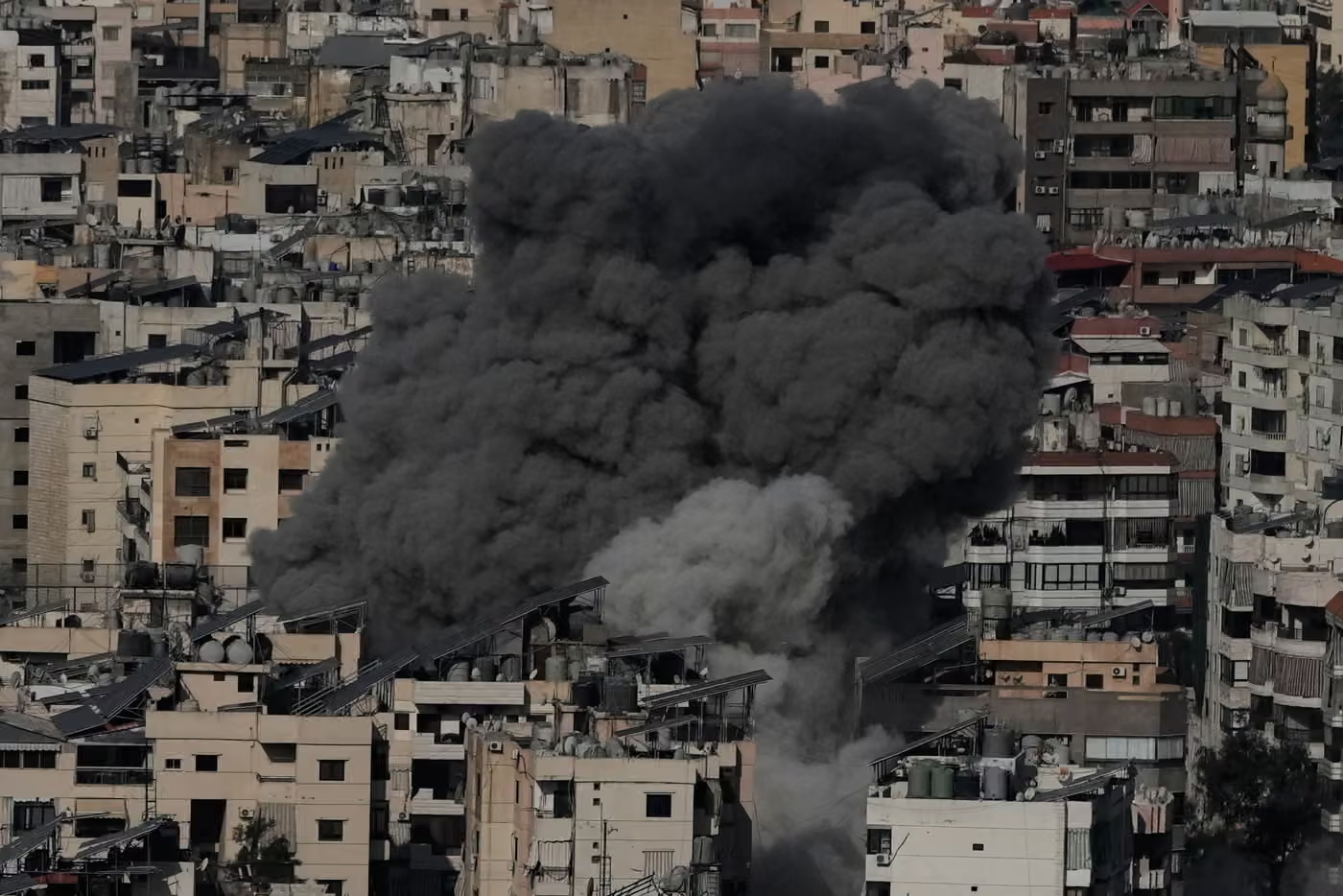
AFPTV footage showed an air strike hit Hezbollah’s bastion in the southern suburbs of the Lebanese capital Beirut, as Israel and the Iran-backed militant group traded strikes and rocket fire.
Lebanon’s health ministry said Israeli strikes on two towns south of Beirut — outside of Iran-backed Hezbollah’s traditional strongholds — killed six people and wounded eight.
Lebanese state media later said Israeli strikes had hit a hotel in the Beirut suburb of Hazmieh, as well as a four-storey building in the eastern city of Baalbek, where five people were reportedly killed.
US commander says 2,000 targets hit in Iran
Admiral Brad Cooper, who leads US military forces in the Middle East, said in a video message that nearly 2,000 targets had been struck so far in Iran.
“We have severely degraded Iran’s air defences and destroyed hundreds of Iran’s ballistic missiles, launchers and drones,” he said.
Saudi Arabia intercepts cruise missiles
The Saudi defence ministry said two cruise missiles were intercepted over an area south of the capital Riyadh, and state media reported nine drones targeting the kingdom were intercepted.
A drone was also shot down near the international airport in the Iraqi capital Baghdad, a security source said.
Qatar says Iranian spy cells dismantled
Qatar, which hosts a major US military base and has been targeted by multiple Iranian strikes since the outbreak of the war, reported it had dismantled two spy cells linked to the Revolutionary Guards, arresting 10 suspects.
Israel says launching new wave of strikes
Israel’s military said Wednesday it has launched a “broad wave of strikes” on Iran, after the Islamic republic launched three separate missile barrages at Israeli territory.
The army said it had struck “dozens” of targets, including security command centres in the capital Tehran.
Drone attack on Dubai’s US consulate
A drone attack caused a fire by the US consulate in Dubai as Iran ramped up its targeting of American diplomatic missions in the Gulf.
US staff allowed to leave Saudi, Oman
The United States said it had ordered non-emergency staff at its consulates in the Pakistani cities of Lahore and Karachi to leave the country over “safety risks”, and granted permission for staff to leave missions in Saudi Arabia, Cyprus and Oman.
© 2026 AFP


Private Credit Investors Rush to Withdraw

UAE moves spring break for schools and universities

How Etihad Rail ferried 350+ UAE passengers back home with Saudi help

Is February 2026 really a once-in -283-years MiracleIn?

Algeria, Burkina Faso, Côte d’Ivoire win AFCON 2025 openers

Bascom Palmer Eye Institute Abu Dhabi and Emirates Society of Ophthalmology Sign Strategic Partnership Agreement
-
Discover1 month ago
Is February 2026 really a once-in -283-years MiracleIn?
-
 Football2 months ago
Algeria, Burkina Faso, Côte d’Ivoire win AFCON 2025 openers
-
 Health3 months ago
Bascom Palmer Eye Institute Abu Dhabi and Emirates Society of Ophthalmology Sign Strategic Partnership Agreement
-

 Health2 months ago
NMC Royal Hospital, Khalifa City, performs rare wrist salvage, restoring function for young patient
-

 Health4 months ago
Emirates Society of Colorectal Surgery Concludes the 3rd International Congress Under the Leadership of Dr. Sara Al Bastaki
-

 Health4 months ago
Born Too Soon: Understanding Premature Birth and the Power of Modern NICU Care
-

 Football3 months ago
Globe Soccer Awards 2025 nominees announced as voting opens in Dubai
-

 Health2 months ago
Decline in Birth Rate in the UAE