
Tech news
Integrated Transport Centre launches world’s first modular smart vehicles in Abu Dhabi

The Integrated Transport Centre (ITC), an affiliate of the Department of Municipalities and Transport in Abu Dhabi, has announced the launch of the world’s first modular smart vehicles in the emirate.
The announcement was made during the ITC’s participation in DRIFTx 2025, held as part of the inaugural “Abu Dhabi Autonomous Systems Week”.
Abu Dhabi has officially become the first city in the world to recognise modular vehicles that are smart and reconfigurable, and can be connected or separated based on operational needs, as a new and independent category of road vehicles.
Developed by NExT, this marks a transformative moment in global mobility policy and innovation. This recognition is grounded in rigorous scientific research, supported by published studies from leading institutions in New York and Abu Dhabi, as well as international awards and real-world trials that have demonstrated the system’s potential to enhance road efficiency, improve sustainability, and increase flexibility in urban mobility.
Modular vehicles are distinguished by their ability to adapt to operational demand, connecting or detaching units based on the number of passengers or use case, optimising traffic flow, reducing congestion, and minimising carbon emissions with exceptional efficiency.
ITC is leading this transformation in partnership with Emirates Driving Company (EDC), Liftango, and Paradigma Innovation Hub, to conduct the world’s first pilot operation of these multi-unit modular smart vehicles on Yas Island, paving the way for a new era of intelligent transport in the capital.
Beyond improving road mobility, these vehicles serve as a transitional platform for developing smart operating systems and remote-control capabilities, part of ITC’s long-term initiatives to gradually expand autonomous driving applications across Abu Dhabi.
Dr. Abdulla Hamad AlGhfeli, Acting Director-General of the ITC, said, “The Integrated Transport Centre continues to reinforce Abu Dhabi’s position as a global hub for innovative mobility technologies through pioneering initiatives that tangibly enhance the transport system’s efficiency and sustainability.
“The adoption of modular smart vehicles represents a strategic step forward in advancing the Emirate’s vision for a more integrated and intelligent mobility ecosystem.”
Antonio Guadagnino, CIO of NexT, said, “We are thrilled to contribute with NExT to a concrete and immediately deployable solution that requires no new infrastructure to drastically reduce traffic congestion and enhance first and last mile services—two critical needs that we strongly believe will define mobility across Gulf countries for the next decade.”
WAM
Tech
SIRI Getting Smarter

Google and Apple have confirmed a multi‑year partnership under which Apple will rely on Google’s Gemini artificial intelligence models and cloud infrastructure to power the next generation of its AI features — notably a revamped Siri voice assistant and Apple Intelligence system slated to roll out later in 2026.
The announcement marks a significant collaboration between two longtime rivals in consumer technology. According to the joint statement, Apple selected Google’s AI after extensive evaluation, citing Gemini’s performance as the most capable foundation for its future Apple Foundation Models.
Under the agreement, Apple will integrate Gemini models into its internal AI ecosystem — including the long‑anticipated Siri upgrade, which has faced delays in recent years amid challenges in expanding its capabilities. Apple says that despite using Google’s models for core intelligence, key AI features will continue to run on Apple devices and through the company’s Private Cloud Compute platform, maintaining the firm’s strong privacy safeguards.
Multiple outlets confirm that the deal will see Google’s technology underpinning Apple’s AI innovation, but it does not involve sending raw user queries back to Google’s systems. The Verge notes that while Gemini will assist models and features, Apple retains control over on‑device processing and user privacy.
Market reaction was swift: news of the partnership contributed to Alphabet briefly crossing a $4 trillion market valuation, as investor confidence in AI technologies continues to buoy major tech stocks. The collaboration is seen as a validation of Google’s rapid progress with Gemini models — a family of AI systems that have been widely deployed across Google services and rated highly against competitor benchmarks.
The deal also reflects a strategic shift for Apple’s AI roadmap, which has historically focused on in‑house foundation models and selective integrations with third‑party systems like ChatGPT. By choosing Google’s infrastructure, Apple aims to accelerate innovation and close the gap in features such as personalised voice interaction, context‑aware responses and deeper integration with applications.
Experts tell reporters this collaboration could influence the broader AI ecosystem — positioning Gemini as a core engine not just for Google’s own products but also across rival platforms. Meanwhile, consumers can expect to see the first fruits of the partnership as Apple begins rolling out AI‑enhanced Siri features throughout 2026, with updates likely highlighted at Apple’s annual developer conference.
GM
Business
The Top-Performing Sectors Since ChatGPT Launched
Key Takeaways
- Tech-related sectors have dramatically outperformed the broader market since ChatGPT’s debut, driven by an AI-led investment boom.
- Nvidia, Broadcom, and other semiconductor-linked firms have seen extraordinary returns, reflecting soaring demand for AI infrastructure.
The launch of ChatGPT in late 2022 set off one of the most intense technology investment cycles in decades. Investors shifted capital toward companies and sectors positioned to benefit from AI infrastructure, cloud computing, and digital services.
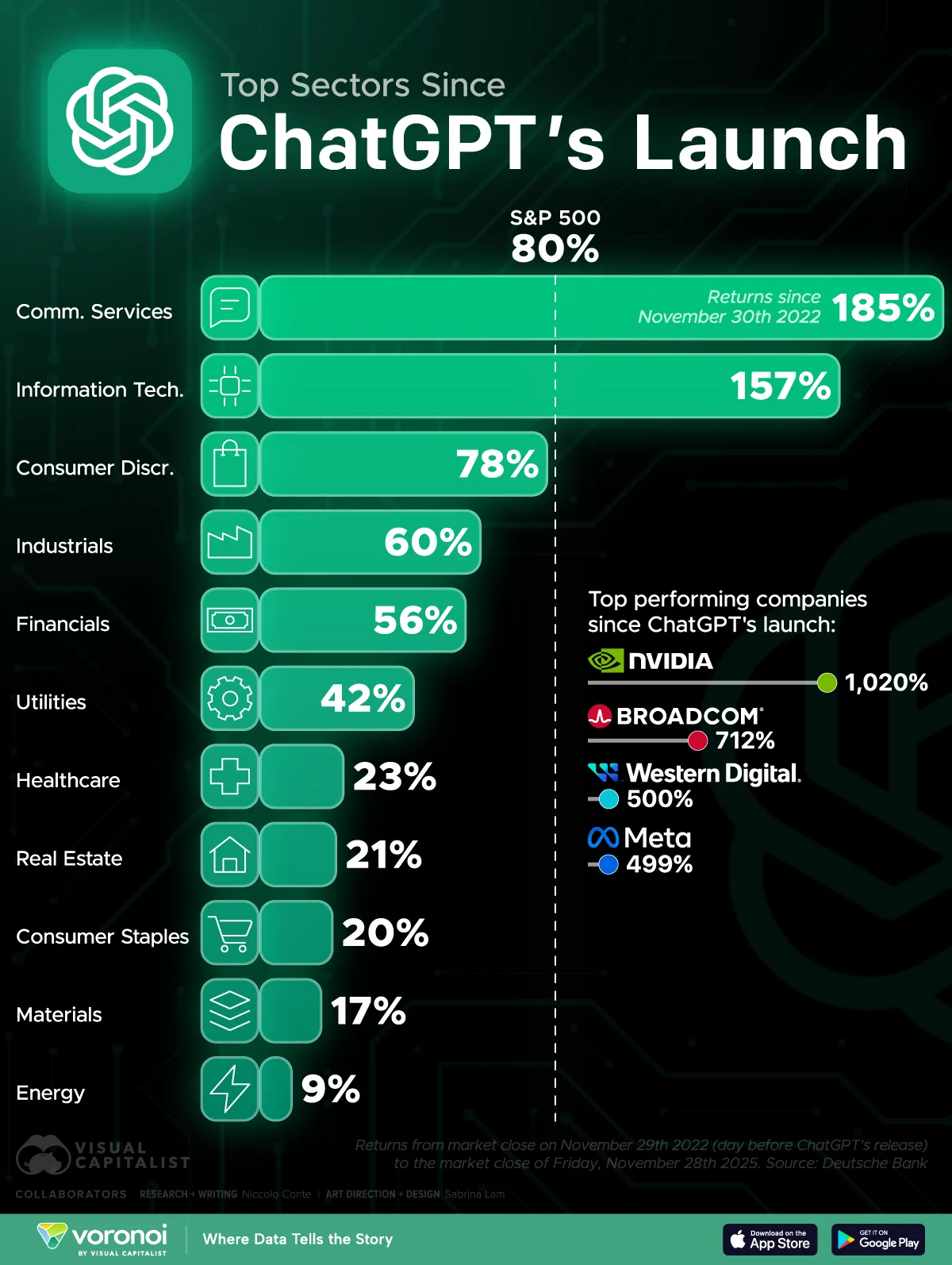
This visualization highlights how each major U.S. equity sector performed from ChatGPT’s debut on November 30, 2022. Nvidia, for instance, climbed over 1,000% as demand for its AI-focused chips skyrocketed.
The data for this visualization comes from Deutsche Bank.
The AI Boom Rewired Market Leadership
Communication Services led all sectors with a 185% return, powered by Meta’s nearly fivefold increase. Information Technology followed at 157%, boosted by chipmakers and cloud providers essential to AI development.
| Rank | Sector | Returns (2022-2025) |
| 1 | Communication ServicesA | 185% |
| 2 | Information Technology | 157% |
| 3 | Consumer Discretionary | 78% |
| 4 | Industrials | 60% |
| 5 | Financials | 56% |
| 6 | Utilities | 42% |
| 7 | Healthcare | 23% |
| 8 | Real Estate | 21% |
| 9 | Consumer Staples | 20% |
| 10 | Materials | 17% |
| 11 | Energy | 9% |
| — | S&P 500 | 80% |
Consumer Discretionary also outperformed, helped by digital-first platforms benefiting indirectly from AI-enabled efficiency gains. Together, these results show how the AI wave extended beyond semiconductors to reshape several adjacent industries.
Nvidia and Broadcom Stand Out as Market Outliers
No companies gained more from the AI surge than semiconductor leaders.
Nvidia returned roughly 1,020%, the single largest increase among major U.S. firms. Broadcom rose over 700%, reflecting its dominance in custom AI accelerators and networking hardware. Western Digital and Meta also delivered exceptional returns, nearing or exceeding 500%.
Traditional Defensive Sectors Lagged Behind
While tech surged, defensive and rate-sensitive sectors grew at a much slower pace.
Utilities returned 42%, healthcare 23%, and consumer staples 20%. Materials hovered near the bottom due to higher interest rates and slower industrial demand. Energy posted just 9%, reflecting weaker commodity dynamics. Meanwhile, the S&P 500 returned 80% over the same period.
Saurce: visualcapitalist
Business
How AI will really change the way we work by 2026

Artificial intelligence adoption surges worldwide, with the Middle East poised to add over $232 billion to GDP by 2035 through focused strategies on skills and infrastructure. Organisations move from experimentation to execution, and, according to Alteryx, these are the five key predictions for how AI will mature in 2026. Leaders can expect a pivot toward measurable results over flashy overhauls.
Precision automation replaces big agents
Enterprise dreams of all-purpose AI agents fade as reality sets in. MIT research reveals 95% of broad AI rollouts delivered no real value, prompting a course correction. In 2026, focus sharpens on narrow, domain-specific automation for tasks such as finance, procurement, and support.
Targeted agents integrate into existing systems, yielding quicker returns than wholesale rebuilds. This pragmatic turn prioritises defensible impact, letting companies automate pain points without upending operations.
Business units take AI reins
IT departments once dominated AI budgets, but business leaders are now stepping forward. CEOs empower CFOs, sales heads and operations managers to pinpoint problems and deploy solutions directly. AI spending follows suit, flowing to teams closest to revenue and results.
Regional surveys back the shift, with 69% of Middle East firms planning higher AI outlays next year. Confidence grows when those who grasp daily challenges drive adoption, ensuring tools align with operational realities.
Data officers embrace pragmatism
Chief Data and Analytics Officers redefine their mandate. Gone is the push for perfect data ecosystems; 2026 demands progress with the resources available. Leaders prioritise rapid insights over flawless preparation, shifting from “fix first” to “deliver now.”
This evolution accelerates testing and scaling, helping business units unlock value without endless cleanup. Pragmatic CDAOs bridge data gaps to fuel decisions, proving outcomes matter more than architecture.
Mission-driven squads lead the charge
Large AI teams give way to compact, specialised units tackling high-impact cases. These squads blend business experts, data pros and engineers on agentic and composite AI projects tied to core needs.
Alteryx data shows that 9 in 10 Middle East respondents credit AI with transforming their work last year, while 94% of global analysts shape strategy. UAE initiatives, such as the 1 Million AI Talents programme, build talent pools for these agile groups, enabling swift execution.
Execution trumps experimentation
AI enters a results-oriented phase, rewarding firms that solve tangible issues and scale successes. Regional momentum, bolstered by investment and skills programs, fosters confident adoption. Middle East businesses lead with a practical focus, turning ambition into sustained advantage.
The year ahead favours precision over promise. Empowered units, realistic data strategies and focused teams position organisations to capture AI’s full potential amid accelerating global uptake.
Story by Gulf News


Cervical Cancer: Why Vaccination and Screening Can Save Lives

Countries With the Most Years in Poor Health

Senegal beat Morocco to emerge Afcon champions

Algeria, Burkina Faso, Côte d’Ivoire win AFCON 2025 openers

Bascom Palmer Eye Institute Abu Dhabi and Emirates Society of Ophthalmology Sign Strategic Partnership Agreement

NMC Royal Hospital, Khalifa City, performs rare wrist salvage, restoring function for young patient
-
 Football4 weeks ago
Algeria, Burkina Faso, Côte d’Ivoire win AFCON 2025 openers
-
 Health1 month ago
Bascom Palmer Eye Institute Abu Dhabi and Emirates Society of Ophthalmology Sign Strategic Partnership Agreement
-
 Health2 weeks ago
NMC Royal Hospital, Khalifa City, performs rare wrist salvage, restoring function for young patient
-

 Football2 months ago
Globe Soccer Awards 2025 nominees announced as voting opens in Dubai
-

 Health2 months ago
Emirates Society of Colorectal Surgery Concludes the 3rd International Congress Under the Leadership of Dr. Sara Al Bastaki
-

 Health2 months ago
Born Too Soon: Understanding Premature Birth and the Power of Modern NICU Care
-

 Health4 weeks ago
Decline in Birth Rate in the UAE
-

 Lifestyle2 months ago
Saudi Arabia Lifestyle Trends 2025: What You Need to Know About Fitness, Wellness, Healthy Eating & Self-Care Growth