
travel
GCC residents can stay in Qatar for up to two months
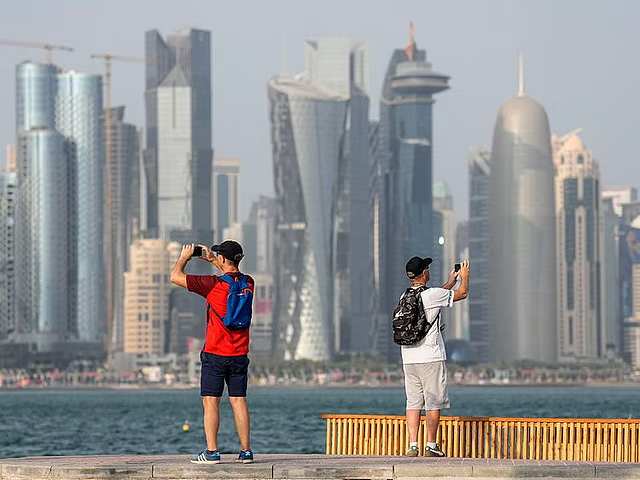
Qatar has introduced a series of updates to its “Hayya” GCC’s Residents Visa to support a sharp rise in regional travel during a busy international events season. The enhancements, announced by Qatar Tourism in collaboration with the Ministry of Interior and the Permanent Committee for Managing Visitor Entry, took effect on November 30.
Under the new rules, GCC residents can stay in Qatar for up to two months and enjoy multiple-entry access, making it easier for visitors to move in and out of the country throughout the season. The changes come as Qatar prepares to welcome regional fans for the 2025 FIFA Arab Cup, alongside a vibrant line-up of cultural and entertainment events.
The Hayya updates are designed to ensure smooth entry through all ports of arrival and strengthen Qatar’s operational readiness during peak visitor periods. Saeed Al Kuwari, Director of Hayya, said: “These measures go beyond simple procedural changes. They reflect Qatar Tourism’s broader vision to strengthen the country’s openness to the region, facilitate visitor movement during major sports and cultural events, increase arrivals, and enhance tourism’s contribution to the national economy.”
Hayya currently offers five visa categories: Tourist Visa (A1), GCC Resident Visa (A2), Visa with ETA (A3), Companion of GCC Citizen Visa (A4), and Visa-Free for US Citizens (F1). By simplifying access for GCC residents, Qatar aims to expand regional tourism, attract more event-goers, and further elevate its position as a leading hub for international events.
Operated by Qatar Tourism, the Hayya platform serves as the country’s official digital e-visa gateway, integrating visa processing, event access, travel information, transport, and lifestyle services into a single interface. Beyond facilitating airport and land border entry, Hayya encourages visitors to explore Qatar’s cultural sites, natural attractions and year-round events.
Gulf News
travel
Emirates extends suspension of Dubai flights amid airspace closures
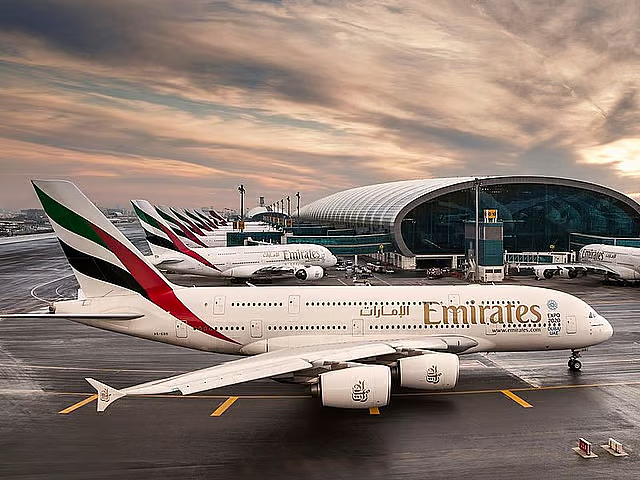
Emirates has temporarily suspended all flights to and from Dubai until 15:00 UAE time on Tuesday, March 3, due to multiple regional airspace closures.
The airline said the situation is dynamic and continuously monitored, urging passengers to check emirates.com
Options for affected passengers
Rebook flights: Passengers can rebook to the same destination on or before 20 March. Those who booked via travel agents should contact them directly; direct bookings can be managed at Emirates Support
Request a refund: Refunds for direct bookings can be requested via Emirates Refund Form
Travel agent bookings should be handled through the agent.
Passengers are advised to ensure contact details are updated via Manage Booking to receive real-time notifications.
All city check-in points across Dubai are temporarily closed until further notice.
Emirates said it is actively monitoring the situation and coordinating with relevant authorities. The airline apologised for the inconvenience and reaffirmed that the safety and security of passengers and crew remain its top priority.
GN
travel
Saudi business visa rejections rise as scrutiny tightens

Riyadh is tightening scrutiny of business visas used mainly by UAE-based professionals travelling into Saudi Arabia, disrupting a decades-long practice that has let companies run projects in the kingdom without staff relocation.
There are no official figures on rejections, but immigration advisers and executives say they have seen more applications returned or refused in recent weeks, particularly for technical specialists and frequent visitors.
The “fly-in fly-out model”, as it is occasionally called, typically involves the misuse of a visa meant as a short-term permit for meetings and relationship-building, not revenue-generating work. Specialists say such misapplication has triggered the clampdown.
Abeer Husseini, a partner at global immigration law practice Fragomen, told AGBI there has been “scaled” misuse of business visas that are not intended for productive work.
“Based on our recent experience, we are seeing a higher possibility for business visa applications to be returned in certain scenarios,” Husseini said.
Abdulrahman Alfahad, a client relationship manager at Sovereign PPG Corporate Services in Saudi Arabia, said companies have relied on repeated business visits for individuals carrying out day-to-day operational roles, “which goes beyond the intended scope of a business visit visa”.
“Authorities are paying closer attention to travel frequency, length of stay and the nature of activities undertaken, particularly where patterns resemble full-time employment,” Alfahad said.
He said the impact is being felt mostly by consulting, professional services and project-based sectors, as well as regional headquarters structures where staff frequently travel in and out of the kingdom.
More than 10 UAE-based professionals at companies across banking, law and management consulting told AGBI their business trips to Saudi Arabia have been cancelled or delayed in recent months, though previously they had been entering and leaving the country nearly every week.
Immigration experts said the stricter outcomes reflect Saudi Arabia’s broader drive to support labour-market policies and a shift toward international standards.
“Saudi is clearly moving towards international best practice by drawing a firmer distinction between permissible business activities and work that requires employment authorisation,” Alfahad said.
Saudi Arabia has been pushing companies to build onshore capacity under Vision 2030 and meet Saudisation requirements – rules that require companies to employ a set proportion of nationals.
In 2024, it required businesses to base their regional headquarters in Saudi Arabia to qualify for government contracts.
Many multinationals that have long run operations out of Dubai have moved to meet Riyadh’s requirements, drawn by the scale of business in Saudi Arabia, which has the Gulf’s largest population.
But an HR executive, who declined to be identified, told AGBI that while companies have set up headquarters in Saudi Arabia, staffing is kept to a minimum – both to limit Saudisation quotas, which increase with each expatriate hire, and because employees are unwilling to relocate.
“Misuse of business visas can distort workforce reporting, and stricter enforcement supports more accurate Saudisation compliance and localisation objectives,” Alfahad said.
Ahmed Hassounah, managing director at Job Borsa, a Saudi recruitment services company that helps businesses comply with localisation requirements, said the goal is enforcement, not disruption for businesses already operating in Saudi Arabia.
“What the government is really focused on is ensuring that citizens and employees are trained and actively participating in the market,” Hassounah said.
AGBI
travel
Riyadh airport starts biggest overhaul in 40 years
King Khalid International Airport in Riyadh has begun implementing its largest operational transformation since opening more than 40 years ago, marking the first comprehensive overhaul of airline operations across its terminals. The phased redistribution came into effect today.
Under the “Terminal Transition” project, managed by Riyadh Airports Company, terminal allocations are being reorganised to enhance operational efficiency and improve passenger flow at the Saudi capital’s main gateway.
From today, Terminals 1 and 2 are designated for international flights operated by Saudi national carriers. From February 24, Terminal 4 will serve domestic flights for national airlines.
Beginning February 25, Terminal 5 will handle international flights operated by foreign carriers. On the same day, operations at Terminal 3 will be merged with Terminal 4 to accommodate domestic services of national carriers.
The move forms part of wider efforts to streamline airport operations and support rising passenger volumes in line with the Kingdom’s aviation growth strategy.
GN


Private Credit Investors Rush to Withdraw

UAE moves spring break for schools and universities

How Etihad Rail ferried 350+ UAE passengers back home with Saudi help

Is February 2026 really a once-in -283-years MiracleIn?

Algeria, Burkina Faso, Côte d’Ivoire win AFCON 2025 openers

Bascom Palmer Eye Institute Abu Dhabi and Emirates Society of Ophthalmology Sign Strategic Partnership Agreement
-
Discover1 month ago
Is February 2026 really a once-in -283-years MiracleIn?
-
 Football2 months ago
Algeria, Burkina Faso, Côte d’Ivoire win AFCON 2025 openers
-
 Health3 months ago
Bascom Palmer Eye Institute Abu Dhabi and Emirates Society of Ophthalmology Sign Strategic Partnership Agreement
-
 Health2 months ago
NMC Royal Hospital, Khalifa City, performs rare wrist salvage, restoring function for young patient
-

 Health4 months ago
Emirates Society of Colorectal Surgery Concludes the 3rd International Congress Under the Leadership of Dr. Sara Al Bastaki
-

 Football3 months ago
Globe Soccer Awards 2025 nominees announced as voting opens in Dubai
-

 Health4 months ago
Born Too Soon: Understanding Premature Birth and the Power of Modern NICU Care
-

 Health2 months ago
Decline in Birth Rate in the UAE