
Business
ChatGPT-maker OpenAI releases browser in attempt to rival Google

BBC
ChatGPT-maker OpenAI has unveiled an artificial intelligence-powered web browser to challenge competitors like Google, which operates Chrome, the most popular browser in the world.
ChatGPT Atlas does away with the address bar that is a key feature in search, with boss Sam Altman saying it was “built around ChatGPT” as the company made the new browser available on Tuesday on Apple’s MacOS operating system.
The arrival of Atlas comes as OpenAI seeks new ways to monetise its massive bet on artificial intelligence (AI) and capitalise on its growing user base.
OpenAI said Atlas would also offer a paid agent mode that conducts searches on its own for users of its popular chatbot.
The agent mode feature will be available only to paying ChatGPT subscribers. It uses the chatbot to make “improvements that make it faster and more useful by working with your browsing context”.
The company has announced a slew of new efforts to corral users towards its online services, entering into partnerships with e-commerce sites like Etsy and Shopify, along with booking services like Expedia and Booking.com.
At OpenAI’s DevDay event earlier this month, Mr Altman announced that ChatGPT had reached 800 million weekly active users, up from 400 million in February, according to data and research firm Demandsage.
“I believe that early adopters will kick the tyres on the new OpenAI browser,” said Pat Moorhead, CEO and chief analyst at Moor Insights & Strategy.
But, he said, he was sceptical that Atlas would pose a serious challenge to Chrome or Microsoft Edge “as more mainstream, beginners, and corporate users will just wait for their favourite browsers to offer this capability.”
Microsoft Edge already provides many of these capabilities today, Mr Moorhead added.
OpenAI’s challenge comes a year after Google was declared an illegal monopolist in online search.
In a recent decision aimed at prescribing remedies for Google’s dominance, the search giant was not ordered to spin off its Chrome browser as US Justice Department lawyers had requested.
A growing number of internet users are opting to use large language models (LLMs) like ChatGPT as they search for answers and recommendations.
The research firm Datos said that as of July, 5.99% of search on desktop browsers went to LLMs – more than double the figure from a year earlier.
Google is also heavily invested in AI, and for the last year has prioritised AI-generated answers to queries in its search results.
Business
Dubai gold dips again as global pressures cool recent rally
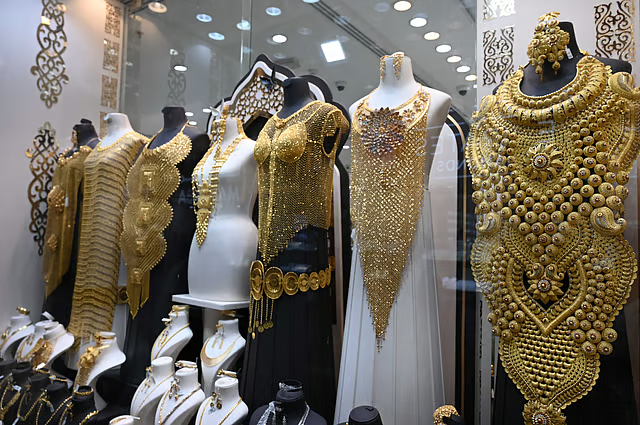
Gold prices in Dubai eased on Thursday morning, giving shoppers a small breather after several sessions of elevated prices earlier this month.
The 24-karat rate stood at Dh619.75 per gram at around 9.30 am on Thursday, down from Dh623.75 recorded a day earlier. The 22-karat price dropped to Dh574, down from Dh577.50 on Wednesday.
The decline reflects broader global moves in bullion markets after recent US economic data shifted expectations for interest rates and strengthened the dollar.
Recent price swings
Gold prices in Dubai have moved sharply through February and early March, showing how quickly global events are feeding into local jewellery rates.
Mid-February levels were closer to Dh600 per gram for 24-karat gold, with prices around Dh596 on February 12 before gradually climbing above Dh600 in the following days. The rally gathered pace toward the end of the month when prices moved past Dh620, and by February 28, the 24-karat rate had climbed to around Dh636.
The start of March saw an even sharper surge, with prices briefly jumping above Dh640 on March 2, marking one of the highest levels seen this year. Gains proved short-lived. Rates pulled back in the following sessions, falling toward the Dh615 range by March 9 before rebounding again above Dh620 earlier this week.
GN
Business
Luxury Shares Drop on Middle East Conflict Fears

Luxury stocks were among the hardest hit sectors early Tuesday, with European markets heading for another day of losses as the conflict in the Middle East intensified overnight.
Shares of conglomerate LVMH, Gucci-owner Kering, and British outerwear maker Burberry were among the worst performers, with week-to-date losses approaching 10% each. The wider European blue-chip index, Stoxx 600, was down nearly 3% Tuesday, after falling 1.6% on Monday.
The Middle East has been a driver of growth in the sector, which is battling a difficult macroeconomic backdrop, and many formerly best-selling brands are struggling to resonate with consumers.
The region’s strength, however, hasn’t been enough to offset weakness elsewhere, notably in China, and industry giants like LVMH and Kering are still struggling to get sales back on a positive track.
“The Middle East has been one of the few bright spots,” Morningstar analyst Jelena Sokolova told CNBC. “You have one area which was small, but which was very, very vibrant, and it’s being affected now.”
The U.S. and Israel launched widespread attacks on Iran over the weekend that killed the country’s Supreme Leader Ayatollah Ali Khamenei. Iran responded with retaliatory strikes, and the conflict now engulfs the wider Middle East region with no clear endpoint in sight.
U.S. President Donald Trump has said the war could last for four to five weeks, but that it could go on “far longer than that.”
Shares of Richemont, the owner of Cartier, Van Cleef, and Chloé, fell heavily on Monday and Tuesday, with a relatively big exposure to the region.
But even with Middle East revenue exposure on average in the mid- to-high single digits for luxury brands, repercussions could spread if a conflict lasts for weeks or even months.
“If people don’t go back to normal, and we have more issues when it comes to sourcing oil and gas from the Gulf, then the probability of a recession globally could be increasing, and that would definitely dampen discretionary sectors like luxury,” Bernstein analyst Luca Solca told CNBC.
If the war carries on for another six months, during which oil is significantly disrupted, “then this is very bad news,” he added.
The ‘feel good’ factor
Luxury stocks come under pressure during times of heighted geopolitical and economic uncertainty because demand typically requires a “feel-good” backdrop and supportive consumer confidence, analysts say.
“Luxury demand relies on positive consumer confidence and constructive outlook of one’s future prospects, as well as the consumer experience which is often less transactional and more emotional,” RBC Capital Markets analysts wrote in a note to clients on Monday. “Conflict, shock, uncertainty and fear are not helpful in this context and can have a shortterm impact on luxury demand.”
The impact on asset prices overall remains to be seen, but moves so far indicate that a hit, at least in the short term, is to be expected.
There are massive uncertainties about a potential end to the conflict and when that would be, said Sokolova, however, also calling the market reaction “exaggerated” given the relatively small sales portion coming from the region.
Travel disruption
Strikes between the U.S., Israel and Iran in the region have forced airlines to cancel thousands of flights. While some airlines said Monday they would resume a “limited number” of flights, aircraft remain largely grounded as the conflict enters its fourth day.
The timing of the strikes also coincides with Ramadan, meaning that post-Ramadan travel may be disrupted if the conflict drags on. Travel from the Middle East after the month-long observance is predominantly to Europe, RBC said.
“Given the timing of the Iran War conflict, and the current grounding of commercial flights, there may be a reluctance for Middle East consumers to travel post Ramadan in 2026 which would likely negatively impact a portion of luxury consumption in Europe.”
CNBC
Business
Oil surges 35%, biggest weekly futures gain since 1983
U.S. crude oil on Friday posted its biggest weekly gain in futures trading history, as the escalating war in the Middle East has triggered a major disruption to global fuel supplies.
West Texas Intermediate futures surged 12.21%, or $9.89, to close at $90.90 per barrel. Global benchmark Brent rallied 8.52%, or $7.28, to settle at $92.69 per barrel.
U.S. crude soared 35.63% for the biggest weekly gain in the history of the futures contract dating back to 1983. Brent jumped about 28% for its biggest weekly gain since April 2020.
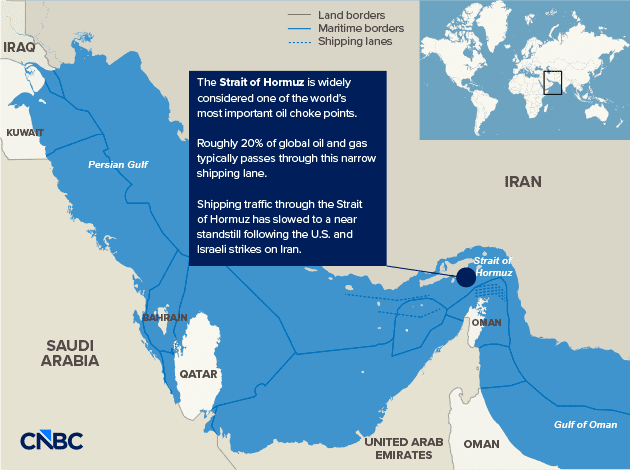
President Donald Trump on Friday demanded unconditional surrender from Iran, raising fears of a prolonged war that could wreak havoc on the global oil and gas market. The war has already brought traffic in the Strait of Hormuz, a critical shipping route for energy supplies, to a near standstill.
Qatar’s energy minister, Saad al-Kaabi, told The Financial Times on Friday that crude prices could reach $150 per barrel in the coming weeks if oil tankers were unable to pass through the Strait.
This could “bring down the economies of the world,” Kaabi said.
“Everybody that has not called for force majeure we expect will do so in the next few days that this continues,” Kaabi told the FT. “All exporters in the Gulf region will have to call force majeure. If they don’t, they are at some point going to pay the liability for that legally, and that’s their choice.”
The Trump administration on Friday announced a $20 billion insurance program for oil tankers in the Persian Gulf, though the measure did little to calm the crude market.
Iraq has shut down 1.5 million barrels per day of production, two Iraqi officials told Reuters Tuesday. Kuwait has also started cutting production after running out of storage space, people familiar with the matter told The Wall Street Journal on Friday.
“The market is shifting from pricing pure geopolitical risk to grappling with tangible operational disruption,” Natasha Kaneva, head of global commodities research at JPMorgan, told clients in a Friday note.
Production cuts could approach 6 million bpd by the end of next week if the Strait is not open to traffic, Kaneva said. JPMorgan expects the United Arab Emirates to show supply constraints next week.
The average price for a gallon of regular gasoline jumped nearly 27 cents in the last week through Thursday to $3.25, according to data from U.S. travel organization AAA
The war between Iran and the U.S. entered its seventh day on Friday. In a press conference on Thursday, U.S. Defense Secretary Pete Hegseth said the U.S. had “only just begun to fight.”
“Iran is hoping that we cannot sustain this, which is a really bad miscalculation,” he told reporters.
CNBC


Jennifer Lopez ‘happy’ and ‘free’ after Ben Affleck divorce

Dubai gold dips again as global pressures cool recent rally

A global food price shock looms as Middle East war rages on

Is February 2026 really a once-in -283-years MiracleIn?

Algeria, Burkina Faso, Côte d’Ivoire win AFCON 2025 openers

Bascom Palmer Eye Institute Abu Dhabi and Emirates Society of Ophthalmology Sign Strategic Partnership Agreement
-
Discover2 months ago
Is February 2026 really a once-in -283-years MiracleIn?
-
 Football3 months ago
Algeria, Burkina Faso, Côte d’Ivoire win AFCON 2025 openers
-
 Health3 months ago
Bascom Palmer Eye Institute Abu Dhabi and Emirates Society of Ophthalmology Sign Strategic Partnership Agreement
-

 Health2 months ago
NMC Royal Hospital, Khalifa City, performs rare wrist salvage, restoring function for young patient
-

 Health4 months ago
Emirates Society of Colorectal Surgery Concludes the 3rd International Congress Under the Leadership of Dr. Sara Al Bastaki
-

 Health4 months ago
Born Too Soon: Understanding Premature Birth and the Power of Modern NICU Care
-

 Football4 months ago
Globe Soccer Awards 2025 nominees announced as voting opens in Dubai
-

 Health3 months ago
Decline in Birth Rate in the UAE