politics
Why Donald Trump halted a risky mission
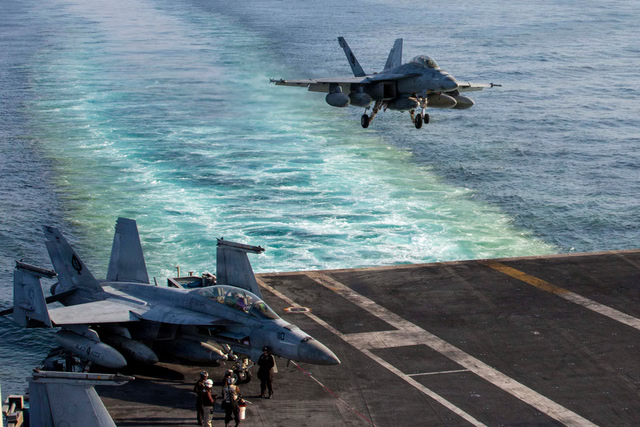
US President Donald Trump has abruptly paused “Project Freedom” — a newly launched American operation aimed at helping commercial ships stranded by Iran’s closure of the Strait of Hormuz — after rising fears the mission could spiral into a wider military confrontation with Tehran.
The operation, announced only days earlier, had been presented by Trump as a “humanitarian gesture” designed to help thousands of trapped sailors and restore shipping through one of the world’s most important energy chokepoints.
But almost immediately after the mission began, tensions escalated sharply.
Iran’s military said it fired at US warships entering the strait, while US Central Command, or CENTCOM, said Iranian missiles, drones and small boats targeted American naval vessels and US-flagged commercial ships.
Within 48 hours, Trump announced the operation would be paused “for a short period of time” to test whether diplomacy could produce a breakthrough with Iran.
What was Project Freedom?
Project Freedom was launched after Iran effectively blocked traffic through the Strait of Hormuz following the US-Israeli strikes on Iran on February 28.
The narrow waterway handles roughly 20% of global oil and liquefied natural gas shipments, making it one of the most strategically important maritime routes in the world.
According to the US military, around 22,500 mariners aboard 1,550 commercial vessels were stranded in the Gulf as shipping companies hesitated to risk passage through the increasingly dangerous corridor.
CENTCOM said the operation involved:
- Guided-missile destroyers
- More than 100 aircraft
- Unmanned surveillance systems
- Around 15,000 US personnel
The mission’s aim was to help restore commercial transit and reassure shipping companies that vessels could move through Hormuz safely.
One of the biggest uncertainties, however, was whether the US Navy would physically escort ships through the strait — a move many analysts feared could trigger direct clashes with Iran.
Why did Trump pause it?
The operation quickly ran into military and political complications.
Iran warned it would attack US forces entering the strait without Tehran’s approval and insisted ships must use “regime-approved routes.”
CENTCOM later confirmed that Iran fired cruise missiles toward US naval forces and commercial ships, although it denied Iranian claims that a US warship had been struck.
The United Arab Emirates also said an ADNOC-linked tanker was targeted by drones while transiting Hormuz, highlighting how rapidly the situation was deteriorating.
Experts say the growing risk of escalation likely forced Trump to reconsider.
Ali Vaez of the International Crisis Group told the BBC that Iran’s aggressive response showed the operation was “not going to solve the problem” and risked “dragging” Trump back into war.
Trump also appears eager to avoid a prolonged conflict ahead of politically sensitive midterm elections, especially as energy prices and shipping costs continue rising globally.
The pause reportedly followed signs of “great progress” in indirect talks between Washington and Tehran, with Pakistan acting as a mediator.
Did the operation work?
Only partially.
CENTCOM said two US-flagged commercial ships successfully passed through Hormuz with American naval support. Shipping giant Maersk also confirmed one of its vessels exited the Gulf accompanied by the US military.
But major uncertainty remains.
Shipping companies and insurers are still wary of sending vessels through the strait amid fears of missile, drone or small-boat attacks.
Industry groups also criticised the lack of detailed coordination for the operation, saying commercial operators were left unclear about how protection would work in practice.
Is the US still pressuring Iran?
Yes.
Even though Project Freedom has been paused, the US continues enforcing a separate naval blockade targeting Iranian ports and vessels accused of supporting Tehran’s oil trade.
US military officials say dozens of ships have already been redirected under the blockade operation, which remains active despite the pause in escort efforts through Hormuz.
GN