politics
Trump warns Iran of ‘hell’ if Hormuz deadline missed
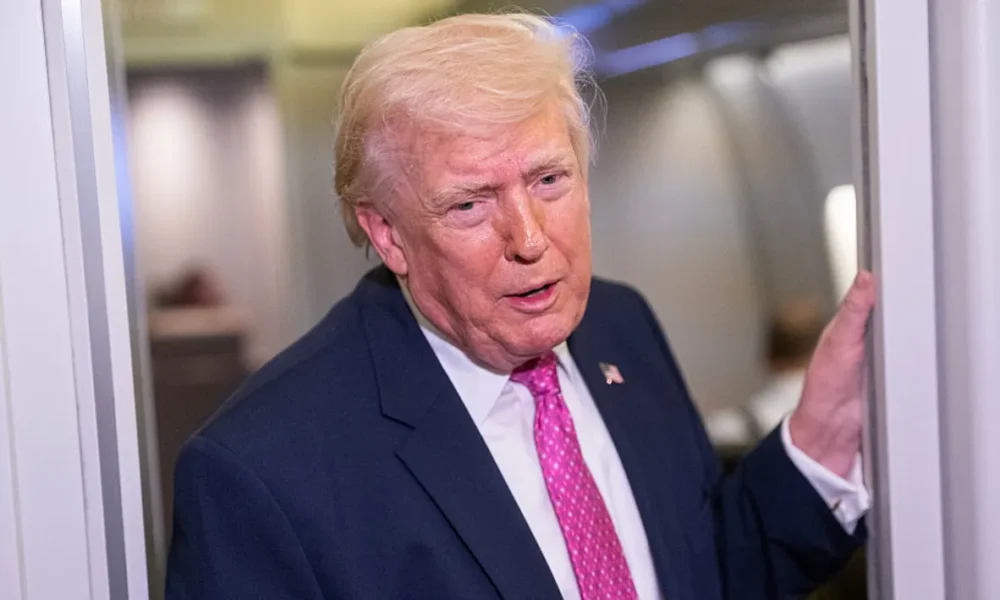
President Donald Trump on Sunday, in a social media post laden with expletives, vowed to strike Iran’s power plants and bridges. He vowed the “crazy bastards” would be “living in Hell” if the Strait of Hormuz isn’t opened to all marine traffic by Tuesday, just hours after announcing the U.S. had rescued the final airman shot down in Iran last week.
“Tuesday will be Power Plant Day, and Bridge Day, all wrapped up in one, in Iran. There will be nothing like it!!!” Trump said in a Truth Social post.
Later on Sunday, Trump posted on Truth Social the date “Tuesday, 8:00 P.M. Eastern Time!” without further explanation. The White House on Sunday told MS NOW that the date is now the deadline for Iran to reach a deal with the U.S.
Trump has repeatedly threatened Iran’s critical infrastructure, vowing to send Iran back to the “stone age” if it does not meet the U.S. demands as the war entered its second month and the conflict in the Middle East showed no signs of slowing.
Destroying civilian infrastructure could constitute a war crime under international humanitarian law.
Sen. Tim Kaine, D-Va., speaking on NBC’s “Meet the Press,” said the president’s comments were “embarrassing and juvenile,” and warned it could place future downed airmen at greater risk if they are captured in Iran.
“If you send the message that there’s no quarter for the folks on the other side, that really encourages them to mistreat our folks,” Kaine, who serves on the Senate Armed Services Committee, said. “It’s people trying to act like they’re puffed up and tough, when what we really see from the administration in this war is the absence of a plan, the absence of a clear rationale, no effort to get allies on board.”
Iran, meanwhile, has shown no signs of backing down, striking economic and infrastructure targets in neighboring Gulf Arab countries.
On Sunday, Iran’s state TV aired a video showing what it claimed were parts of an American aircraft shot down by Iranian forces, along with a photo of thick, black smoke rising into the air. The broadcaster said Iran had shot down an American transport plane and two helicopters that were part of the rescue operation.
However, a regional intelligence official briefed on the mission told The Associated Press that the U.S. military blew up two transport planes due to a technical malfunction, forcing it to bring in additional aircraft to complete the rescue. The official spoke on condition of anonymity to discuss the covert mission.
Iran’s military joint command on Sunday claimed that four U.S. aircraft were destroyed during the rescue operation and warned of stepping up retaliatory attacks on regional oil and civilian infrastructure if the U.S. and Israel attacked such targets in the Islamic Republic, according to state television.
“We once again repeat: if you commit aggression again and strike civilian facilities, our responses will be more forceful,” a spokesman said in comments run by IRNA news agency.
Countdown to Trump’s deadline
Meanwhile, the U.S. has been ramping up pressure on Tehran to open the Strait of Hormuz, a key chokepoint linking Iran and the Arabian Peninsula through which a large proportion of the world’s oil and gas supplies pass.
Trump said Saturday in a Truth Social post: “Remember when I gave Iran ten days to MAKE A DEAL or OPEN UP THE HORMUZ STRAIT. Time is running out – 48 hours before all Hell will reign [sic] down on them.”
Oman’s foreign ministry said on Sunday that it met with Iranian officials a day earlier to discuss “possible options for ensuring the smooth flow of transit through the Strait of Hormuz.”
“During the meeting, experts from both sides presented a number of visions and proposals that will be studied,” the Omani statement on X read.
On March 26, Trump said he would extend a pause in attacking Iran’s energy facilities by 10 days to April 6 at the request of the government of the Islamic Republic.
In a televised address from the White House on Wednesday, Trump told Americans that he expects the Iran war to last another two to three weeks, but said the conflict was close to an end.
“We are going to finish the job, and we’re going to finish it very fast,” he said.
The spot price for current physical cargoes of Brent crude oil soared Thursday to $141.36, the highest level since the 2008 financial crisis, according to S&P Global, which tracks the data.
The spot price reflects demand for Brent oil to be delivered in the next 10 to 30 days. The high price of immediate oil deliveries points to current physical supply constraints due to the huge disruption triggered by Iran’s closure of the Strait of Hormuz.
The price was $32.33 higher than the Brent crude futures contract for June delivery, which closed at $109.03 on Thursday.
Iran’s foreign minister, in principle, left the door open for peace talks with the U.S. amid talks about mediation from Pakistan, but he gave no sign of Tehran’s willingness to bow to Trump’s demands.
“We are deeply grateful to Pakistan for its efforts and have never refused to go to Islamabad. What we care about are the terms of a conclusive and lasting END to the illegal war that is imposed on us,” Foreign Minister Abbas Araghchi said on X.
Pakistan told the Associated Press on Saturday that efforts to broker a ceasefire are “right on track.”
U.S. rescues last airman shot down by Iran
Trump said Sunday the U.S. has rescued a service member who went missing after Iran downed a fighter jet, while vowing to strike key infrastructure if Tehran doesn’t reopen the Strait of Hormuz by Tuesday.
Trump confirmed that a U.S. airman who had gone missing after an F-15E Strike Eagle fighter jet was shot down in Iran has been rescued. The jet’s pilot had been rescued soon after the aircraft was downed.
“WE GOT HIM!” Trump said in a Truth Social post referring to the second officer.
“Over the past several hours, the United States Military pulled off one of the most daring Search and Rescue Operations in U.S. History,” Trump said.
The president later said the rescued airman, an officer, was “seriously wounded.”
“We have rescued the seriously wounded, and really brave, F-15 Crew Member/Officer, from deep inside the mountains of Iran,” Trump said in a post on Truth Social. “He is a highly respected Colonel.”
Trump said his administration did not initially confirm the rescue of the first crew member in order to avoid jeopardizing the operation.
The president also said he will speak about the military operation in Iran at a news conference at the Oval Office on Monday at 1 p.m. ET.
U.S. Central Command issued a brief statement, saying, “U.S. forces successfully completed the rescues of two American service members from Iran after their F-15E fighter jet was shot down April 2 during a combat mission. The service members were safely recovered during separate search and rescue missions.”
CENTCOM added that strikes into Iran would continue in an attempt to “dismantle the Iranian regime’s ability to project power beyond its borders.”
Tehran and Washington confirmed Saturday that Iran downed the two-seat F-15E jet. The incident marks the first time Iranian forces have successfully shot down a U.S. combat aircraft since the U.S. and Israel began their airstrikes on Iran on Feb. 28.
Separately, two U.S. officials said Saturday the pilot of a U.S. A-10 Warthog jet ejected from the aircraft that crashed in Kuwait after being hit by Iranian fire. The Wall Street Journal and The Washington Post were the first to report that the A-10 had been shot down.
Petrochemical zone struck in Iran
However, Iran appeared to maintain its retaliatory attacks on neighbors in the Gulf region, and seemed to be targeting petrochemical facilities.
Abu Dhabi’s media office said in a post on X that authorities in the city responded to multiple fires at the Borouge petrochemical plant “caused by falling debris following successful interceptions by air defense systems.”
Operations at the plant have been suspended, the Abu Dhabi Media Office said.
Borouge did not immediately respond to CNBC’s email on Sunday requesting confirmation.
The company operates a petrochemical complex in Al Ruwais Industrial City in the United Arab Emirates, according to its website.
Bahrain’s state news agency reported that the Gulf Petrochemical Industries Company (GPIC) confirmed a “number of its operational units were subject to an attack by Iranian drones, in the early hours of Sunday morning.”
GPIC also did not immediately respond to CNBC’s emailed request for comment.
On Saturday, Iranian state media reported air strikes at a petrochemical zone in southwestern Iran, with at least five people injured.
A projectile also hit an auxiliary building near the perimeter of Iran’s Bushehr nuclear plant, the Tasnim news agency said, killing one person. The operations of the plant were unaffected.
Russia’s state nuclear company Rosatom evacuated a further 198 of its staff from the site on Saturday, Russian news agencies reported, in evacuations already planned before the latest incident.
The Israeli military, meanwhile, said it had carried out “a wave of strikes” on Tehran.
Iran attacks targets in three Gulf states
In Kuwait, Iranian drone attacks caused significant damage to power plants and a petrochemical plant. They also put a water desalination station out of service, according to the Ministry of Electricity. No injuries were reported, the ministry said.
In Bahrain, a drone attack caused a fire at one of the national oil company’s storage facilities and a state-run petrochemical plant, the kingdom’s official news agency said.
In the United Arab Emirates, authorities responded to fires at a petrochemical plant in Ruwais that they said were caused by intercepted debris, halting operations.
The strikes came a day after Israel struck a petrochemical plant in Iran that Prime Minister Benjamin Netanyahu said generated revenue that it had used to fund the war.
The petrochemical industry is a key sector in many Gulf states. Plants in Bahrain, Kuwait, the UAE and Iran convert oil and gas into products like plastics, polymers and fertilizer, bringing in billions in export revenue.
Kuwait Petroleum reports damage after drone attacks
Iranian drone attacks hit various targets in Kuwait on Sunday, with the state energy company, Kuwait Petroleum Corporation, reporting fires and “severe material damage” at some operating units. KPC said in a statement that teams were working to contain the fires at affiliates Petrochemical Industries Company and National Petroleum Company.
In a separate incident, KPC earlier said a fire broke out in its Shuwaikh oil sector complex, which houses the oil ministry and KPC headquarters, after a drone attack.
Kuwaiti state media, citing the finance ministry, said an Iranian drone hit an office complex for government ministries, causing significant material damage but no casualties.
Two power generation units were also taken out of service after Iranian drones targeted two power and water desalination plants, causing significant damage, Kuwait’s electricity and water ministry said.
No injuries were reported in any of the incidents.
The U.S.-Israeli war on Iran is in its sixth week, with Tehran striking Israel and Gulf Arab states hosting U.S. military installations.
Iran’s Revolutionary Guards claimed responsibility for attacks on petrochemical plants in Kuwait, as well as the United Arab Emirates and Bahrain.
CNBC