politics
Lebanon-Israel 10-day ceasefire begins
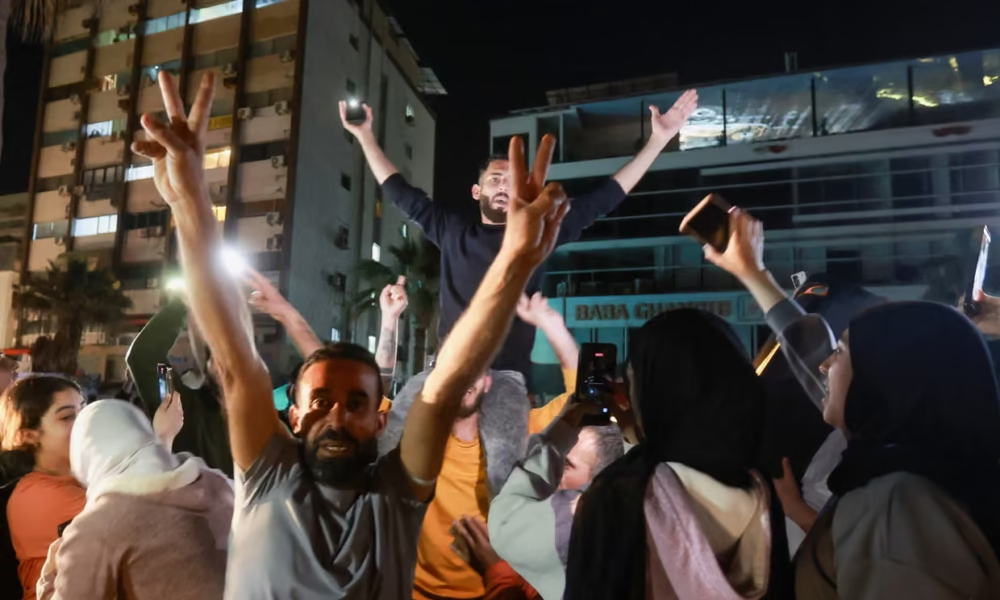
A 10-day ceasefire between Israel and Lebanon has taken effect, with US President Donald Trump saying a White House meeting could follow within two weeks and a deal to end the Iran war is “very close”. He suggested talks could resume in Islamabad this weekend. The Lebanese army has accused Israel of violating the truce with shelling in the south, while Benjamin Netanyahu says Israeli forces will stay in southern Lebanon and Hezbollah warns it may respond to attacks. Follow our live coverage for the latest updates:
08:02 AM, 17 April 2026
Trump hails Israel-Lebanon ceasefire as ‘historic day’
In two social media posts Thursday night, US President Donald Trump said that Thursday could have been “a historic day for Lebanon.”
In a separate Truth Social message after the ceasefire between Israel and Lebanon went into effect, Trump added that he hoped the Lebanon-based, Iran-backed Hezbollah militant group “acts nicely and well.” “It will be an GREAT moment for them if they do,” Trump added.
07:20 AM, 17 April 2026
US deploys 12 ships, 100 aircraft to enforce blockade on Iranian ports
The US Central Command (CENTCOM) on Thursday (local time) said that US forces are actively enforcing a large-scale maritime blockade targeting Iran’s ports and coastline, involving more than 10,000 personnel, over a dozen naval vessels, and upwards of 100 aircraft.
In a post on X, CENTCOM said, “USS Abraham Lincoln (CVN 72) transits the Arabian Sea as the United States blockades Iran’s ports and coastline. US forces are not blockading the Strait of Hormuz. More than 10,000 American service members, 12+ ships, and 100+ aircraft have enforced the blockade in regional waters, ensuring that no vessels violate the President’s proclamation.”
USS Abraham Lincoln (CVN 72) transits the Arabian Sea as the United States blockades Iran’s ports and coastline. U.S. forces are NOT blockading the Strait of Hormuz. More than 10,000 American service members, 12+ ships, and 100+ aircraft have enforced the blockade in regional… pic.twitter.com/yQP4J1uSha
— U.S. Central Command (@CENTCOM) April 16, 2026
The deployment includes the USS Abraham Lincoln (CVN 72) operating in the Arabian Sea, highlighting the scale of the US naval presence in the Iranian waters amid escalating tensions.
In another update, CENTCOM added, “Sailors aboard guided-missile destroyer USS Delbert D Black (DDG 119) stand watch as US forces remain vigilant and enforce the blockade against ships attempting to enter or depart Iranian ports and coastal areas.”
The USS Delbert D Black (DDG 119) is among the warships tasked with monitoring an interceptingvessels in the vicinity of Iranian waters.
Sailors aboard guided-missile destroyer USS Delbert D. Black (DDG 119) stand watch as U.S. forces remain vigilant and enforce the blockade against ships attempting to enter or depart Iranian ports and coastal areas. pic.twitter.com/oHSq4RhiVd
— U.S. Central Command (@CENTCOM) April 17, 2026
06:30 AM, 17 April 2026
Australia says no request from US on Hormuz after Trump criticism
Australian Prime Minister Anthony Albanese said the US has made “no new requests” to help in Iran after Trump said he was “not happy with Australia”.
US security ally Australia has said it is not involved in the Iran conflict but has an interest in the Strait of Hormuz reopening to fuel shipments.
Trump has repeatedly criticised Australia for not helping in the Iran war. “I’m not happy with Australia because they were not there when we asked them to be there,” he told reporters in Washington Thursday. “They were not there, having to do with Hormuz,” he said.
Albanese told reporters Trump had made it clear he has “got this” when it came to Iran.
“There’s been no new requests at all,” he said.
Australia is also in talks with France, Britain and the US over the Strait of Hormuz, Defence Minister Richard Marles said on Friday.
Canberra was asked by Washington last month to assist with the defence of Gulf states, and responded by sending an E7 Wedgetail surveillance aircraft and missiles to protect the United Arab Emirates, Australian officials said.
06:12 AM, 17 April 2026
Trump characterises Iran war as a ‘little diversion’
President Donald Trump said Thursday the US war with Iran was a “little diversion” during his second term in power, as recent polling shows the conflict’s unpopularity with the American public.
At an event in Las Vegas, Nevada touting his “no tax on tips” measure from the major tax reform bill passed last year, the 79-year-old president boasted about his economic record since returning to office in 2025.
“We had the best economy in the history of our country in my first term. And we’re blowing it out now…And despite our little diversion to the lovely country of Iran, lovely place,” Trump told the crowd of supporters.
“But we had to do that, because otherwise, bad things could happen, the really bad thing,” he continued, referencing Iran’s apparent nuclear potential.
An Ipsos poll conducted last weekend found 51 percent of the more than 1,000 respondents thought the Iran war was not worth the costs associated with it.
Less than a quarter of respondents, 24 percent, said the opposite.
Another recent poll published Wednesday by Quinnipiac University found 65 percent of US voters blame Trump for the recent rise in gas prices prompted by the Strait of Hormuz closing since the start of the Iran war.
The same poll reported only 36 percent of voters approved how Trump was handling the situation with Iran, while 58 percent disapproved.
06:12 AM, 17 April 2026
Trump says Iran war ‘going along swimmingly’
The president said in a Las Vegas speech he was feeling pretty positive about the Iran war, despite the energy price spikes, the death and destruction and the anxiety about the future of NATO and the Middle East.
“I will say the war in Iran is going along swimmingly,” Trump said. “It should be ending pretty soon.”
Trump added that the war was “was perfect” as he praised the power of the US military.
05:01 AM, 17 April 2026
Trump continues attacks on Pope Leo
US President Donald Trump renewed his criticism of Pope Leo XIV, repeating a claim that the pontiff supports Iran having a nuclear weapon. The assertion is not supported by the pope’s public statements.
Asked by CNN anchor Kaitlan Collins why he was “fighting with the pope,” Trump said he had “nothing against the pope” but added, “I have to do what’s right.” He then said: “The pope made a statement. He says, Iran can have a nuclear weapon. I say Iran cannot have a nuclear weapon.”
Pope Leo XIV has not said Iran should possess nuclear weapons and has repeatedly denounced nuclear arms and called on nations to abandon them. Pope Francis also taught that both the use and the possession of nuclear weapons are “immoral” due to their indiscriminate destructive power and the false sense of security they create.
The disagreement over the Iran war has escalated into a rare and public spat between the White House and the Vatican. US President Donald Trump and Vice-President JD Vance have repeatedly assailed the Pope Leo, accusing him of being “weak on crime” and overstepping into politics. The pontiff has refused to back down, insisting he will continue to speak out for peace.
04:30 AM, 17 April 2026
UN chief welcomes Israel and Lebanon ceasefire
Secretary-General Antonio Guterres hopes the ceasefire will pave the way for negotiations toward a long-term solution to the Israel-Hezbollah conflict, UN spokesperson Stephane Dujarric said.
Guterres commends the United States for facilitating the ceasefire between Israel and Lebanon, he said.
The secretary-general reaffirms UN support for all efforts to end hostilities and the suffering of people on both sides of the Israel-Lebanon border, Dujarric said.
04:25 AM, 17 April 2026
Lebanon army reports Israeli ‘acts of aggression’
Lebanon’s army reported “acts of aggression” by Israel that it said violated a ceasefire which took effect at midnight Friday local time.
Lebanon’s army in an X post early on Friday called on residents in the south to exercise caution “in light of a number of violations” of the ceasefire agreement by “several Israeli acts of aggression.”
03:27 AM, 17 April 2026
Strait of Hormuz must reopen, but “not at any price”: France minister
French Finance Minister Roland Lescure told reporters Thursday that the Strait of Hormuz needs to reopen “but not at any price,” adding that G7 leaders stand ready to mitigate the war’s economic fallout.
Finance ministers and central bank governors from the Group of Seven advanced economies added in a statement that “it is urgent to limit” the global economic cost of an enduring conflict in the Middle East.
02:55 AM, 17 April 2026
Gunfire erupts in Beirut as ceasefire with Israel kicks in
Gunfire erupted in Beirut’s southern suburbs as a ceasefire with Israel came into effect at midnight on Friday (2100 GMT Thursday), according to AFP journalists.
01:00 AM, 17 April 2026
10-day ceasefire in Lebanon begins
A 10-day ceasefire between Lebanon and Israel went into effect, pausing more than six weeks of intense fighting between Israeli forces and the Iran-aligned militant group Hezbollah, US officials said.
The truce started at 5 pm Eastern Thursday (1am, Friday, April 17), Donald Trump announced. He spoke separately with Lebanese President Joseph Aoun and Israeli Prime Minister Benjamin Netanyahu, and welcomed the pause as a step toward broader peace. Analysts caution the truce is fragile, especially because Hezbollah itself was not a direct party to the agreement and has issued mixed signals about complying with the pause.
The ceasefire could ease hostilities and create breathing room for further diplomatic engagement, bridging local conflict and the broader US–Iran negotiations.
12:02 AM, 17 April 2026
UAE welcomes Lebanon-Israel ceasefire
The UAE has welcomed the announcement by US President Donald Trump of a ceasefire agreement between Lebanon and Israel, commending the diplomatic efforts that led to the breakthrough.
In a statement, the Ministry of Foreign Affairs expressed hope that the development would represent a positive step towards fostering a supportive environment for regional stability. The ministry underscored the importance of continued international coordination to prevent further escalation and to mitigate the humanitarian and security repercussions across the region.
GN