Analytics
How Much People Save Around the World
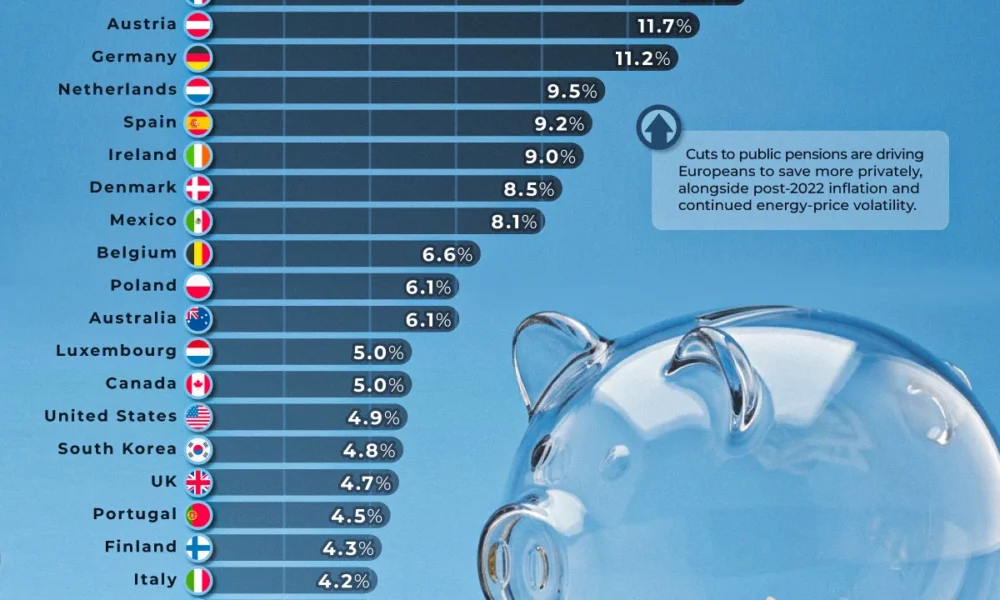
This chart ranks household savings rates across major economies using the latest OECD data. It reveals a wide gap between top savers and those struggling to set money aside. In countries like Sweden and Hungary, households save more than 10% of their income. In the U.S., that figure is just 4.9%.
In some cases, the gap is even more striking. Americans save roughly half as much as households in Mexico, highlighting how cost pressures and consumption patterns differ across economies.
How Much People Save by Country
Sweden ranks as the most disciplined saver, with net household savings rates rising nearly eightfold from 2.3% to 16% over the past two decades.
Many European countries also rank at the top of the list. Households continue to set aside a relatively large share of their income, including Hungary (14.3%) and France (12.8%). These elevated rates are often linked to structural factors such as pension systems and aging
he table below shows savings rates by country in 2024, or the latest available data:
| Country | Net Saving Rate (% of net disposable income) |
| 🇸🇪 Sweden | 16.0% |
| 🇭🇺 Hungary | 14.3% |
| 🇨🇿 Czechia | 13.7% |
| 🇫🇷 France | 12.8% |
| 🇦🇹 Austria | 11.7% |
| 🇩🇪 Germany | 11.2% |
| 🇳🇱 Netherlands | 9.5% |
| 🇪🇸 Spain | 9.2% |
| 🇮🇪 Ireland | 9.0% |
| 🇩🇰 Denmark | 8.5% |
| 🇲🇽 Mexico | 8.1% |
| 🇧🇪 Belgium | 6.6% |
| 🇵🇱 Poland | 6.1% |
| 🇦🇺 Australia | 6.1% |
| 🇱🇺 Luxembourg | 5.0% |
| 🇨🇦 Canada | 5.0% |
| 🇺🇸 United States | 4.9% |
| 🇰🇷 South Korea | 4.8% |
| 🇬🇧 United Kingdom | 4.7% |
| 🇵🇹 Portugal | 4.5% |
| 🇫🇮 Finland | 4.3% |
| 🇮🇹 Italy | 4.2% |
| 🇳🇴 Norway | 4.2% |
| 🇱🇹 Lithuania | 3.8% |
| 🇪🇪 Estonia | 3.0% |
| 🇯🇵 Japan | 0.9% |
| 🇱🇻 Latvia | 0.0% |
| 🇿🇦 South Africa | -1.0% |
| 🇳🇿 New Zealand | -1.3% |
In the middle of the pack, savings rates drop off quickly. The U.S., Canada, and the UK all cluster around 5% or lower, far behind top European savers. The gap is particularly striking when compared globally. U.S. households save about half as much as those in Mexico, and less than one-third of what households in Sweden set aside each year.
At the bottom of the ranking, the picture flips entirely. In countries like New Zealand and South Africa, households are not saving at all. Instead, they are spending more than they earn.
Negative savings rates typically mean people are dipping into past savings or taking on debt to cover everyday expenses, a sign of financial strain rather than choice.
What It Means Going Forward
Savings rates are a key signal of financial resilience.
Countries where households consistently save more tend to have a stronger buffer against inflation, job losses, or economic shocks. Higher savings can also support long-term investment and stability.
On the other hand, persistently low or negative savings rates can point to underlying pressure. When households have little margin to save, economies may become more vulnerable to downturns, rising debt levels, and weaker consumer spending over time.
Visual Capitalist